
Dividend Yield, Dividend Tax Credit and DRIPs in Canada
How dividend yield, the gross-up and dividend tax credit, and DRIPs work for Canadian investors, with a 20-year CA$ example in a TFSA and a taxable account.
By Redbison Dev · · 10 min read
Canada edition. Written for Canadian investors: CA$ amounts, quarterly and monthly payers, the 38% and 15% gross-ups with the 2026 federal and Ontario dividend tax credits, TFSA and RRSP accounts, and how reinvested dividends change your adjusted cost base. US edition
A Canadian stock at CA$60 that pays CA$0.675 a quarter yields 4.5%. CA$30,000 buys 500 shares and CA$1,350 of dividends a year. In a TFSA, all of it can go straight into a DRIP. In a non-registered account, the tax depends on the kind of dividend: an eligible dividend from a Canadian corporation goes through the gross-up and the dividend tax credit, and for an Ontario resident with taxable income between about CA$58,500 and CA$107,800 in 2026 that works out to about 6.4 cents of tax per dollar. The same dollar of US dividends or interest would cost 29.65 cents.
This edition works through the yield arithmetic, the 2026 dividend tax credit, DRIPs and adjusted cost base, and a 20-year example run in the Canadian dividend calculator. It explains the arithmetic, not which stock to own; a fee-only planner or tax professional can check how your accounts fit together.
Yield, quarterly and monthly payers
dividend yield = annual dividend per share / share price x 100
(4 x CA$0.675) / CA$60 x 100 = 4.5%
Canadian payers distribute quarterly or monthly; the company's investor page lists the schedule. For a forward yield, multiply the latest regular payment by the number of payments a year; for a trailing yield, add up the last 12 months. After an increase the forward figure is higher; after a cut the trailing figure overstates what you will get.
Yield moves against price. If the CA$60 stock falls to CA$50 and the dividend holds, the yield rises to 5.4% with no change in the cheque. A yield far above the sector usually means the market doubts the payout.
To size a holding for an income: CA$2,000 a month is CA$24,000 a year, which at 4.5% needs CA$24,000 / 0.045 = CA$533,333 invested.
How the gross-up and dividend tax credit work
The CRA's T5 guide sets out two kinds of Canadian dividend:
| Eligible dividends | Other than eligible dividends | |
|---|---|---|
| Gross-up (T5 box 25 or 11) | 38% | 15% |
| Federal dividend tax credit, of the grossed-up amount (box 26 or 12) | 15.0198% | 9.0301% |
| Ontario dividend tax credit, 2026 | 10.0% | 2.9863% |
| Combined federal and Ontario credit | 25.0198% | 12.0164% |
The arithmetic for CA$1,000 of cash dividends in 2026, for an Ontario resident whose income sits in the 20.5% federal and 9.15% Ontario brackets (29.65% combined):
eligible:      1,000 x 1.38 = 1,380 taxable
               tax 1,380 x 29.65% = 409.17, credit 1,380 x 25.0198% = 345.27
               net tax 63.90
non-eligible:  1,000 x 1.15 = 1,150 taxable
               tax 1,150 x 29.65% = 340.98, credit 1,150 x 12.0164% = 138.19
               net tax 202.79
interest or foreign dividends: 1,000 x 29.65% = 296.50
The calculator's credit method does this sum on every payment. The bracket matters a great deal:
| Combined 2026 Ontario bracket | Tax on CA$1,000 of eligible dividends |
|---|---|
| 19.05% (14% federal, 5.05% Ontario, income up to CA$53,891) | CA$0.00 |
| 29.65% (20.5% and 9.15%, about CA$58,523 to CA$107,785) | CA$63.90 |
| 37.16% (26% and 11.16%, about CA$117,045 to CA$150,000) | CA$167.53 |
In the lowest bracket the combined credit (25.02%) is larger than the marginal rate (19.05%), so the dividend itself bears no tax. The credit is non-refundable, so the surplus can only reduce tax on your other income; the calculator stops at zero. The Ontario surtax and health premium are not modelled.
Two details are easy to miss. Your taxable income includes the grossed-up CA$1,380, not the CA$1,000 you received. And in other provinces the federal credit is the same but the provincial one differs, so replace Ontario's 10% with your own province's dividend tax credit rate.
The 2026 rates for every bracket
The CRA's 2026 federal brackets are 14% to CA$58,523, 20.5% to CA$117,045, 26% to CA$181,440, 29% to CA$258,482 and 33% above. Ontario's are 5.05% to CA$53,891, 9.15% to CA$107,785, 11.16% to CA$150,000, 12.16% to CA$220,000 and 13.16% above. Add the two rates that apply to your last dollar of income to get the marginal rate the calculator asks for.
DRIPs and adjusted cost base
A dividend reinvestment plan uses each dividend to buy more shares, often including fractions. In a non-registered account a reinvested dividend is still reported on your T5 for the year it was paid, and the shares it buys are a new purchase at that price.
The CRA's capital gains guide (T4037, chapter 3) shows exactly how this feeds the adjusted cost base. In its example an investor buys 833.3333 units of a mutual fund at CA$18.00 for CA$15,000, then reinvests CA$1,170 of distributions at CA$19.55 a unit. The pool becomes 893.1799 units costing CA$16,170, an average of CA$18.10 a unit. Each later reinvestment is added the same way. Without those additions you would be taxed again on money that was already taxed as a dividend, so keep every DRIP statement or a running ACB record.
Twenty years in a TFSA and a taxable account
Run the CA$30,000 holding for 20 years with quarterly DRIP purchases, the dividend rising 5% a year and the price 4%:
| Account and tax treatment | Tax in year 1 | Value after 20 years | Dividends in year 21 |
|---|---|---|---|
| TFSA (no tax) | CA$0.00 | CA$171,254.12 | CA$9,331.96 |
| Taxable, eligible, Ontario 19.05% | CA$0.00 | CA$171,254.12 | CA$9,331.96 |
| Taxable, eligible, Ontario 29.65% | CA$87.61 | CA$161,145.50 | CA$8,781.12 |
| Taxable, eligible, Ontario 37.16% | CA$229.32 | CA$145,988.43 | CA$7,955.18 |
| Taxable, non-eligible, Ontario 29.65% | CA$277.41 | CA$141,160.87 | CA$7,692.12 |
| Taxable at 29.65% with no credit | CA$404.97 | CA$129,080.46 | CA$7,033.84 |
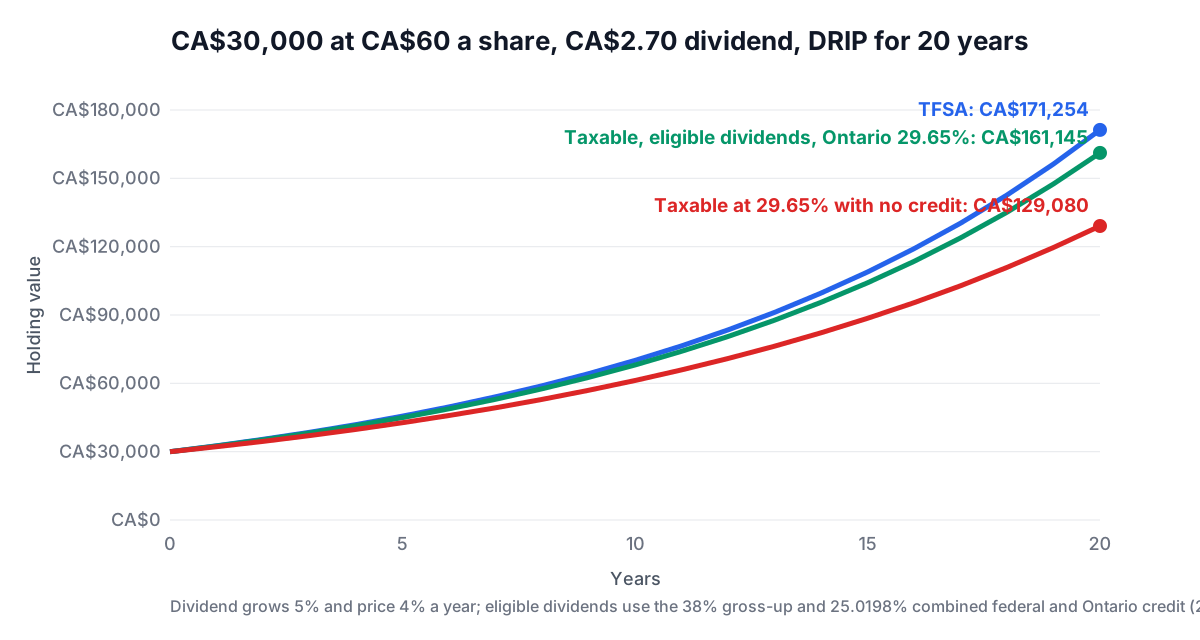
The dividend tax credit closes most of the gap between a taxable account and a TFSA for eligible Canadian dividends: CA$10,109 behind after 20 years at 29.65%, against CA$42,174 behind when the same income gets no credit, as with US dividends in a taxable account. That arithmetic is why some investors keep Canadian dividend payers in the non-registered account and put interest and foreign income in registered accounts first.
The TFSA dollar limit is CA$7,000 for 2026, so a CA$30,000 lump sum fits only if you have unused room from earlier years.
Yield on cost and what the projection skips
In the TFSA case, CA$9,331.96 a year on CA$30,000 is a 31.11% yield on cost. The holding is then worth CA$171,254.12, and on that the yield is about 5.4%. Use the current yield when you decide whether to hold.
- Dividends can be cut. Boards set them each quarter, and a steady 5% growth rate is an assumption.
- Prices are not smooth. A DRIP buys more shares in a falling market and fewer in a rising one.
- Tax rates are 2026 rates held flat for 20 years, and the Ontario non-eligible credit is already scheduled to fall to 1.9863% for 2027.
- One company is one risk. The Canadian edition of the ETF fees and dividends guide covers what an MER and US withholding tax do to a fund's income.
Tools for this job
- The Canadian dividend calculator applies the gross-up and credit on each payment, or no tax for a TFSA.
- The Canadian ETF investment calculator projects TFSA or RRSP contributions with the MER.
- The Canadian compound interest calculator shows the same compounding on a GIC, explained in the Canadian compound interest guide.
- The stock average calculator works out the average cost after several purchases, the starting point for ACB.
Frequently asked questions
Are reinvested DRIP dividends taxable in Canada?
In a non-registered account, yes. The dividend is reported on your T5 for the year it was paid even though no cash reached you, and the shares it bought are added to your adjusted cost base at their purchase price. In a TFSA or RRSP nothing is reported when the dividend is paid.
Why is my grossed-up dividend higher than what I received?
Because the T5 rules make the taxable amount of an eligible dividend 138% of the cash (115% for other dividends), and the dividend tax credit is then worked out on that higher amount. Your T5 shows the actual amount, the taxable amount and the federal credit in separate boxes.
Do US dividends get the dividend tax credit?
No. The CRA's line 12000 covers dividends from taxable Canadian corporations, and only those carry the gross-up and credit. Dividends from a US company are taxed at your full marginal rate, which is why the no-credit line in the 20-year table falls so far behind.
What is the TFSA limit for 2026?
The TFSA dollar limit is CA$7,000 for 2026, the same as for 2025. Unused room carries forward, so your actual room can be much larger; CRA My Account shows the figure.
Sources and further reading
- T4015, T5 Guide: return of investment income, Canada Revenue Agency. Gross-up of 38% and 15%, federal credits of 15.0198% and 9.0301%, boxes 10 to 12 and 24 to 26.
- Ontario dividend tax credit, Government of Ontario. 10% for eligible dividends; 2.9863% for other dividends in 2026 and 1.9863% in 2027.
- Tax rates and income brackets for individuals: current year, Canada Revenue Agency. 2026 federal and Ontario brackets.
- T4037, Capital Gains 2025, Canada Revenue Agency. Chapter 3, identical properties and the reinvested distributions example.
- Line 12000: taxable amount of dividends from taxable Canadian corporations, Canada Revenue Agency. Eligible and other than eligible dividends.
- MP, DB, RRSP, DPSP, ALDA, TFSA limits, YMPE and the YAMPE, Canada Revenue Agency. The TFSA dollar limit by year.
More Calculators
Every tool in the Calculators section, free and in your browser.
- Investment Calculator
- Compound Interest Calculator
- Simple Interest Calculator
- Interest Calculator
- EMI Calculator
- Retirement Calculator
- Time-Weighted Return Calculator
- Savings Goal Calculator
- Inflation Calculator
- CAGR Calculator
- ROI Calculator
- Present and Future Value Calculator
- NPV and IRR Calculator
- 401(k) Calculator
- Roth IRA Calculator
- APY and CD Calculator
- SIP Calculator
- Annuity Calculator
- Bond Price and Yield Calculator
- Currency Converter
- Dividend Calculator
- Stock Average Calculator
- RMD Calculator