
Pool Volume in Litres, Salt Bags and Chlorine Doses
How many litres your backyard pool holds, salt in 20 kg bags for the chlorinator, chlorine per 10,000 L and how tablets push stabiliser past 50 mg/L.
By Redbison Dev · · 11 min read
Australia edition. Written for Australian backyard pools: litres and doses per 10,000 L, salt chlorinators topped up from 20 kg bags, NSW Health's stabiliser limits and the free chlorine they require, and NSW pool registration and barrier rules. US edition
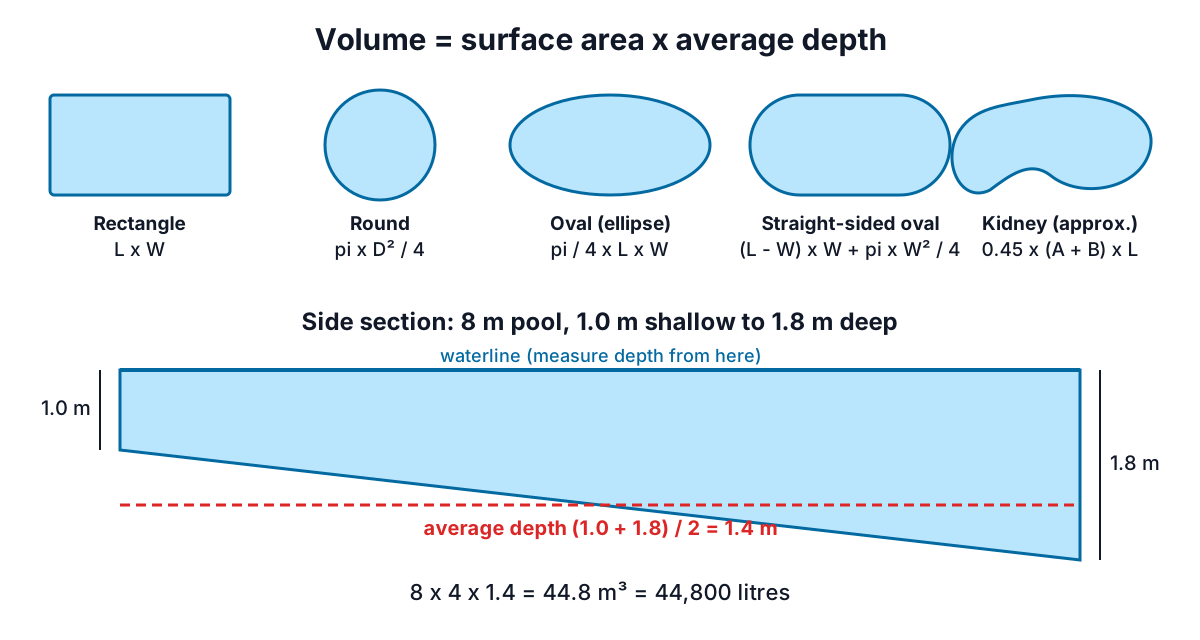
An 8 × 4 m backyard pool running from 1.0 m at the shallow end to 1.8 m at the deep end holds 44,800 L. Bringing it up to a salt chlorinator level of 4,000 ppm from fresh water takes 179.2 kg of salt, nine 20 kg bags, and lifting free chlorine by 2 ppm takes 0.72 L of 12.5% liquid chlorine. Doses are worked out per 10,000 L, so every figure starts with the volume. This edition works it out with the Australian pool volume calculator, then covers the salt, the chlorine and the stabiliser that quietly builds up over a summer.
Litres from length, width and two depths
litres = surface area (m²) × average depth (m) × 1,000
average depth = (shallow end + deep end) ÷ 2
Measure depth to the water line, not the coping. For a freeform pool, take the surface area from the builder's plans rather than guessing it from a sketch.
| Pool | Size | Water depth | Litres |
|---|---|---|---|
| Family pool | 8 × 4 m | 1.0 to 1.8 m | 44,800 |
| Longer pool | 10 × 4 m | 1.0 to 1.8 m | 56,000 |
| Plunge pool | 4 × 2.5 m | 1.4 m flat | 14,000 |
A pool with a small deep "hopper" rather than an even slope holds less than the average of the two depths suggests. Split it into a shallow and a deep rectangle, or accept a slight overestimate and dose a little under.
Salt for the chlorinator
A salt chlorinator makes chlorine from dissolved salt, and its label or manual gives the level it needs; 4,000 ppm is used here as an example. Salt in ppm is milligrams per litre:
salt (kg) = (target ppm − current ppm) × litres ÷ 1,000,000
| Situation | Salt needed | 20 kg bags |
|---|---|---|
| 8 × 4 m pool, fresh water to 4,000 ppm | 179.2 kg | 9 |
| Same pool, test reads 3,200 ppm | 35.8 kg | 2 |
| 4 × 2.5 m plunge pool, fresh water to 4,000 ppm | 56 kg | 3 |
Rain and backwashing dilute salt, so top up from a test result rather than by habit. Add it with the pump running, brush it around until it dissolves, and retest a day later.
Chlorine per 10,000 litres
One ppm is one milligram per litre, so 1 ppm in 10,000 L is 10 g of available chlorine. The product's strength sets how much you add, and each product leaves something else behind:
| Product | For 1 ppm in 10,000 L | Side effect per 1 ppm |
|---|---|---|
| Liquid chlorine 12.5% | 80 mL | none |
| Liquid chlorine 10% | 100 mL | none |
| Granular calcium hypochlorite 65% | 15.4 g | +0.7 ppm calcium hardness |
| Stabilised dichlor 56% | 17.9 g | +0.9 ppm cyanuric acid |
| Trichlor tablets 90% | 11.1 g | +0.6 ppm cyanuric acid |
For the 8 × 4 m pool, a 2 ppm rise is 0.72 L of 12.5% liquid, 138 g of calcium hypochlorite, 160 g of dichlor or 100 g of trichlor. Liquid chlorine adds no stabiliser or calcium, which makes it a clean way to correct a salt pool whose chlorinator has fallen behind.
Stabiliser: the slow problem
Stabiliser (cyanuric acid) is used in outdoor pools, but it also makes chlorine less effective, which is why NSW Health raises the minimum free chlorine where it is used. Its fact sheet for outdoor public pools sets:
- an optimum of about 30 mg/L and a maximum of 50 mg/L, the limit in the Public Health Regulation 2012 for public pools;
- a minimum free chlorine of 3 mg/L where stabiliser is used, against 1 mg/L otherwise;
- no stabiliser in indoor pools, bromine pools or spa pools.
It also says dichlor carries about 56 to 62% available chlorine and trichlor about 90%, and both add cyanurate with every dose, which leaves the water only through splashing and backwashing. Home pools are not covered by the regulation, but the chemistry is identical.
The arithmetic shows how fast tablets get you there. Each 2 ppm of chlorine from trichlor adds 1.2 ppm of stabiliser. A pool using 2 ppm a day from tablets alone goes from 30 to 50 mg/L in about 17 days. NSW Health's advice once the level reaches 50 mg/L is to stop dichlor and trichlor and use a non-stabilised chlorine such as sodium or calcium hypochlorite until it falls to 25 mg/L.
Bringing it down by replacing water
If the level is well past the limit, partial draining is the direct fix. The share of water to replace is 1 minus the target divided by the current level. Taking the 8 × 4 m pool from 70 to 30 mg/L means replacing four sevenths of it, 25,600 L. Check your water authority's current restrictions before a large refill, and do it in stages if your pool's construction or groundwater makes a full drain risky.
Filling time
At 15 L/min from a garden hose, the 8 × 4 m pool takes about 50 hours to fill. For a new pool, a water carter delivery is much quicker.
Pool rules in NSW
The NSW Government's pool owner page says all pool and spa owners must register on the NSW Swimming Pool Register. Portable and inflatable pools that can hold more than 30 cm of water must be registered and fenced like permanent pools. Registration is done on the NSW Swimming Pool Register, and Building Commission NSW publishes a user guide to registering a pool or spa and viewing certificates. Nationally, Product Safety Australia says portable pools must be sold with a warning message and a safety sign marked on them, under a mandatory standard that also covers portable spas and hot tubs, and advises emptying smaller pools when they are not in use. The child-resistant barrier must be at least 1.2 m high with no gap under it larger than 10 cm, gates must swing outward, close automatically and self-latch, and a CPR sign must be readable from 3 m. Selling or leasing needs a registration certificate and, depending on the case, a compliance certificate, which is valid for three years. Other states keep their own rules, so check with your council.
Frequently asked questions
How many 20 kg bags of salt does my pool need?
Work out kilograms with (target ppm − current ppm) × litres ÷ 1,000,000, then divide by 20 and round up. A 44,800 L pool from fresh water to 4,000 ppm needs 179.2 kg, nine bags; from a reading of 3,200 ppm it needs 35.8 kg, two bags.
What should stabiliser be in a pool?
NSW Health gives about 30 mg/L as optimal and 50 mg/L as the maximum for outdoor public pools, with at least 3 mg/L of free chlorine when stabiliser is used. The same levels are a sensible target at home.
Can I use stabiliser or trichlor in a spa?
No. NSW Health says cyanurate must not be used in a spa pool under any circumstances, and not in indoor or bromine pools either. Use a non-stabilised chlorine or bromine as the spa's manual directs.
How much liquid chlorine per 10,000 litres?
About 80 mL of 12.5% liquid chlorine, or 100 mL of 10%, raises 10,000 L by 1 ppm.
Sources and further reading
- Stabiliser (cyanurate) use in outdoor swimming pools, NSW Health. Optimum and maximum cyanurate, minimum free chlorine and reducing high levels.
- Swimming Pool Register user guide for pool and spa owners, Building Commission NSW. Registering a pool or spa and viewing certificates.
- Swimming pools (portable and inflatable) guide, ACCC Product Safety Australia. Warning message and safety sign, emptying small pools, fencing for larger ones.
- Portable swimming pools mandatory standard, ACCC Product Safety Australia. Which portable pools, spas and hot tubs it covers and the labelling it requires.
- Owning a pool or spa: your obligations, NSW Government. Swimming Pool Register, barriers, CPR signs and certificates.
Open the Pool Volume Calculator
More Construction & Home
Every tool in the Construction & Home section, free and in your browser.