
Pool Litres, Chlorine Doses and What a Fill Costs in NZ
Work out how many litres your pool or spa pool holds, chlorine and salt doses per 10,000 L, and what a town-supply fill adds to a metered Auckland water bill.
By Redbison Dev · · 11 min read
New Zealand edition. Written for New Zealand pools and spa pools: metres and litres, doses per 10,000 L, Watercare's 2026/27 water and wastewater prices for filling and partial refills, the lockable-cover rule for small spa pools, and three-yearly council barrier inspections. US edition
A 9 × 4.5 m in-ground pool running from 1.1 m deep at the shallow end to 1.9 m at the deep end holds 60,750 litres. Raising its free chlorine by 2 ppm takes 972 mL of 12.5% liquid chlorine, a new salt pool needs 243 kg of salt to reach 4,000 ppm, and filling it from a metered Auckland supply adds about $353.55 to the Watercare bill at 2026/27 prices, more than half of it wastewater charged on water that never goes down a drain. This edition works through litres, doses and the cost of water for New Zealand pools and spa pools, using the NZ pool volume calculator.
Litres from metres
litres = water surface area (m²) × average depth (m) × 1,000
average depth = (shallow end + deep end) ÷ 2
Measure depth to the water line, not the coping, and for a free-form pool take the surface area from the builder's plans.
| Pool | Size | Water depth | Surface area | Litres |
|---|---|---|---|---|
| In-ground family pool | 9 × 4.5 m | 1.1 to 1.9 m | 40.5 m² | 60,750 |
| Larger in-ground pool | 10 × 5 m | 1.0 to 2.0 m | 50 m² | 75,000 |
| Round above-ground pool | 4.5 m across | 1.2 m flat | 15.9 m² | about 19,085 |
| Spa pool | 2.2 × 2.2 m | 0.9 m | 4.84 m² | 4,356 |
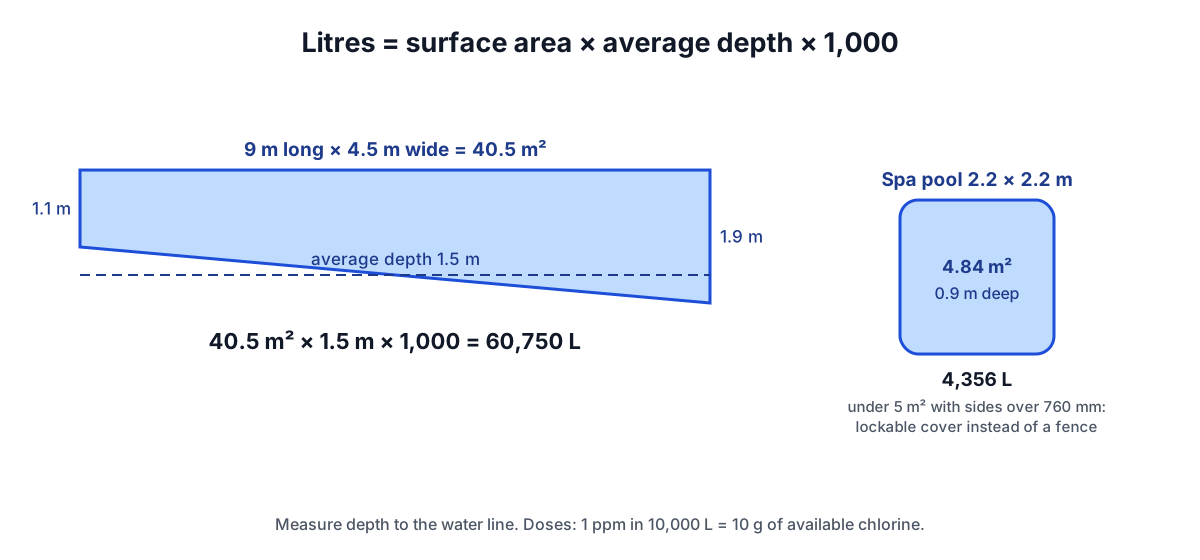
A pool with a short, steep drop into a deep hopper holds less than the two-depth average suggests. Split it into a shallow and a deep rectangle, or accept a small overestimate and dose slightly under.
Chlorine per 10,000 litres
One ppm is one milligram per litre, so raising 10,000 L by 1 ppm needs 10 g of available chlorine. The product's strength sets the amount, and each product leaves something behind:
| Product | For 1 ppm in 10,000 L | 9 × 4.5 m pool, +2 ppm | Side effect |
|---|---|---|---|
| Liquid chlorine 12.5% | 80 mL | 972 mL | none |
| Liquid chlorine 10% | 100 mL | 1,215 mL | none |
| Household bleach, about 6% | 167 mL | 2,025 mL | none |
| Calcium hypochlorite 65% | 15.4 g | 186.9 g | +1.4 ppm calcium hardness |
| Dichlor 56% | 17.9 g | 217.0 g | +1.8 ppm stabiliser |
| Trichlor 90% | 11.1 g | 135.0 g | +1.2 ppm stabiliser |
For the round 19,085 L above-ground pool, the same 2 ppm rise is about 305 mL of 12.5% liquid or 59 g of 65% calcium hypochlorite. For the 4,356 L spa pool it is 69.7 mL of 12.5% liquid; small volumes are easy to overdose, so measure with a syringe or a marked jug.
Trichlor tablets and dichlor carry stabiliser (cyanuric acid) with every dose, and it leaves the water only through splash-out, backwashing and refilling. A floating tablet dispenser that adds 2 ppm a day of chlorine adds 1.2 ppm of stabiliser a day, so a pool can climb from 30 to 50 ppm in under three weeks. Liquid chlorine and calcium hypochlorite add none.
Salt for a salt chlorinator
Salt in ppm is milligrams per litre, so:
salt (kg) = (target ppm − current ppm) × litres ÷ 1,000,000
| Situation, 60,750 L pool | Salt needed |
|---|---|
| Fresh water to 4,000 ppm | 243 kg |
| Reading 2,500 ppm, target 4,000 | 91.1 kg |
| Reading 3,400 ppm, target 4,000 | 36.5 kg |
Use the level printed on your chlorinator rather than 4,000 ppm if it differs, and divide by the bag size your supplier sells, rounding up. Rain and backwashing dilute the salt, so top up from a test result, with the pump running, and retest a day later.
What water costs in Auckland
Watercare's residential prices from 1 July 2026, including GST, are $2.46 per 1,000 litres for water and $4.28 per 1,000 litres for wastewater. Wastewater is not metered separately: Watercare calculates it as 78.5% of the water your meter records, on the assumption that the rest goes on the garden and car. A pool fill is charged the same way.
| Job | Water | Wastewater (78.5% of the water) | Total |
|---|---|---|---|
| First fill, 60,750 L pool | about $149 | about $204 | $353.55 |
| Replacing 34,714 L to cut stabiliser from 70 to 30 ppm | about $202 | ||
| Refilling the 4,356 L spa pool | about $25 |
The partial drain uses the replacement rule: the share of water to replace is 1 minus the target divided by the current level, so going from 70 to 30 ppm means replacing four sevenths of the pool. That is the main reason to keep stabiliser under control with liquid chlorine rather than tablets on a town supply. Watercare's fixed charges do not change with a fill. Other councils and water suppliers set their own prices, and some properties are on tank water, so use the figures on your own bill.
Filling time
Divide the litres by your hose flow. At 15 L a minute the 60,750 L pool takes 67.5 hours, and at 20 L a minute about 50.6 hours; the 4,356 L spa pool takes under 5 hours at 15 L a minute. Time how long your hose takes to fill a 10 L bucket to find the flow.
Barriers and inspections
Hamilton City Council explains that the government set new rules in 2017, replacing the Fencing of Swimming Pools Act 1987, and that pools at homes must have barrier fencing. It inspects every pool in the city once every three years and charges $252 an hour for additional audit time. A spa pool with a water surface under 5 m² and sides higher than 760 mm can have a lockable cover instead of a fence, and such spas are not inspected; larger spas, or ones with lower sides, must be fenced.
The surface area from the calculator tells you which side of that line a spa falls on. The 2.2 × 2.2 m example is 4.84 m², just under 5 m²; a 2.3 × 2.3 m spa would be 5.29 m² and need a barrier. Make sure a new pool or spa is on your council's register, and check your own council's page for how it books inspections.
Safe dosing habits
- Add chlorine with the pump running, in front of a return, and let it circulate before testing.
- Never mix chlorine products with each other or with acid. Add chemicals to water, never water to chemicals.
- Store chlorine and acid apart, out of the sun; liquid chlorine loses strength with heat and time.
- Dose to a test result, not a schedule.
Tools for this job
- NZ pool volume calculator: litres, chlorine and salt doses and fill time, in metres.
- Tank volume calculator: rainwater tanks and other containers, if you top up from a tank.
- NZ water heating time calculator: how long a spa heater takes to warm the water.
- Related reading: the New Zealand edition of how long it takes to heat water.
Frequently asked questions
How many litres is my pool?
Multiply the water surface area in m² by the average depth in metres and by 1,000. A 9 × 4.5 m pool from 1.1 to 1.9 m deep is 40.5 m² × 1.5 m × 1,000 = 60,750 litres.
How much does it cost to fill a pool in Auckland?
At Watercare's prices from 1 July 2026, water is $2.46 and wastewater $4.28 per 1,000 litres including GST, with wastewater charged on 78.5% of the metered water. A 60,750 L fill comes to about $353.55.
Does a spa pool need a fence in NZ?
Not if its water surface is under 5 m² and its sides are higher than 760 mm: Hamilton City Council says such spas can have a lockable cover instead, and they are not inspected. Larger spas or ones with lower sides need a barrier.
How much liquid chlorine do I add per 10,000 litres?
About 80 mL of 12.5% liquid chlorine, or 100 mL of 10%, raises 10,000 L by 1 ppm. For a 2 ppm rise in a 60,750 L pool that is 972 mL of 12.5%.
How do I lower stabiliser in my pool?
Replace part of the water. The share to replace is 1 minus the target divided by the current level, so from 70 to 30 ppm you replace four sevenths, about 34,714 L in a 60,750 L pool. Then switch to liquid chlorine, which adds no stabiliser.
Sources and further reading
- Residential water services and wastewater charges 2026-2027, Watercare Services. Water $2.46 and wastewater $4.28 per 1,000 litres including GST from 1 July 2026; wastewater at 78.5% of metered water.
- How residential charges work, Watercare Services. Why 21.5% of metered water is not charged as wastewater.
- Swimming pool monitoring, Hamilton City Council. Three-yearly inspections, the 2017 rules and the lockable-cover rule for small spa pools.
- NIST Guide to the SI, Appendix B.8: Factors for units listed alphabetically, NIST. Volume conversions.
- Symclosene (trichloroisocyanuric acid), NIST Chemistry WebBook. Formula and molar mass of trichlor, behind its stabiliser load.
- Cyanuric acid, NIST Chemistry WebBook. Formula and molar mass of stabiliser.
Open the Pool Volume Calculator
More Construction & Home
Every tool in the Construction & Home section, free and in your browser.