
Pool Volume in Litres, Chlorine Doses and Salt in Canada
How many litres your above-ground or in-ground pool holds, chlorine per 10,000 L for Health Canada's 1 to 3 ppm range, salt at spring opening and hot tub levels.
By Redbison Dev · · 11 min read
Canada edition. Written for Canadian pool owners: pools sold in feet but dosed in litres, Health Canada's 1 to 3 ppm pool and 3 to 5 ppm hot tub ranges, registered products with a PCP number, salt top-ups at spring opening, and CANUTEC's storage advice. US edition
An 18 ft round above-ground pool with 1.2 m of water holds 28,406 L, and taking it from 1 to 3 ppm of free chlorine needs 0.45 L of 12.5% liquid chlorine. Pools are often described in feet, but the chemicals on the shelf are registered with Health Canada and dosed in litres and per 10,000 L, so the first job every spring is knowing your pool's volume in litres. This edition works it out with the Canadian pool volume calculator, then turns it into chlorine and salt doses that keep the water inside Health Canada's recommended range.
From feet to litres
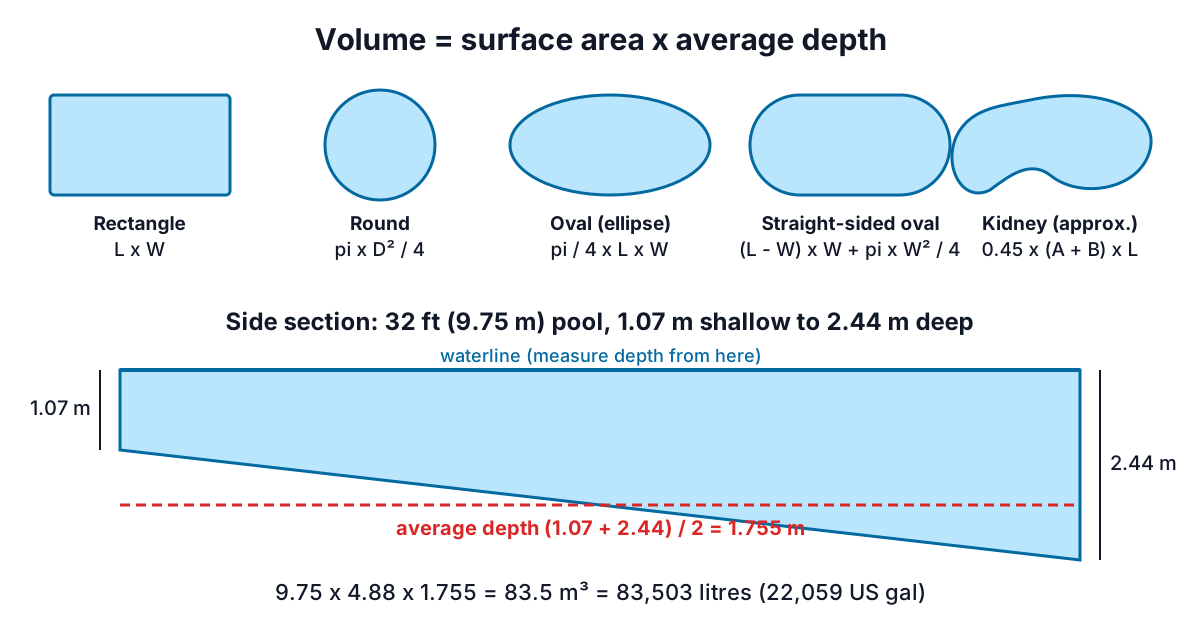
Volume is surface area times average water depth. Measure the water, not the wall: on an above-ground pool the water line sits partway up the skimmer, below the top rail.
litres = surface area (m²) × average depth (m) × 1,000
average depth = (shallow end + deep end) ÷ 2
Convert the size first: 18 ft is 5.49 m, 24 ft is 7.32 m, and a 16 × 32 ft in-ground pool is 4.88 × 9.75 m.
| Pool | Metric size | Water depth | Litres | US gallons |
|---|---|---|---|---|
| 18 ft round above-ground | 5.49 m across | 1.2 m | 28,406 | 7,504 |
| 24 ft round above-ground | 7.32 m across | 1.2 m | 50,500 | 13,341 |
| 15 × 30 ft straight-sided oval | 4.57 × 9.14 m | 1.2 m | 44,745 | 11,820 |
| 16 × 32 ft in-ground, 3.5 to 8 ft | 4.88 × 9.75 m | 1.07 to 2.44 m | 83,503 | 22,059 |
| Square hot tub | 2.1 × 2.1 m | 0.8 m | 3,528 | 932 |
Ovals: check which kind you have
Some above-ground "ovals" are a rectangle with half circles on the ends, not a true ellipse. A 15 × 30 ft pool of that shape holds 44,745 L at 1.2 m; an ellipse of the same length and width would hold 39,367 L. Using the ellipse formula on a straight-sided pool underdoses by about 12%.
Which gallons?
Pump and heater manuals may quote US gallons (3.785 L) or imperial gallons (4.546 L). The 18 ft pool is 7,504 US gallons but 6,249 imperial gallons. Working in litres, as the labels do, avoids mixing them up.
Health Canada's chlorine ranges
Health Canada recommends free available chlorine of 1 to 3 ppm in residential pools, inflatable pools included, and 3 to 5 ppm in residential spas and hot tubs. Some product labels allow pool water as low as 0.6 ppm, but only where organic matter is controlled, and never for spas. Commercial pools follow provincial or municipal rules instead.
One ppm in water is one milligram per litre, so 1 ppm in 10,000 L is 10 g of available chlorine. The product strength does the rest:
| Product | For 1 ppm in 10,000 L | Side effect per 1 ppm |
|---|---|---|
| Liquid chlorine 12.5% | 80 mL | none |
| Liquid chlorine 10% | 100 mL | none |
| Calcium hypochlorite 65% | 15.4 g | +0.7 ppm calcium hardness |
| Dichlor 56% | 17.9 g | +0.9 ppm cyanuric acid |
| Trichlor 90% | 11.1 g | +0.6 ppm cyanuric acid |
For the 18 ft pool, a 2 ppm rise is 0.45 L of 12.5% liquid or 0.57 L of 10%. For the 16 × 32 in-ground pool, a 2 ppm rise with cal-hypo is 257 g, and it adds 1.4 ppm of calcium hardness, which matters if your municipal water is already hard. For the 3,528 L hot tub, going from 1 to 4 ppm is 18.9 g of dichlor; at that size, weigh it.
Check the label for a PCP number
Health Canada says registered pool and spa chemicals carry a Pest Control Products Act registration number on the label, and that salt chlorine generators and ionizers must be registered too. Ozone devices do not replace chlorine; Health Canada says they should only be used with chlorine-based sanitizers. Health Canada's label search lets you look up any registered product by name or registration number and read its directions.
Stabilizer: how trichlor pucks build it up
Trichlor and dichlor carry cyanuric acid with every dose, and it leaves only with water you splash out, backwash or drain. A floater of trichlor that holds the 18 ft pool's chlorine steady adds about 0.6 ppm of stabilizer for every ppm of chlorine it releases, so a summer on pucks alone keeps raising it. NSW Health, which regulates public pools in New South Wales, puts the optimum at about 30 mg/L and the maximum at 50 mg/L, and tells operators who reach it to switch to a non-stabilized chlorine until the level falls. Home pools in Canada are not bound by that limit, but the chemistry is the same: test stabilizer every few weeks and switch to liquid chlorine when it climbs.
Salt at spring opening
A salt chlorine generator needs the salt level its manual gives. Salt in ppm is milligrams per litre, so:
salt (kg) = (target ppm − current ppm) × litres ÷ 1,000,000
Filling the 18 ft pool with fresh water and bringing it to 3,200 ppm takes 90.9 kg, five 20 kg bags. At spring opening, test before you buy: most of last year's salt is still in the water unless you drained a lot of it. If snowmelt and rain have diluted it to 2,400 ppm, you need only 22.7 kg: one 20 kg bag plus about 3 kg. The 24 ft pool from fresh water needs 161.6 kg.
Filling time
Time a bucket to find your hose flow in litres a minute, then divide. At 15 L/min the 18 ft pool takes about 32 hours and the 16 × 32 in-ground pool about 93 hours, so a bulk water delivery is worth pricing for a first fill.
Storing and mixing chemicals safely
Transport Canada's CANUTEC centre, which handles dangerous goods emergencies, notes that most common pool chemicals react with each other and can release heat and toxic gas or start a fire. Its advice:
- add pool chemicals to a large amount of water, never a little water to the chemical; even a wet scoop in a container can start a reaction;
- clean and dry scoops before switching products, and never combine old and new batches;
- store in a cool, dry, ventilated place out of sunlight, with liquid containers never above dry chemicals.
Health Canada adds: keep products in their original containers, away from children and pets, and never use a product from an unlabelled container.
Frequently asked questions
What chlorine level should my pool be in Canada?
Health Canada recommends 1 to 3 ppm of free chlorine for residential pools, including inflatable pools, and 3 to 5 ppm for residential hot tubs and spas.
How many litres are in a 24 ft round pool?
About 50,500 L with 1.2 m of water. At 1.07 m it is about 45,000 L, so measure your actual water depth before dosing.
How much liquid chlorine do I need per 10,000 litres?
80 mL of 12.5% liquid chlorine raises 10,000 L by 1 ppm; 100 mL of 10% does the same. Multiply by your litres divided by 10,000 and by the rise you want.
Do I need to add salt every spring?
Only what testing shows is missing. Salt stays in the water over winter except what is drained or splashed out, so an 18 ft pool at 2,400 ppm needs about 22.7 kg to reach 3,200 ppm, not the full 90.9 kg.
Sources and further reading
- Swimming pool and spa chemicals, Health Canada. Free chlorine ranges for residential pools and spas, registration, ozone and ionizers, storage.
- Search product label, Health Canada, Pest Management Regulatory Agency. Labels of registered pool and spa products.
- Swimming pool chemicals, Transport Canada, CANUTEC. Reactions, mixing, storage and incident response.
- Stabiliser (cyanurate) use in outdoor swimming pools, NSW Health. Optimum and maximum cyanurate and how dichlor and trichlor add it.
- The control of legionella and other infectious agents in spa-pool systems (HSG282), Health and Safety Executive. Hot tub disinfection and keeping cyanuric acid below 100 mg/l by dilution.
Open the Pool Volume Calculator
More Construction & Home
Every tool in the Construction & Home section, free and in your browser.