
Pool and Hot Tub Litres, Chlorine Doses and Salt in the UK
How many litres your frame pool or hot tub holds, chlorine granules per 10,000 litres, stabiliser build-up, salt in kg, and the hosepipe ban rule on pools.
By Redbison Dev · · 11 min read

United Kingdom edition. Written for UK frame pools, hot tubs and the occasional in-ground pool: volumes in litres and imperial gallons, doses per 10,000 litres, the HSE spa-pool guidance that applies to hot tubs in holiday lets, and the Water Industry Act power to ban filling pools. US edition
A 12 ft round frame pool filled to 0.9 m holds 9,469 litres, and raising its free chlorine by 2 ppm takes about 34 g of dichlor granules. Whether you have a frame pool like that, a hot tub or an in-ground pool, doses are worked out per 10,000 litres, so get the litres wrong and every dose is wrong with it. This edition works out the volume, the dose and the salt with the UK pool volume calculator, and covers the two UK rules a pool owner is most likely to meet: hosepipe bans and the HSE guidance for hot tubs in holiday lets.
Litres are area times average depth
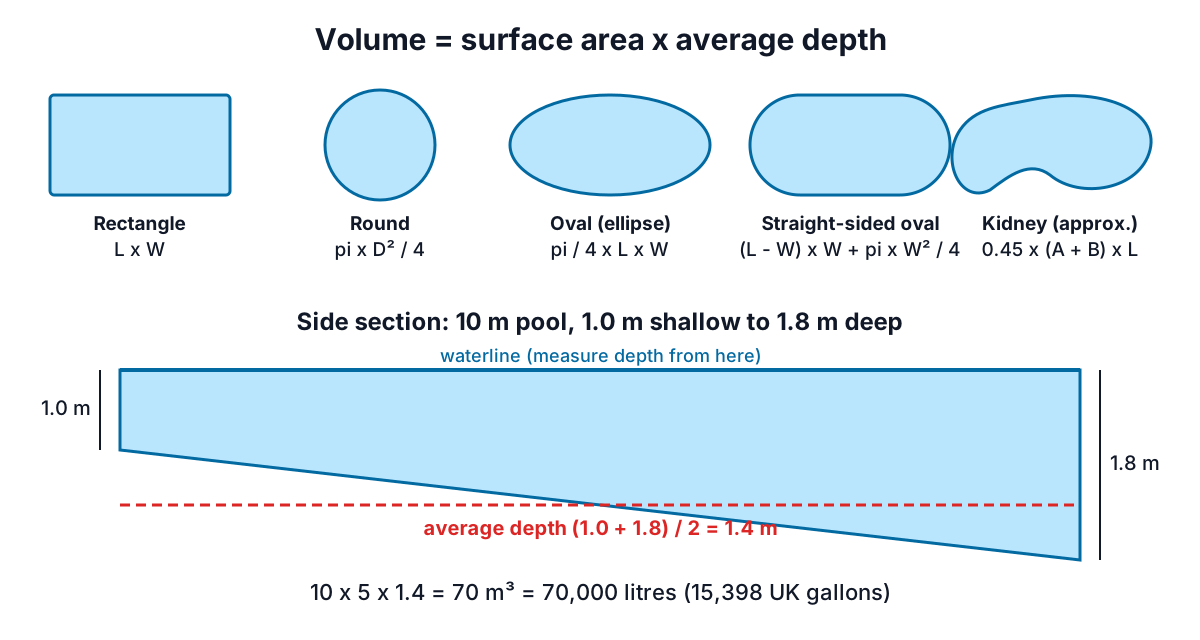
Measure the water, not the pool. A frame pool's advertised size and wall height are not its water volume: the water sits below the top rail, and the inside diameter is a little smaller than the outside. Use the inside measurement and the depth of the water:
litres = surface area (m²) × average depth (m) × 1,000
average depth = (shallow end + deep end) ÷ 2
For a flat-floored frame pool the two depths are the same. For an in-ground pool that slopes evenly, a 10 × 5 m pool running from 1.0 m to 1.8 m averages 1.4 m and holds 70,000 litres.
| Pool | Size | Water depth | Litres | UK gallons |
|---|---|---|---|---|
| 12 ft round frame pool | 3.66 m across | 0.9 m | 9,469 | 2,083 |
| 15 ft round frame pool | 4.57 m across | 1.07 m | 17,551 | 3,861 |
| 18 × 10 ft rectangular frame pool | 5.49 × 3.05 m | 1.07 m | 17,917 | 3,941 |
| Round hot tub | 1.8 m across | 0.7 m | 1,781 | 392 |
| In-ground pool | 10 × 5 m | 1.0 to 1.8 m | 70,000 | 15,398 |
A moulded hot tub holds less than its cylinder because of the seats, so the manufacturer's stated litres beat any measurement.
UK gallons or US gallons?
The Weights and Measures Act 1985 defines the UK gallon as 4.54609 litres; a US gallon is 3.785 litres. Pumps, heaters and dosing charts written for the American market quote US gallons, so the 12 ft pool is 2,083 UK gallons but 2,501 US gallons. Read a UK gallon figure against a US "per 10,000 gallons" chart and you underdose by about a sixth. Working in litres avoids the problem altogether.
What 1 ppm means in grams
One part per million in water is one milligram per litre. Raising free chlorine by 1 ppm in 10,000 litres needs 10 g of available chlorine, and the product's strength sets how much you add:
| Product | Available chlorine | For 1 ppm in 10,000 L | Side effect per 1 ppm |
|---|---|---|---|
| Dichlor granules | 56% | 17.9 g | +0.9 ppm cyanuric acid |
| Trichlor tablets | 90% | 11.1 g | +0.6 ppm cyanuric acid |
| Calcium hypochlorite | 65% | 15.4 g | +0.7 ppm calcium hardness |
| Liquid chlorine | 12.5% | 80 ml | none |
| Liquid chlorine | 10% | 100 ml | none |
Check the strength printed on your tub and set the calculator to match.
For the 12 ft frame pool, a 2 ppm rise is 33.8 g of dichlor, and it adds 1.8 ppm of cyanuric acid (stabiliser). For the 1,781 litre hot tub, a 3 ppm rise is 9.5 g. At that size, the difference between a level and a heaped scoop is a whole ppm, so weigh it on kitchen scales kept for the purpose.
Hot tubs: stabiliser builds up fast
Dichlor is convenient because it dissolves quickly and barely moves pH, but every dose leaves its cyanuric acid behind, and nothing removes it except replacing water. HSE's spa-pool guidance (HSG282) says cyanuric acid should be kept below 100 mg/l by dilution with fresh water, because above that it can encourage algae and stop chlorine being released. Small volumes reach that level quickly: a hot tub dosed with dichlor at 3 ppm every couple of days gains about 2.7 ppm of stabiliser each time.
Diluting is arithmetic. To bring the 1,781 litre tub from 120 mg/l down to 80 mg/l, replace a third of the water, 594 litres, then rebalance. A test kit that reads cyanuric acid is worth having for exactly this reason.
If the hot tub is in a holiday let
HSG282 states that hot tubs in private homes, used only by the owner, family and occasional guests, are outside its scope. A hot tub in a holiday rental unit, or let with a property for a family or group, is different: HSG282 treats it as a business activity subject to the general duties of the Health and Safety at Work Act, to be managed in proportion to the risk, and describes the water in such tubs as changed after each rental or each week, whichever is shorter. For those, HSG282 sets free chlorine at 3 to 5 mg/l (or total bromine at 4 to 6 mg/l) at pH 7, says combined chlorine should ideally be 0 and normally below 1 mg/l, and treats hand-dosing with dichlor granules as an emergency or shock measure rather than routine treatment. If you let a property with a hot tub, read the full guidance; it also covers legionella risk assessment.
Salt-water systems
A salt chlorinator makes chlorine from dissolved salt, and the cell's manual gives the level it needs. Salt in ppm is milligrams per litre, so:
salt (kg) = (target ppm − current ppm) × litres ÷ 1,000,000
The 17,917 litre rectangular frame pool, starting from fresh water at a 3,000 ppm target, needs 53.7 kg: two 25 kg bags and about 4 kg from a third. Add it in stages with the pump running and retest after a day, because the only cure for too much salt is draining and refilling.
Filling the pool, and hosepipe bans
Time a bucket to find your hose flow. At 15 litres a minute the 12 ft frame pool fills in about 10.5 hours and the 70,000 litre in-ground pool takes almost 78 hours.
In England and Wales, a water company can impose a temporary use ban in a drought. Section 76 of the Water Industry Act 1991, which extends to England and Wales only, lists the uses that can be banned, and filling or maintaining a domestic swimming or paddling pool is one of them. Unlike most items on the list, which refer to using a hosepipe, the pool item does not, so a ban can cover filling a pool by watering can or bucket from the mains too. Your water company publishes the terms and any exceptions of its own ban; check before filling a pool in a dry summer. Scotland and Northern Ireland have their own arrangements, so there check your water supplier's rules.
Safe handling
- Add chemicals to plenty of water, never water to chemicals, and never mix dry chlorine products or put a wet scoop into a tub.
- Store chlorine products apart from acids such as pH reducer.
- Dose with the pump running and test before adding more.
- Trichlor is acidic: HSG282 notes it tends to lower pH, while dichlor has little effect.
Frequently asked questions
How much chlorine should a hot tub have in the UK?
HSE's HSG282 sets 3 to 5 mg/l of free chlorine at pH 7 for hot tubs run as a business, such as holiday lets. Privately owned tubs are outside its scope, so follow the manufacturer's handbook.
How do I lower cyanuric acid in a hot tub or pool?
Replace part of the water. The fraction to drain is 1 minus the target level divided by the current level: going from 120 to 80 mg/l means replacing a third. Then switch to a chlorine without stabiliser, such as calcium hypochlorite or liquid chlorine, for a while.
How many grams of chlorine granules per 10,000 litres?
For dichlor at 56% available chlorine, 17.9 g raises 10,000 litres by 1 ppm. Multiply by the litres in your pool divided by 10,000 and by the rise you want.
Can a hosepipe ban stop me filling a paddling pool?
In England and Wales, yes, if your water company's temporary use ban includes it. The Water Industry Act 1991 lets a ban cover filling or maintaining a domestic swimming or paddling pool, and that item is not limited to hosepipes.
Sources and further reading
- Water Industry Act 1991, section 76, legislation.gov.uk. The uses a temporary use ban can cover, including domestic swimming and paddling pools; the section extends to England and Wales.
- The control of legionella and other infectious agents in spa-pool systems (HSG282), Health and Safety Executive. Scope for domestic-type tubs, 3 to 5 mg/l free chlorine, cyanuric acid below 100 mg/l.
- Health and safety in swimming pools (HSG179), Health and Safety Executive. Guidance for those operating and managing pools.
- Weights and Measures Act 1985, Schedule 1, legislation.gov.uk. The UK gallon of 4.54609 litres.
- Stabiliser (cyanurate) use in outdoor swimming pools, NSW Health. How dichlor and trichlor add cyanurate with every dose.
- Swimming pool and spa chemicals, Health Canada. Recommended free chlorine for residential pools and hot tubs, and storage advice.
Open the Pool Volume Calculator
More Construction & Home
Every tool in the Construction & Home section, free and in your browser.