
How Much Protein a Day in Australia? RDI, Over 70s, Training
Australia's protein RDIs for men and women, why they rise after 70, the 10 to 35% energy range, what training adds, and where the calculator falls below the RDI.
By Redbison Dev · · 6 min read
Australia edition. Written for Australian readers: healthdirect's daily protein amounts, which differ for men and women and rise after 70, the calculator's per-kilogram NHMRC setting and 10 to 35% energy guide, and worked examples that compare the calculator with the RDI that applies at each age. US edition
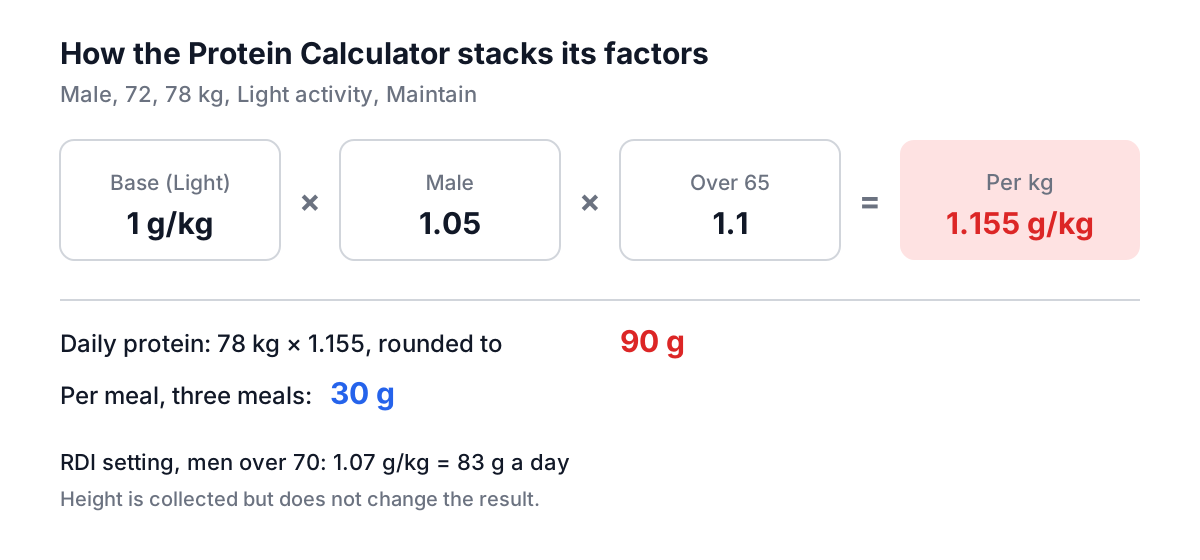
Australia's protein figures differ for men and women and rise after 70. healthdirect, the Australian Government's health information service, puts daily needs for adults aged 19 to 70 at 52 to 64 g for men and 37 to 46 g for women, and over 70 at 65 to 81 g for men and 46 to 57 g for women. The calculator's NHMRC setting turns the recommended dietary intake (RDI) into grams per kilogram of your own weight instead. A lightly active 72-year-old man of 78 kg gets 90 g a day from the Australian protein calculator, against 83 g from that RDI setting for his weight. This edition explains how the two figures relate and where the RDI should win.
It is general information. People with kidney disease, or anyone told to limit protein, should follow their GP or specialist.
The Australian figures
healthdirect gives the daily amounts in grams. The calculator's NHMRC setting applies a per-kilogram figure to your own weight instead:
| Age | Men | Women |
|---|---|---|
| 19 to 70 | 52 to 64 g; calculator 0.84 g/kg | 37 to 46 g; calculator 0.75 g/kg |
| Over 70 | 65 to 81 g; calculator 1.07 g/kg | 46 to 57 g; calculator 0.94 g/kg |
healthdirect adds that you should aim for 10 to 35% of your daily energy from protein, and lists older adults among the people who may need to take special care to eat enough. It also warns against taking too much protein from supplements and suggests talking to a doctor or dietitian before a high-protein diet.
Where the calculator and the RDI differ
The calculator starts from activity and goal, then multiplies by 1.05 for men and 1.1 over 65. The RDI starts from sex and age. Most of the time the calculator gives the higher figure; for some older people it does not.
| Who | Calculator target | Calculator's RDI setting |
|---|---|---|
| Man, 72, 78 kg, lightly active | 90 g (30 g a meal) | 83 g (1.07 g/kg) |
| Woman, 74, 62 kg, sedentary | 55 g (18 g a meal) | 58 g (0.94 g/kg) |
| Woman, 34, 64 kg, running, endurance goal | 84 g (28 g a meal) | 48 g (0.75 g/kg) |
| Man, 28, 85 kg, training for muscle gain | 175 g (58 g a meal) | 71 g (0.84 g/kg) |
The second line is the one to notice. A sedentary 74-year-old woman of 62 kg gets 0.88 g/kg from the calculator, below the calculator's 0.94 g/kg RDI setting for women over 70, which gives her 58 g. Where the RDI is higher, use it. The PROT-AGE study group (Bauer and colleagues, 2013) went further for people over 65, recommending at least 1.0 to 1.2 g/kg, or 62 to 74 g for her, because ageing muscle responds less to the same dose. An older person losing weight or strength without trying should see their GP.
What training adds
The International Society of Sports Nutrition's position stand (Jäger and colleagues, 2017) says 1.4 to 2.0 g/kg a day is sufficient for most people who exercise to build and keep muscle, with 20 to 40 g, or about 0.25 g/kg, at each serving. A meta-analysis by Morton and colleagues found that gains in fat-free mass from resistance training stopped rising beyond about 1.6 g/kg.
So the runner's 84 g, about 1.3 g/kg, sits just below the training range and is easy to reach. The 85 kg man's 175 g is 2.06 g/kg, above the point where research shows extra gain; at 1.6 g/kg he would aim for 136 g. That is 544 kcal of protein, roughly 18% of a 3,000 kcal day, well inside healthdirect's 10 to 35% guide.
Reaching the target
healthdirect lists lean meats, poultry and fish, eggs, dairy, nuts and seeds, and legumes and beans as protein sources. For a target near 30 g a meal:
- build each meal around one of those foods rather than adding protein at dinner only;
- use the nutrition panel: Food Standards Australia New Zealand explains that labels give amounts per serving and per 100 g, and that the per 100 g column is the one to compare products with.
Protein powders are optional. These targets can often be met from food, and healthdirect suggests talking to a doctor or dietitian about how much supplement, if any, you need.
Frequently asked questions
How much protein should a woman eat a day in Australia?
healthdirect gives 37 to 46 g a day for women aged 19 to 70 and 46 to 57 g over 70. The calculator's RDI setting works per kilogram, at 0.75 g up to 70 and 0.94 g after, which gives a 64 kg woman 48 g. Women who train regularly benefit from more, about 1.4 to 2.0 g/kg.
Why do people over 70 need more protein?
healthdirect's daily amounts rise after 70, to 65 to 81 g for men and 46 to 57 g for women, and research groups such as PROT-AGE recommend at least 1.0 to 1.2 g/kg for people over 65 to help keep muscle.
Is a high-protein diet safe?
For most healthy adults, staying within 10 to 35% of daily energy from protein is healthdirect's guide. Talk to your doctor or dietitian before a high-protein diet, and follow medical advice if you have kidney disease.
Do I need protein powder to build muscle?
No. Training targets of 1.4 to 2.0 g/kg can usually be met from food. A powder is a convenience when the target is high or meals are hard to plan.
Sources and further reading
- Protein, healthdirect Australia. Daily ranges by sex and age, 10 to 35% of energy, food sources and supplements.
- Nutrition information panels, Food Standards Australia New Zealand. Per serving and per 100 g columns.
- ISSN position stand: protein and exercise, Journal of the International Society of Sports Nutrition. Jäger and colleagues, 2017.
- Protein supplementation and resistance training: meta-analysis, British Journal of Sports Medicine. Morton and colleagues.
- Optimal dietary protein intake in older people: PROT-AGE position paper, Journal of the American Medical Directors Association. Bauer and colleagues, 2013.
More Fitness Calculators
Every tool in the Fitness Calculators section, free and in your browser.
- BMI Calculator
- Calorie Calculator
- Protein Calculator
- Hydration Calculator
- Calorie Deficit Planner
- Body Fat Calculator
- Ideal Weight Calculator
- Running Pace Calculator
- Target Heart Rate Calculator
- One Rep Max Calculator
- Barbell Plate Calculator
- RPE Calculator
- Interval Timer
- Calories Burned Calculator
- Body Surface Area Calculator
- Waist-to-Hip Ratio Calculator
- VO2 Max Calculator
- Steps to Distance & Calories Calculator