
How Much Protein a Day in Canada? Pounds, Grams and the DRI
Health Canada's protein RDA of 0.80 g per kg, converting a weight in pounds, the 10 to 35% energy range, what training and dieting add, and plant protein foods.
By Redbison Dev · · 6 min read
Canada edition. Written for Canadian readers: Health Canada's Dietary Reference Intake tables (RDA 0.80 g/kg, AMDR 10 to 35% of energy, no upper limit set), weights in pounds converted to kilograms, Canada's food guide advice to choose plant protein foods more often, and worked examples in lb. US edition
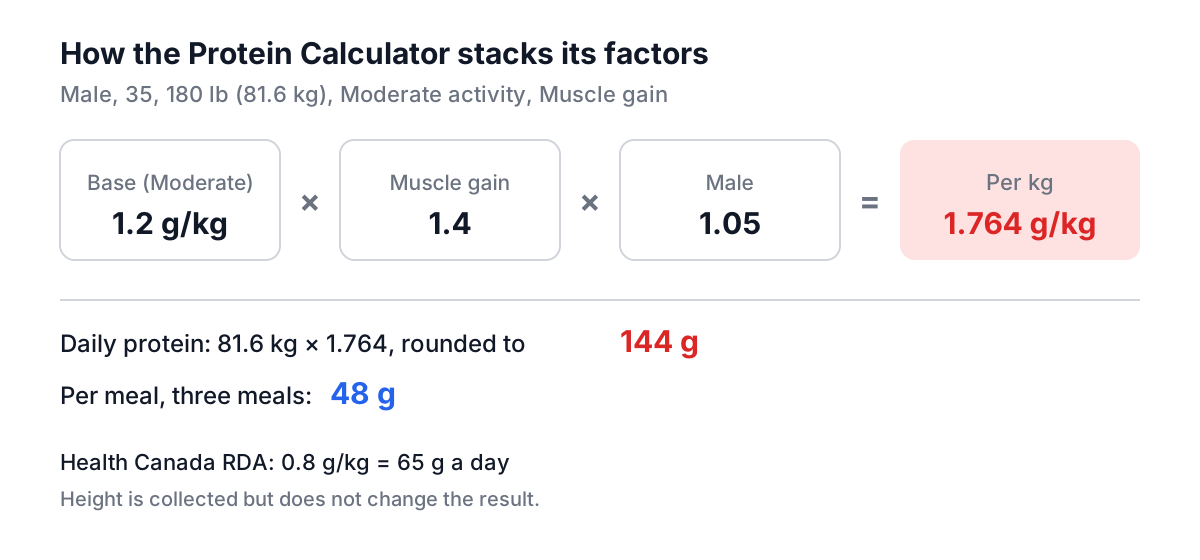
Health Canada's Recommended Dietary Allowance for protein is 0.80 g per kilogram of body weight a day for every adult age group. Many Canadians know their weight in pounds, so the first step is a conversion: 180 lb is 81.6 kg, which gives an RDA of 65 g. The same 180 lb man training to build muscle gets 144 g a day from the Canadian protein calculator, a little over twice the RDA. This edition explains the difference, how the "grams per pound" shortcuts compare, and how to reach the target with the plant-forward eating Canada's food guide recommends.
It is general information. If you have kidney disease or have been told to limit protein, follow your family doctor or nephrologist.
Health Canada's numbers
Health Canada's Dietary Reference Intake tables for macronutrients give, for men and women aged 19 to 30, 31 to 50, 51 to 70 and over 70:
| Measure | Value |
|---|---|
| Estimated Average Requirement | 0.66 g/kg a day |
| Recommended Dietary Allowance | 0.80 g/kg a day (56 g for the reference man, 46 g for the reference woman) |
| Acceptable Macronutrient Distribution Range | 10 to 35% of energy |
| Tolerable Upper Intake Level | none set |
The tables add that the absence of an upper limit does not mean high intakes over a long time are known to be safe. The RDA is a floor for health, not a training target.
Pounds to grams
Divide pounds by 2.2046 to get kilograms, then multiply by the grams per kilogram:
| Weight | Kilograms | RDA (0.80 g/kg) | 1.6 g/kg |
|---|---|---|---|
| 140 lb | 63.5 kg | 51 g | 102 g |
| 150 lb | 68.0 kg | 54 g | 109 g |
| 180 lb | 81.6 kg | 65 g | 131 g |
"One gram per pound" is a gym rule of thumb that works out to 2.2 g/kg, at or above the top of the range research supports, so most people can aim lower.
What training and dieting add
The International Society of Sports Nutrition's position stand (Jäger and colleagues, 2017) says an overall daily intake of 1.4 to 2.0 g/kg is sufficient for most people who exercise to build and keep muscle, and that 2.3 to 3.1 g/kg may be needed to keep lean mass in resistance-trained people during a calorie deficit. A meta-analysis by Morton and colleagues found gains in fat-free mass from resistance training levelled off at about 1.6 g/kg a day.
| Who | Calculator target | Health Canada RDA |
|---|---|---|
| Man, 35, 180 lb, moderately active, building muscle | 144 g (48 g a meal) | 65 g |
| Woman, 30, 150 lb, moderately active, losing weight | 98 g (33 g a meal) | 54 g |
| Woman, 68, 140 lb, lightly active | 70 g (23 g a meal) | 51 g |
The 180 lb man's 1.76 g/kg sits inside the ISSN range. Splitting 144 g over four meals and snacks of about 36 g each fits the stand's per-serving guidance of 20 to 40 g better than three large plates.
For the woman losing weight, 98 g is 392 kcal. On 1,600 Calories a day that is about 25% of energy, comfortably inside the 10 to 35% range. The ISSN stand's higher range for dieting is about protecting lean mass while energy is short.
Older adults
Health Canada's RDA stays at 0.80 g/kg over 70. The PROT-AGE study group (Bauer and colleagues, 2013) recommended at least 1.0 to 1.2 g/kg for people over 65, and more for those who are active or ill, because ageing muscle responds less to the same dose. The calculator adds 10% over 65, so the 68-year-old woman of 140 lb gets 70 g, about 1.1 g/kg. If you are losing weight or strength without trying, talk to your family doctor.
Plant protein foods, as the food guide asks
Canada's food guide's healthy eating recommendations are short: eat plenty of vegetables and fruits, whole grains and protein foods, and choose protein foods that come from plants more often. In practice that means building more meals around beans, lentils, chickpeas, tofu, nuts or seeds, with fish, eggs, poultry, meat and dairy filling the rest, and mixing sources across the day.
To check a meal, use the label: where it gives protein per serving, scale it to the amount you actually eat.
Frequently asked questions
How much protein do I need per pound of body weight?
Health Canada's RDA of 0.80 g/kg is about 0.36 g per pound. For people who train, 1.4 to 2.0 g/kg is about 0.64 to 0.91 g per pound.
Is the protein RDA the same in Canada and the US?
Yes. Health Canada uses the Dietary Reference Intakes it shares with the US, and its DRI tables give an RDA of 0.80 g/kg and a range of 10 to 35% of energy for adults.
How much protein is too much?
Health Canada set no upper limit for protein, but notes that this does not prove long-term high intakes are safe. Staying inside 10 to 35% of energy is a sensible check, and people with kidney disease should follow medical advice.
Do women over 60 need more protein?
The RDA does not change with age, but the PROT-AGE group recommends at least 1.0 to 1.2 g/kg for people over 65 to help keep muscle. For a 140 lb woman that is about 64 to 76 g a day.
Sources and further reading
- Dietary Reference Intakes tables: reference values for macronutrients, Health Canada. EAR 0.66 g/kg, RDA 0.80 g/kg, AMDR 10 to 35%, no UL.
- Canada's food guide: healthy eating recommendations, Health Canada. Choose protein foods that come from plants more often.
- ISSN position stand: protein and exercise, Journal of the International Society of Sports Nutrition. Jäger and colleagues, 2017.
- Protein supplementation and resistance training: meta-analysis, British Journal of Sports Medicine. Morton and colleagues.
- Optimal dietary protein intake in older people: PROT-AGE position paper, Journal of the American Medical Directors Association. Bauer and colleagues, 2013.
More Fitness Calculators
Every tool in the Fitness Calculators section, free and in your browser.
- BMI Calculator
- Calorie Calculator
- Protein Calculator
- Hydration Calculator
- Calorie Deficit Planner
- Body Fat Calculator
- Ideal Weight Calculator
- Running Pace Calculator
- Target Heart Rate Calculator
- One Rep Max Calculator
- Barbell Plate Calculator
- RPE Calculator
- Interval Timer
- Calories Burned Calculator
- Body Surface Area Calculator
- Waist-to-Hip Ratio Calculator
- VO2 Max Calculator
- Steps to Distance & Calories Calculator