
How Much Protein a Day in the UK? 55.5 g, 45 g and Training
The UK's 55.5 g and 45 g protein figures, what they mean per kg of your own weight, what people who train need, and how to reach it from British meals.
By Redbison Dev · · 6 min read
United Kingdom edition. Written for UK readers: the government's 55.5 g and 45 g, applied as 0.75 g/kg of your own weight by the UK calculator, the 65 to 74 figures, weights in stones, NHS advice on fish and red meat, and worked examples from the UK protein calculator. US edition
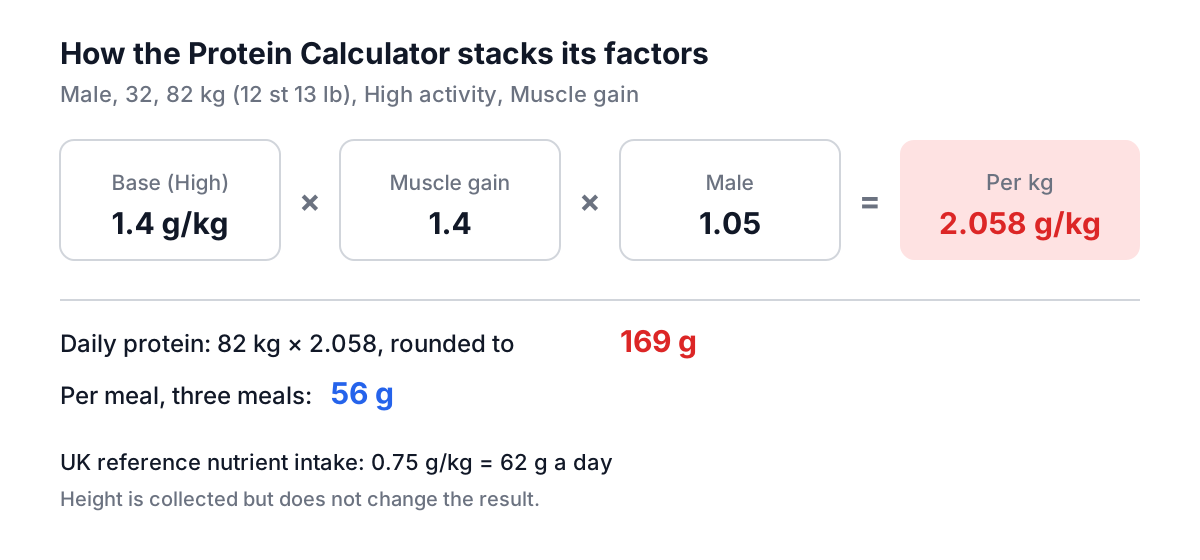
The UK government's dietary recommendations put protein at 55.5 g a day for men and 45 g for women aged 19 to 64, figures taken from the 1991 Dietary Reference Values. The UK protein calculator turns that reference into 0.75 g per kilogram of your own weight. Either way it is a floor for health, not a training target. A man of 82 kg lifting weights to build muscle gets 169 g a day from the UK protein calculator, against a reference of 62 g. This edition explains the gap, when it matters and how to fill it from ordinary British food.
It is general information. If you have chronic kidney disease or have been told to limit protein, follow your GP or renal team.
Where 55.5 g and 45 g come from
Table 2 of the Government Dietary Recommendations lists protein for adults:
| Age | Men | Women |
|---|---|---|
| 19 to 64 | 55.5 g a day | 45.0 g a day |
| 65 to 74 | 53.3 g a day | 46.5 g a day |
| 75 and over | 53.3 g a day | 46.5 g a day |
The notes give the source as the 1991 report Dietary Reference Values for Food Energy and Nutrients for the United Kingdom. Those are fixed grams for an average adult. The British Nutrition Foundation states the underlying reference nutrient intake as 0.75 g per kg of body weight a day, and the calculator's UK comparison applies that to your own weight instead: 51 g for a 68 kg woman, 60 g for an 80 kg man, 62 g for an 82 kg man.
Working in stones
Many people in the UK know their weight in stones and pounds, so convert before you multiply. A stone is 14 lb and a pound is 0.45359237 kg. 10 st 10 lb is 150 lb, which is 68.04 kg; the calculator takes the weight in pounds directly and gives the same 68 g target for a lightly active 45-year-old woman as it does for 68 kg.
What people who train need
The reference intake is about avoiding deficiency, not about building or keeping muscle. The International Society of Sports Nutrition's position stand (Jäger and colleagues, 2017) puts an overall daily intake of 1.4 to 2.0 g/kg as sufficient for most people who exercise, with 20 to 40 g at meals spread through the day. A meta-analysis by Morton and colleagues in the British Journal of Sports Medicine found the gain in lean mass from resistance training levelled off at around 1.6 g/kg a day.
The calculator builds its figure from activity, goal, sex and age:
| Who | Calculator target | UK reference (0.75 g/kg) |
|---|---|---|
| Woman, 45, 68 kg, lightly active | 68 g (23 g a meal) | 51 g |
| Woman, 52, 76 kg, moderately active, losing weight | 109 g (36 g a meal) | 57 g |
| Man, 70, 80 kg, sedentary | 74 g (25 g a meal) | 60 g |
| Man, 32, 82 kg, lifting for muscle gain | 169 g (56 g a meal) | 62 g |
The last line is 2.06 g/kg, above the point where the research shows extra benefit. At 1.6 g/kg the same man would aim for about 131 g, which gives most of the gain and is far easier to eat. Treat the calculator's figure for a heavy training goal as a ceiling, not a requirement.
Older adults
The UK figures barely change with age: 53.3 g for men and 46.5 g for women over 65 in the government table. Research points the other way. The PROT-AGE study group (Bauer and colleagues, 2013) recommended 1.0 to 1.2 g/kg for healthy people over 65, because ageing muscle responds less to the same dose. The calculator adds 10% over 65, so a sedentary 70-year-old man of 80 kg gets 74 g, against 53.3 g in the table and 60 g at 0.75 g/kg for his own weight. If you or a parent are losing weight or strength without trying, see the GP; protein and strength exercise both help, and it is worth ruling out other causes.
Losing weight
The ISSN position stand notes that higher intakes, 2.3 to 3.1 g/kg, may be needed to keep lean mass in resistance-trained people during a calorie deficit. The calculator raises protein by a fifth on a weight loss goal: a 52-year-old woman of 76 kg exercising moderately gets 109 g, about 1.44 g/kg. That is 436 kcal of protein, so fit it inside your calorie target rather than on top of it.
Reaching the target from UK food
The ISSN position stand's general recommendation per serving is 20 to 40 g, or 0.25 g of high-quality protein per kg of body weight. For the 169 g target that is four or five protein-rich meals and snacks, not three large plates.
Use the label to plan it. Where a label lists protein per 100 g, a portion's protein is the per 100 g figure times the portion weight divided by 100: a yoghurt listing 10 g per 100 g gives 15 g in a 150 g pot. Weigh your usual portions once and you will know which meals fall short.
NHS advice adds two limits worth building around. Eat at least two portions of fish a week, one of them oily, with a portion around 140 g. And if you eat more than 90 g of red or processed meat a day, cut down to 70 g, the daily average to stay under. For someone aiming at 100 g of protein or more, that means leaning on chicken, fish, eggs, dairy, beans and lentils rather than more red meat.
Frequently asked questions
How much protein does a woman need a day in the UK?
The government's figure is 45 g a day for women aged 19 to 64 and 46.5 g over 65; the British Nutrition Foundation gives the underlying reference nutrient intake as 0.75 g per kg of body weight a day for adults. Applied to your own weight, a 68 kg woman's reference is 51 g; if you train, the ISSN range of 1.4 to 2.0 g/kg is the more useful guide.
Is 0.75 g/kg enough to build muscle?
No. It is set to prevent deficiency. Sports nutrition research supports about 1.4 to 2.0 g/kg for people who train, with gains levelling off near 1.6 g/kg.
Do I need protein shakes?
Usually not. Most targets can be reached with food across three meals and a snack. A shake can help when the target is high, appetite is low or meals are hard to plan.
Is a high-protein diet safe?
For healthy adults the training ranges above are widely used. The PROT-AGE group notes that older people with severe kidney disease who are not on dialysis may need to limit protein, so anyone with kidney disease or a restricted diet should talk to their GP or a registered dietitian first.
Sources and further reading
- Government Dietary Recommendations, Public Health England. Table 2: 55.5 g and 45.0 g at 19 to 64, 53.3 g and 46.5 g from 65, from the 1991 Dietary Reference Values.
- Protein, British Nutrition Foundation. The adult reference nutrient intake of 0.75 g of protein per kg of body weight a day.
- Meat in your diet, NHS. Cut red and processed meat to a 70 g daily average.
- Fish and shellfish, NHS. At least two 140 g portions a week, one oily.
- The Eatwell Guide, Office for Health Improvement and Disparities. The five food groups.
- ISSN position stand: protein and exercise, Journal of the International Society of Sports Nutrition. Jäger and colleagues, 2017.
- Protein supplementation and resistance training: meta-analysis, British Journal of Sports Medicine. Morton and colleagues.
- Optimal dietary protein intake in older people: PROT-AGE position paper, Journal of the American Medical Directors Association. Bauer and colleagues, 2013.
More Fitness Calculators
Every tool in the Fitness Calculators section, free and in your browser.
- BMI Calculator
- Calorie Calculator
- Protein Calculator
- Hydration Calculator
- Calorie Deficit Planner
- Body Fat Calculator
- Ideal Weight Calculator
- Running Pace Calculator
- Target Heart Rate Calculator
- One Rep Max Calculator
- Barbell Plate Calculator
- RPE Calculator
- Interval Timer
- Calories Burned Calculator
- Body Surface Area Calculator
- Waist-to-Hip Ratio Calculator
- VO2 Max Calculator
- Steps to Distance & Calories Calculator