
How Much Protein Do Indians Need? ICMR RDA and Gym Targets
The ICMR-NIN RDA of 0.83 g per kg, why a cereal-heavy diet needs 1 g per kg, what training adds, and reaching the target with dal, curd, paneer and eggs.
By Redbison Dev · · 6 min read
India edition. Written for Indian readers: the ICMR-NIN 2020 RDA of 0.83 g/kg and the 1 g/kg figure for cereal-based diets, the 3:1:2.5 cereal-legume-milk pattern, the 2024 Dietary Guidelines' advice against protein supplements for muscle, and vegetarian worked examples. US edition
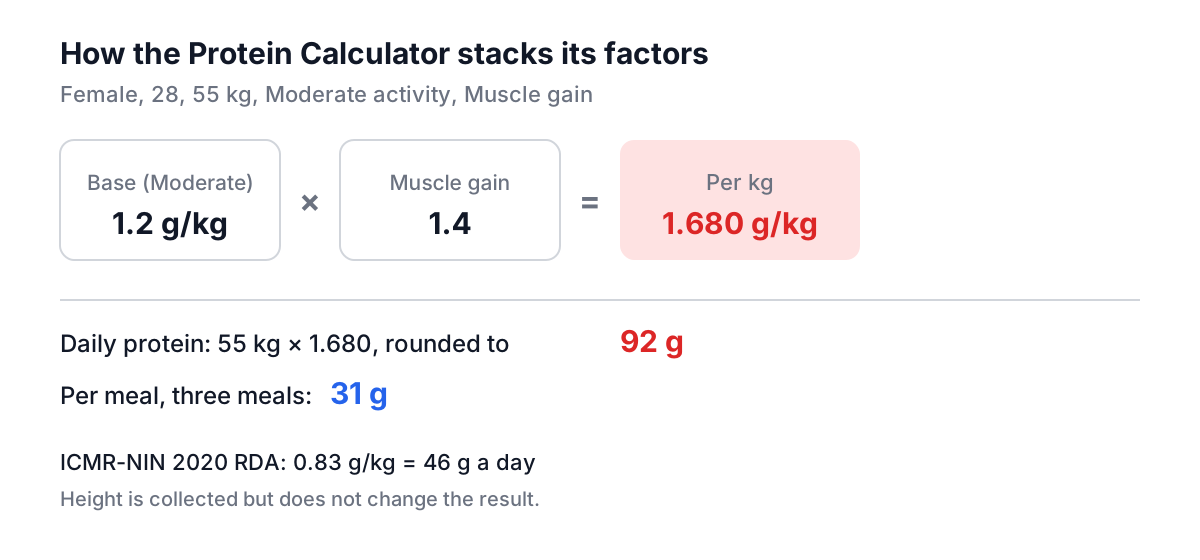
ICMR-NIN puts the protein requirement of a healthy Indian adult at 0.83 g per kilogram of body weight a day. For the reference 65 kg man that is 54 g, and for the reference 55 kg woman 45.7 g. Two things change that number in practice: a diet that is mostly rice or roti with little dal, milk or eggs, which ICMR-NIN says needs 1 g per kg instead, and training, which raises the useful intake well above any RDA. A 55 kg woman lifting three days a week gets 92 g a day from the protein calculator for India, twice her RDA. This edition explains the numbers and how to reach them from Indian food.
It is general information. People with kidney disease, diabetes with kidney involvement, or a protein restriction should follow their doctor.
What the ICMR-NIN 2020 RDA says
The ICMR-NIN expert committee's 2020 note on Nutrient Requirements for Indians explains how the figure was set. Using the median obligatory nitrogen loss, it derived an average requirement (EAR) of 0.66 g/kg a day and a safe intake (RDA) of 0.83 g/kg for healthy adults, replacing the 1 g/kg of the 2010 RDA. The new figure assumes good-quality protein, and the committee improved the reference diet's cereal-legume-milk mix to 3:1:2.5.
| Group | Reference weight | EAR | RDA |
|---|---|---|---|
| Adult man | 65 kg | 42.9 g (0.66 g/kg) | 54.0 g (0.83 g/kg) |
| Adult woman | 55 kg | 36.3 g (0.66 g/kg) | 45.7 g (0.83 g/kg) |
| Pregnancy, 2nd trimester | +9.5 g | ||
| Pregnancy, 3rd trimester | +22.0 g | ||
| Lactation, 0 to 6 months | +16.9 g |
The table carries a footnote worth reading closely: for people eating a cereal-based diet with low-quality protein, the requirement is 1 g/kg a day. The calculator's ICMR comparison uses 0.83 g/kg; if your meals are mostly cereal, read the line as 1 g/kg instead, which is 65 g for the 65 kg man.
The RDA is the same for sedentary, moderate and heavy work in the 2020 table, and the table has no separate figure for older adults. It is a floor for health, not a target for building muscle.
What training adds
The International Society of Sports Nutrition's position stand (Jäger and colleagues, 2017) says an overall intake of 1.4 to 2.0 g/kg a day is sufficient for most people who exercise to build and keep muscle, with 20 to 40 g at a meal. A meta-analysis by Morton and colleagues found that gains in fat-free mass from resistance training stopped rising beyond about 1.6 g/kg a day.
| Who | Calculator target | ICMR-NIN RDA (0.83 g/kg) |
|---|---|---|
| Man, 30, 65 kg, desk job | 55 g (18 g a meal) | 54 g |
| Man, 68, 60 kg, lightly active | 69 g (23 g a meal) | 50 g |
| Woman, 28, 55 kg, gym three days a week | 92 g (31 g a meal) | 46 g |
| Man, 25, 70 kg, training hard for muscle | 144 g (48 g a meal) | 58 g |
For the sedentary man the two figures agree. For the 70 kg man the calculator's 2.06 g/kg is above the range the research supports; 1.6 g/kg, about 112 g, gives most of the benefit and is far easier to eat. The calculator adds 10% over 65, so the 68-year-old gets 69 g; the PROT-AGE study group (Bauer and colleagues, 2013) recommended at least 1.0 to 1.2 g/kg for people over 65, because ageing muscle responds less to the same dose.
Food first: what the 2024 Dietary Guidelines say
Guideline 8 of ICMR-NIN's Dietary Guidelines for Indians (2024) is direct: obtain good-quality protein and essential amino acids through an appropriate combination of foods and avoid protein supplements to build muscle mass. Its points to register:
- combining cereals with pulses in the ratio of 3:1 improves the protein quality of a meal;
- most athletes can get the recommended protein through the right choice of foods, and protein powders are unnecessary for a normal healthy life;
- using excess protein supplements indiscriminately for long periods can affect health;
- non-vegetarians can meet their needs with fish, poultry, meat or eggs, and vegetarians with pulses, beans, peas and milk or curd.
For a vegetarian aiming at 31 g a meal, that means a pulse or dairy food at every meal rather than relying on rice and roti: dal with paneer, rajma or chana with curd, sprouts, besan chilla or soya chunks. Where a pack label gives protein per 100 g, multiply by the portion weight and divide by 100 to check a meal.
Plan it per meal
The ISSN stand's general recommendation per serving is 0.25 g of high-quality protein per kg of body weight, about 14 g for the 55 kg woman, or an absolute dose of 20 to 40 g. A day of three meals and one curd or milk snack spreads 92 g more evenly than a light breakfast and a heavy dinner.
Common mistakes
- Treating the RDA as a gym target. 0.83 g/kg prevents deficiency; it is not what training research supports.
- Using the RDA on a cereal-heavy diet. ICMR-NIN's own footnote raises it to 1 g/kg when protein quality is low.
- Reaching for powder first. The 2024 guidelines advise food combinations; a powder helps only when food cannot reach the target.
- Ignoring calories. 92 g of protein is 368 kcal; fit it inside your daily energy, not on top of it.
Frequently asked questions
How much protein does an Indian adult need per day?
ICMR-NIN's 2020 RDA is 0.83 g per kg body weight: 54 g for a 65 kg man and 45.7 g for a 55 kg woman. On a cereal-based diet with low-quality protein it is 1 g per kg.
Can vegetarians in India get enough protein without supplements?
Yes, according to the Dietary Guidelines for Indians (2024), by combining cereals and pulses (about 3:1) and adding milk or curd. Protein powders are described as unnecessary for a normal healthy life.
How much protein should I eat for the gym?
Sports nutrition research supports 1.4 to 2.0 g/kg a day, with gains levelling off near 1.6 g/kg. For a 70 kg man, 1.6 g/kg is about 112 g.
Do pregnant women need more protein?
Yes. ICMR-NIN adds 9.5 g a day in the second trimester and 22 g in the third. Follow your antenatal clinic's advice rather than a calculator.
Sources and further reading
- Nutrient Requirements for Indians: brief note on the ICMR-NIN 2020 RDA and EAR, ICMR-National Institute of Nutrition. 0.66 g/kg EAR, 0.83 g/kg RDA, 1 g/kg for cereal-based diets, 3:1:2.5 cereal-legume-milk mix, pregnancy additions.
- Dietary Guidelines for Indians (2024), ICMR-National Institute of Nutrition. Guideline 8 on protein quality and supplements.
- ISSN position stand: protein and exercise, Journal of the International Society of Sports Nutrition. Jäger and colleagues, 2017.
- Protein supplementation and resistance training: meta-analysis, British Journal of Sports Medicine. Morton and colleagues.
- Optimal dietary protein intake in older people: PROT-AGE position paper, Journal of the American Medical Directors Association. Bauer and colleagues, 2013.
More Fitness Calculators
Every tool in the Fitness Calculators section, free and in your browser.
- BMI Calculator
- Calorie Calculator
- Protein Calculator
- Hydration Calculator
- Calorie Deficit Planner
- Body Fat Calculator
- Ideal Weight Calculator
- Running Pace Calculator
- Target Heart Rate Calculator
- One Rep Max Calculator
- Barbell Plate Calculator
- RPE Calculator
- Interval Timer
- Calories Burned Calculator
- Body Surface Area Calculator
- Waist-to-Hip Ratio Calculator
- VO2 Max Calculator
- Steps to Distance & Calories Calculator