
Quarter Mile Time to kW: Estimate Power From a Timeslip
Estimate engine kW from a quarter-mile timeslip in kg and km/h, convert dyno wheel kW to flywheel kW, and see what 130 kW per tonne means on the strip.
By Redbison Dev · · 10 min read

Australia edition. Written for Australian drivers: power in kW as Australian makers quote it, mass in kg, trap speed in km/h over a 402 m quarter mile, chassis dyno figures at the wheels, and the NSW P-plate power-to-tare-mass rule. US edition
Australian spec sheets give engine power in kilowatts, scales give mass in kilograms, and a drag strip gives you elapsed time (ET) and a trap speed. Put the car's race mass and the trap speed into an empirical formula and you get an estimate of flywheel kW. A car weighing 1,530 kg with the driver that crosses the line at 172 km/h is making about 240 kW by Hale's formula. This edition works through the formulas in kg and kW, shows how to read a timeslip from a strip such as Sydney Dragway, and turns a chassis dyno sheet into flywheel kW, using the Horsepower and kW Calculator (Australia).
The formulas in kg, kW and km/h
ET and trap speed both follow the cube root of power-to-weight:
ET   = c_ET  × (W / P)^(1/3)
trap = c_mph × (P / W)^(1/3)
The constants were fitted in pounds, horsepower and mph:
| Model | ET constant | mph constant |
|---|---|---|
| Hale | 5.825 | 234 |
| Fox | 6.269 | 230 |
| Huntington | 6.290 | 224 |
The calculator converts for you: enter mass in kg and trap speed in km/h. To work Hale's version by hand in Australian units, with W in kg and P in kW:
ET    ≈ 6.87 × (kg / kW)^(1/3)
km/h  ≈ 319  × (kW / kg)^(1/3)
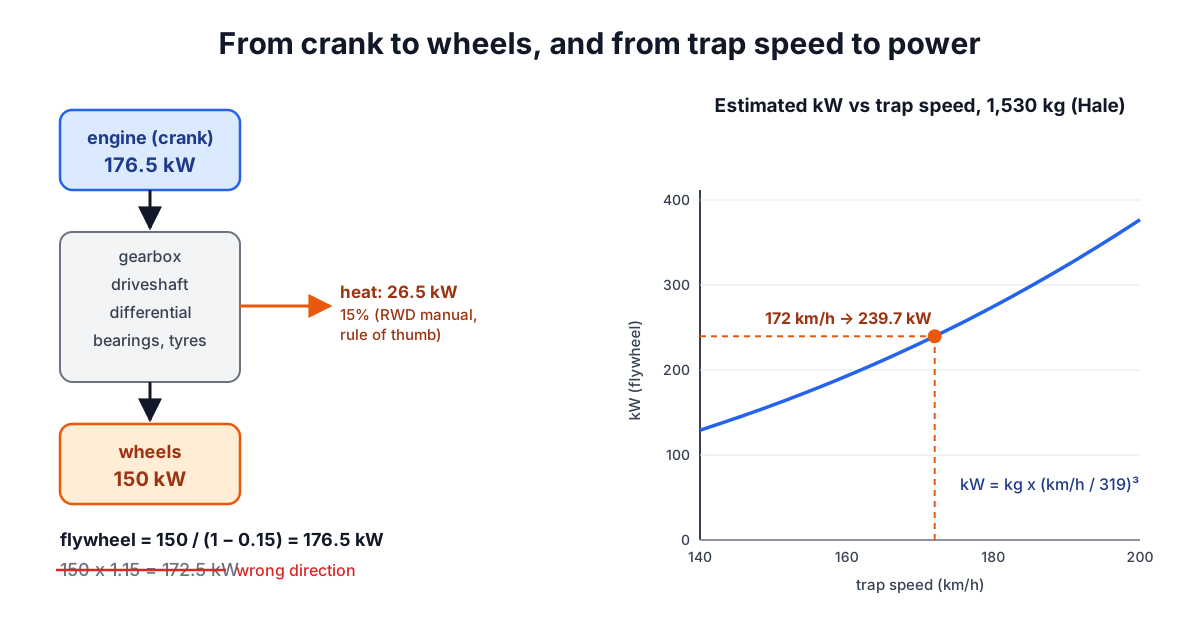
kW    ≈ kg × (km/h / 319)³
W is race mass: the car with fuel and the driver. P is flywheel power, the same basis as the manufacturer's figure, not the wheel figure from a dyno.
Reading a timeslip
For each pass, drag strip timing records the reaction time, the elapsed time and the speed. The speed is an average through a trap over the last 20 m or so before the finish line. Sydney Dragway at Eastern Creek runs a ¼ mile of 402 m and an ⅛ mile of 201 m; the formulas here are for the quarter mile only.
Use the trap speed for a power estimate. ET includes the launch, and wheelspin, a slow reaction or a bog off the line can add half a second without the engine losing any power. Trap speed reflects how hard the car is pulling at the top end, where traction no longer limits it.
Worked example: a 13.2 second pass
A sedan weighing 1,530 kg with the driver runs 13.2 seconds at 172 km/h. Entering those figures:
| Input | Hale | Fox | Huntington |
|---|---|---|---|
| 13.2 s ET | 216.2 kW (289.9 hp) | 269.4 kW | 272.2 kW |
| 172 km/h trap | 239.7 kW (321.4 hp) | 252.4 kW | 273.2 kW |
Hale's two estimates differ by about 10%, and the ET figure is the lower one, which points to a launch that lost time. The trap speed estimate of about 240 kW is the better guide to flywheel power. Notice how much more the models disagree on ET than on trap speed: the ET constants are cubed, so small differences between them become large differences in power.
What 130 kW per tonne means on the strip
In NSW, P1 and P2 drivers may not drive a high-performance vehicle, defined as one with a power to tare mass ratio greater than 130 kW per tonne. Transport for NSW uses the manufacturer's tare mass and, for a petrol or diesel car, the net engine power at the flywheel under the Australian Design Rules, rounded to the nearest kW. The ratio itself is not rounded, so 130.01 kW per tonne is over the line. Other states set their own rules.
The test is about tare mass, not race mass. Take a car rated at 183 kW with a 1,450 kg tare: 183 / 1.450 = 126.2 kW per tonne, so it is allowed. With an 80 kg driver its race mass is 1,530 kg, and Hale's formula predicts 13.95 seconds at 157 km/h. The same 1,530 kg car trapping at 172 km/h in the example above is behaving like a 240 kW car, which is a reminder that a timeslip estimate is not the figure the rule uses, in either direction. The rule uses the manufacturer's numbers, and modified engines come under separate rules.
Chassis dyno figures: divide, do not multiply
A chassis dyno sheet gives kW at the wheels. The calculator's rule-of-thumb drivetrain losses are 12% for front-wheel drive manual, 15% for rear-wheel drive manual, 18% for rear-wheel drive automatic and 22% for all-wheel drive. They are hobby estimates; the real loss depends on the gearbox, oil temperature, tyres and the dyno itself.
Loss is a fraction of flywheel power, so:
flywheel kW = wheel kW / (1 − loss)
150 kW at the wheels with a 15% loss is 150 / 0.85 = 176.5 kW at the flywheel. The shortcut 150 × 1.15 = 172.5 kW is wrong, and the error grows with the loss. Better still, compare wheel figures from the same dyno; a converted number from a different dyno is a rough guide at best.
kW, hp and PS
Australian makers quote kW. Imported marketing and older magazines use horsepower or PS. One mechanical horsepower is 745.7 W and one metric horsepower (PS) is 735.5 W:
| From | kW | hp | PS |
|---|---|---|---|
| 1 kW | 1 | 1.3410 | 1.3596 |
| 1 hp | 0.7457 | 1 | 1.0139 |
| 1 PS | 0.7355 | 0.9863 | 1 |
So 200 kW is 268.2 hp or 271.9 PS, and a 300 PS European engine is 220.6 kW.
When the estimate breaks down
- All-wheel drive with launch control. Launches better than the formulas assume, so ET overstates power; use trap speed.
- Electric cars. Strong low-speed torque and no gear changes give quick ETs for their power.
- Utes and four-wheel drives. Poor aerodynamics and tall tyres cost top-end speed, so the trap estimate reads low.
- Hot days. Thin, hot air costs a naturally aspirated engine power. Sydney Dragway sits 72 m above sea level, so altitude is not the issue there, but summer heat is.
- Motorcycles. Traction-limited for much of the run, so ET estimates are poor.
Tools for this job
- Horsepower and kW Calculator (Australia): quarter-mile mode with mass in kg and trap speed in km/h; enter 1,530 kg and 172 km/h to repeat the example, or use the wheels setting for dyno sheets.
- Torque and Power Calculator: Nm and rpm to kW.
- Gear Speed Calculator: road speed in each gear, to check the engine is near peak power through the traps.
- Background: the torque, horsepower and rpm formula and road speed from rpm, gear ratio and tyre size.
Frequently asked questions
How do I estimate kW from a quarter-mile trap speed?
Using Hale's formula in metric units, kW ≈ race mass in kg × (trap speed in km/h / 319)³. A 1,530 kg car trapping at 172 km/h works out at about 240 kW at the flywheel. The calculator does this from kg and km/h directly.
What quarter-mile time does 130 kW per tonne give?
It depends on the race mass, not the tare. A car rated at 183 kW with a 1,450 kg tare (126.2 kW per tonne) weighs about 1,530 kg with an 80 kg driver, and Hale's formula predicts 13.95 seconds at 157 km/h.
Can I use a dyno sheet to show my car is under the P-plate limit?
No. Transport for NSW uses the manufacturer's net engine power at the flywheel and the manufacturer's tare mass. A chassis dyno reads at the wheels, and its figure is not the one used.
Why do my ET and trap speed give different kW?
The ET includes the launch, so wheelspin or a slow start lowers the ET-based estimate without any loss of power. Trap speed reflects top-end power and is the better gauge.
Sources and further reading
- Prohibited vehicle definitions, Transport for NSW. High-performance vehicles over 130 kW per tonne; tare mass and ADR net engine power; rounding.
- Track facts, Sydney Dragway. ¼ mile of 402 m, ⅛ mile of 201 m, 72 m above sea level.
- NIST Guide to the SI, Appendix B.9, National Institute of Standards and Technology. Horsepower (745.7 W) and metric horsepower (735.5 W).
- On the Physics of Drag Racing, G. T. Fox, American Journal of Physics 41(3), 1973. The physical basis for the cube-root formulas.
- Drag racing, Wikipedia. Reaction time, elapsed time and the speed trap over the final 66 ft (20 m).
Open the Horsepower Calculator
More Automotive
Every tool in the Automotive section, free and in your browser.