
Quarter Mile Time to BHP: Estimate Power From a Timeslip
Turn a Santa Pod RWYB timeslip into bhp, PS and kW from weight in kg and trap speed in mph, and convert rolling road wheel figures to flywheel power.
By Redbison Dev · · 10 min read

United Kingdom edition. Written for UK drivers: weight in kg, power in bhp, PS and kW as British brochures quote it, trap speeds in mph from a Santa Pod Run What Ya Brung timeslip, and rolling road figures at the wheels. US edition
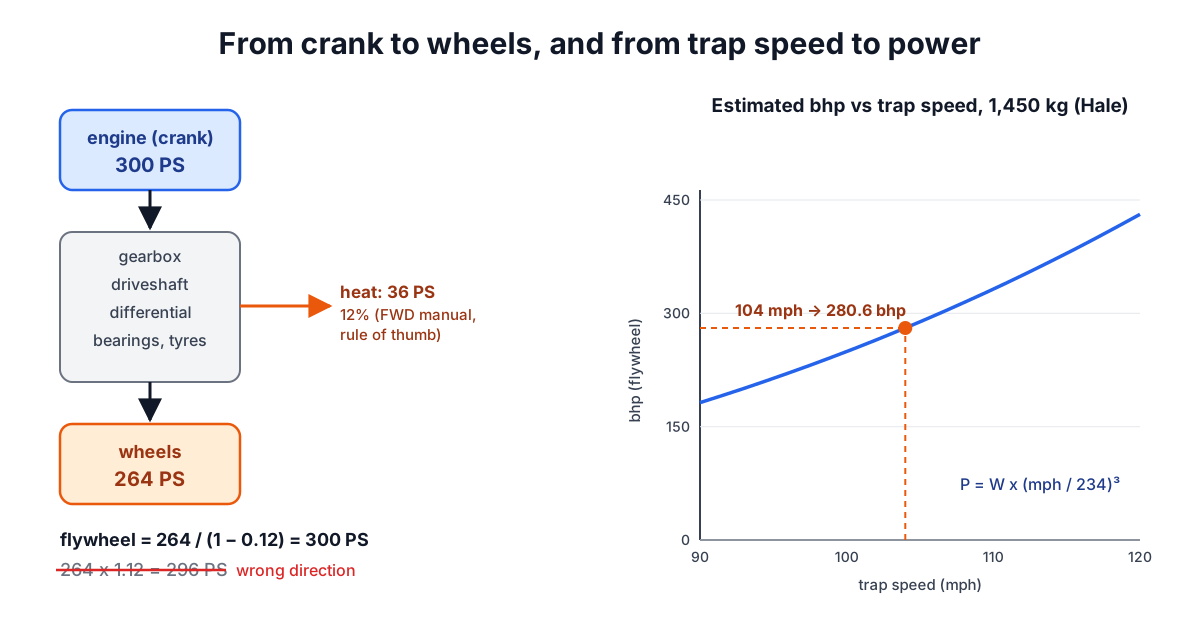
A timeslip from a public drag day is the cheapest power check you can get in Britain. At Santa Pod's Run What Ya Brung days, road cars and bikes run the quarter mile with only a valid driving licence and a helmet, and each driver gets a print-out of the run. Put the car's weight with you in it and the trap speed into an empirical formula and you have a flywheel power estimate. A 1,450 kg hot hatch with driver that crosses the line at 104 mph is making about 281 bhp (284 PS, 209 kW) by Hale's formula. This edition shows how to read a UK timeslip, convert between bhp, PS and kW, and turn a rolling road figure into flywheel power, using the BHP Calculator (UK).
The formulas, in kg and PS
Every quarter-mile formula has the same shape, because elapsed time (ET) and trap speed depend on the cube root of power-to-weight:
ET  = c_ET  × (W / P)^(1/3)
mph = c_mph × (P / W)^(1/3)
The constants were fitted in pounds and horsepower. Three sets are in use:
| Model | ET constant | mph constant |
|---|---|---|
| Hale | 5.825 | 234 |
| Fox | 6.269 | 230 |
| Huntington | 6.290 | 224 |
You do not need to convert anything: the calculator takes the weight in kg and the trap speed in mph or km/h. If you want to work it by hand in British units, Hale's constants become, with W in kg and P in PS:
ET  ≈ 7.62 × (kg / PS)^(1/3)
mph ≈ 179  × (PS / kg)^(1/3)
W is race weight: the car, the fuel in it and you. The answer is flywheel (brake) power, comparable with the manufacturer's figure, not with a rolling road reading.
Reading a Santa Pod timeslip
Drag strip timing records three things for each pass: reaction time, elapsed time (ET) and speed, the speed being the average through a trap over the last 20 m or so before the finish line. Santa Pod hands Run What Ya Brung drivers a print-out of each run. For a power estimate, trust the trap speed more than the ET.
The ET includes the launch. A front-wheel-drive car that spins its tyres off the line, a driver who short-shifts, or a cold track can add half a second without the engine making any less power. Trap speed is set by how hard the car is pulling at the top end, where traction no longer limits it, so it moves far less from run to run.
Worked example: a 300 PS hot hatch
The brochure says 300 PS. The car weighs 1,450 kg with the driver and a quarter tank. Hale's formula predicts 12.88 seconds at 105.9 mph.
On the day it runs 13.6 seconds at 104 mph. Entering 1,450 kg and each figure into the calculator's quarter-mile mode:
| Input | Hale | Fox | Huntington |
|---|---|---|---|
| 13.6 s ET | 251.2 bhp (254.7 PS) | 313.1 bhp | 316.3 bhp |
| 104 mph trap | 280.6 bhp (284.5 PS, 209.3 kW) | 295.5 bhp | 319.9 bhp |
The trap-speed estimate from Hale, 284.5 PS, is about 5% below the 300 PS brochure figure. The ET estimate is 15% lower, which is what a wheelspinning front-drive launch looks like on paper: the power is there, the car is not putting it down in the first 60 feet. The spread between the models is also wider for ET, because the ET constants are cubed.
bhp, PS and kW
UK brochures and reviews mix all three. The units are defined by NIST as follows: one mechanical horsepower is 745.7 W, and one metric horsepower (PS) is 735.5 W.
| From | bhp | PS | kW |
|---|---|---|---|
| 1 bhp | 1 | 1.0139 | 0.7457 |
| 1 PS | 0.9863 | 1 | 0.7355 |
| 1 kW | 1.3410 | 1.3596 | 1 |
So 300 PS is 295.9 bhp or 220.6 kW. In everyday British use, "bhp" means the same mechanical horsepower as the US "hp", measured at the flywheel. The PS figure is always about 1.4% bigger for the same engine, which is one reason a European brochure number looks slightly higher than a UK magazine's.
Rolling road figures: dividing, not multiplying
Many rolling roads measure at the wheels. Some print an estimated flywheel figure too, using their own loss model. If you only have the wheel figure, the calculator's rule-of-thumb losses are 12% for front-wheel drive manual, 15% for rear-wheel drive manual, 18% for rear-wheel drive automatic and 22% for all-wheel drive. These are hobby rules of thumb, not measurements.
The arithmetic trap is the direction:
flywheel = wheels / (1 − loss)
A front-wheel-drive car showing 264 PS at the wheels with a 12% loss has 264 / 0.88 = 300 PS at the flywheel. Multiplying by 1.12 gives 296 PS, which understates it, and the error grows with the loss. Compare like with like where you can: two runs on the same rolling road, on the same day, tell you more than a converted figure.
How fast is fast enough to need a cage?
Santa Pod's Run What Ya Brung rules strongly recommend a roll cage for vehicles running quicker than 12 seconds over the quarter mile, and make a suitable roll cage (minimum roll bar) mandatory for anything capable of, or that has run, quicker than 9.00. Passenger rides are only allowed in vehicles finishing at less than 130 mph.
Running the formula backwards gives a feel for those lines. For a 1,450 kg car with driver, Hale predicts a 12.0 second pass at about 366 bhp (371 PS, 273 kW) at the flywheel. A 9.00 second pass in the same car would take about 867 bhp, which is serious build territory. Real cars with good traction, launch control and four-wheel drive can beat the ET prediction, so check the rules with the track before you go.
Where the estimate is weak
- Motorcycles. Bikes are light and traction-limited for much of the run, so ET estimates are poor. For an A2 bike, the legal tests are the 35 kW cap and 0.2 kW per kg, not a timeslip.
- Electric cars. Instant torque and no gear changes give quicker ETs than the power suggests, so the ET estimate overstates power.
- Four-wheel drive with launch control. Better launches than the formulas assume, so lean on trap speed.
- Tall gearing. If the engine is past or below peak power at the line, trap speed and the estimate fall.
Tools for this job
- BHP Calculator (UK): choose quarter-mile mode, enter 1,450 kg and 104 mph to repeat the trap example, or switch to "Wheels (chassis dyno)" for rolling road figures.
- Torque and Power Calculator: torque in Nm and rpm to power.
- Gear Speed Calculator: road speed in each gear, to see whether the engine is near peak power at the traps.
- Background: the torque, horsepower and rpm formula and road speed from rpm, gear ratio and tyre size.
Frequently asked questions
How do I work out bhp from a quarter-mile time in the UK?
Enter the car's weight with you in it in kg and the trap speed in mph into Hale's formula: bhp = weight in lb × (mph / 234)³, which the calculator does from kg. A 1,450 kg car trapping at 104 mph is making about 281 bhp at the flywheel.
Why is my ET estimate lower than my trap speed estimate?
ET includes the launch. Wheelspin, a slow reaction to the lights or a cold track adds time without any loss of power, so the ET-based estimate drops. Trap speed reflects the power at the top end and is the better gauge.
How much bhp does a 1,450 kg car need for a 12 second quarter mile?
About 366 bhp (371 PS) at the flywheel by Hale's formula, with the driver included in the 1,450 kg. Traction, gearing and launch control can move the real answer either way.
Where do I get my Santa Pod timing slip?
Santa Pod says Run What Ya Brung timing slips can be collected from the signing-on office at the start line tower or online at etslips.co.uk. The calculator accepts trap speed in mph or km/h, whichever the slip shows.
Sources and further reading
- Run What Ya Brung, Santa Pod Raceway. Requirements to take part, timing slips, the 12 second roll cage recommendation, the 9.00 second mandatory cage and the 130 mph passenger limit.
- Riding a motorcycle, moped or motor tricycle: bike categories, ages and licence requirements, GOV.UK. A2 limits of 35 kW and 0.2 kW per kg.
- NIST Guide to the SI, Appendix B.9, National Institute of Standards and Technology. Horsepower (745.7 W) and metric horsepower (735.5 W).
- On the Physics of Drag Racing, G. T. Fox, American Journal of Physics 41(3), 1973. The physical basis for the cube-root formulas.
- Drag racing, Wikipedia. Reaction time, elapsed time and the speed trap over the final 66 ft (20 m).
Open the Horsepower Calculator
More Automotive
Every tool in the Automotive section, free and in your browser.