
Body Fat, Healthy Weight and Macros in Canada
Tape-measure body fat in inches and pounds, Health Canada's BMI and 102/88 cm waist cut-offs, and macros set against the Canadian DRIs.
By Redbison Dev · · 9 min read
Canada edition. Works in feet, inches and pounds as most Canadians weigh themselves, reads the results against Health Canada's body weight classification (BMI plus the 102 cm and 88 cm waist cut-offs) and checks macros against the Dietary Reference Intakes Health Canada publishes. US edition
Health Canada classifies adult weight with two measurements, not one: BMI, and a waist circumference cut-off of 102 cm (40 in) for men and 88 cm (35 in) for women. The same guideline warns that BMI may misjudge risk in highly muscular adults and in some ethnic groups, which is exactly where a body fat estimate and a waist measurement help. This guide shows how a tape-measure body fat calculator, the Canadian ideal weight calculator and the Canadian macro calculator fit around those rules, in the pounds and inches most Canadians use for their bodies.
This is general information for healthy adults. If you have diabetes, heart or kidney disease, an eating disorder, or are pregnant, ask your family doctor or a registered dietitian before you change your eating.
What Health Canada's classification actually says
The Canadian Guidelines for Body Weight Classification in Adults give the familiar BMI bands with a risk label for each:
| BMI | Classification | Risk of developing health problems |
|---|---|---|
| under 18.5 | Underweight | Increased |
| 18.5 to 24.9 | Normal weight | Least |
| 25.0 to 29.9 | Overweight | Increased |
| 30.0 to 34.9 | Obese class I | High |
| 35.0 to 39.9 | Obese class II | Very high |
| 40 or more | Obese class III | Extremely high |
On top of that, a waist of 102 cm (40 in) or more in men, or 88 cm (35 in) or more in women, marks increased risk of type 2 diabetes, coronary heart disease and hypertension. The quick reference tool also notes that the system may underestimate or overestimate risk in highly muscular adults and in certain ethnic and racial groups. In other words, the official tool tells you when to look past BMI.
Body fat with a tape, in inches
The body fat calculator uses the US Navy circumference equations, which were written in inches, so a Canadian tape measure works without conversion. Men need height, neck and waist; women add hips.
Worked example: a 200 lb man
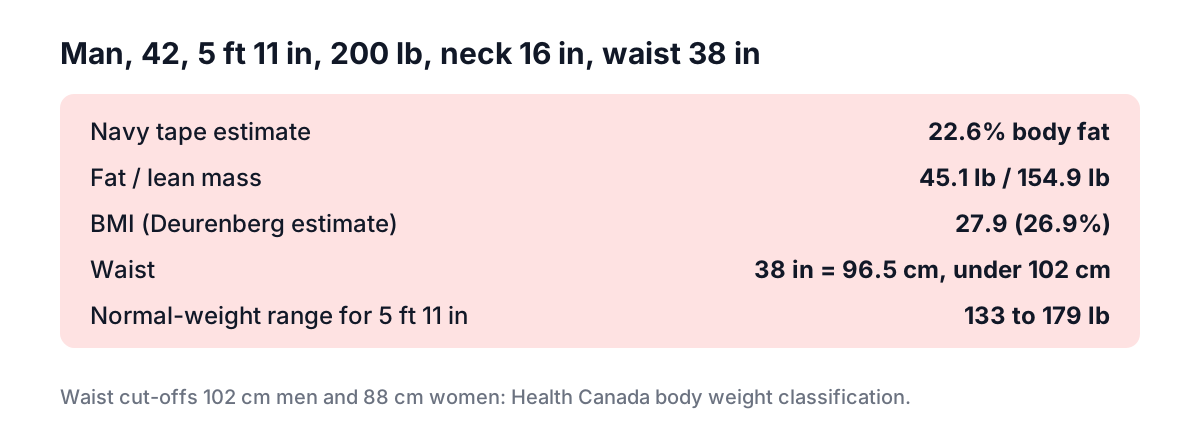
A 42-year-old man, 5 ft 11 in and 200 lb, neck 16 in, waist 38 in:
| Result | Value |
|---|---|
| Tape estimate | 22.6% body fat |
| Fat | 45.1 lb |
| Lean mass | 154.9 lb |
| BMI | 27.9 (overweight) |
| BMI-based (Deurenberg) estimate | 26.9% |
| Waist | 38 in, about 96.5 cm: under the 102 cm line |
His BMI says overweight, his waist is under Health Canada's cut-off, and the tape puts him four points leaner than a BMI-only estimate. That combination usually means a man who carries more muscle than average. The waist is still worth watching: at 38 in on a 71 in frame his waist-to-height ratio is 0.54, above the 0.5 mark that several health services use as a simple screen.
Worked example: a woman just under the waist line
A woman of 5 ft 5 in and 160 lb with a 13 in neck, 33 in waist and 41 in hips comes out at 35.9% body fat. Her BMI is 26.6 and her waist, about 83.8 cm, is under the 88 cm line. On the American Council on Exercise bands the calculator shows, 32% and up is labelled obese; those are US fitness categories, not part of the Canadian classification, so read the figure as a trend line rather than a verdict.
Getting a reliable reading
Measure in the morning, before eating, on bare skin, at the end of a normal breath out. Keep the tape level and snug without pressing in, and take each site twice. A tape pulled tighter by a centimetre at the waist moves the result by about half a point to two-thirds of a point. Home bioimpedance scales change with hydration through the day, so if you use one, weigh at the same time each morning and compare only with itself.
Healthy weight in pounds
The Canadian ideal weight calculator gives the weight range that keeps BMI between 18.5 and 24.9 for your height, beside the four classic ideal body weight formulas. For a man of 5 ft 11 in:
| Measure | Weight |
|---|---|
| Normal-weight range (BMI 18.5 to 24.9) | 133 to 179 lb |
| Hamwi (1964) | 172 lb |
| Devine (1974) | 166 lb |
| Robinson (1983) | 161 lb |
| Miller (1983) | 158 lb |
The 200 lb man in the example is 21 lb above the range, yet his tape result and waist are better than his BMI suggests. A sensible target for him is a waist under 35.5 in (half his height) and a body fat figure trending down, not a particular weight between 158 and 172 lb. The formulas were built for drug dosing and insurance tables; the range is the part tied to health outcomes.
Macros against the Canadian DRIs
Health Canada publishes Dietary Reference Intakes tables for macronutrients. For adults they set:
| Reference | Value |
|---|---|
| Protein RDA | 0.80 g per kg a day (56 g for men, 46 g for women aged 19 to 30) |
| Carbohydrate RDA | 130 g a day |
| Fibre adequate intake | 38 g (men 19 to 50), 30 g (men 51+), 25 g (women 19 to 50), 21 g (women 51+) |
| Acceptable ranges | protein 10 to 35%, fat 20 to 35%, carbohydrate 45 to 65% of energy |
Canada's food guide does not use macro percentages at all; it says to eat plenty of vegetables and fruits, whole grains and protein foods, and to choose protein foods that come from plants more often. A macro split is a way to put numbers on that when you track food in an app.
Two Canadian macro plans
A moderately active 35-year-old man of 82 kg (181 lb) and 178 cm who wants to build muscle gets 3,005 calories in the Canadian macro calculator. With protein at 1.6 g per kg and fat at 25%, that is 131 g protein, 432 g carbohydrate and 83 g fat, all inside the DRI ranges, with a fibre target of 38 g.
A lightly active 45-year-old woman of 70 kg (154 lb) and 163 cm who is losing weight gets 1,466 calories. On a high-protein 35/35/30 split that is 128 g protein and 128 g carbohydrate, and the calculator flags carbohydrate at 35% as under the 45% floor. Her DRI protein figure is 56 g (0.8 x 70 kg), so 128 g is more than double it. Protein at 25% (92 g) would leave room for carbohydrate inside the range and still give her about 1.3 g per kg.
A routine that fits Canadian units
- Measure waist, neck (and hips) in inches and weigh in pounds on the same morning.
- Compare the waist with 40 in (men) or 35 in (women), and BMI with the Health Canada bands.
- Note the tape body fat figure; re-measure every two to four weeks.
- Set calories with the Canadian calorie calculator, then protein by body weight and carbohydrate inside 45 to 65%.
- If weight drops but the waist does not, raise protein and add strength training before eating less. The Canadian calorie deficit planner sets a pace in pounds per week.
Tools for this job
- Body fat calculator: Navy tape method in inches, with fat and lean mass.
- Ideal weight calculator (Canada): the normal-weight range in pounds for your height.
- Macro calculator (Canada): grams of each macro checked against the DRI ranges and fibre targets.
- Protein calculator (Canada) and waist-to-hip ratio calculator (Canada) for the related checks.
- The Canadian TDEE guide explains the calorie target the macros start from.
Frequently asked questions
What waist size does Health Canada consider risky?
102 cm (40 in) or more for men and 88 cm (35 in) or more for women. Health Canada links waists at or above those cut-offs to increased risk of type 2 diabetes, coronary heart disease and hypertension, alongside the BMI classification.
Is BMI accurate for muscular people in Canada?
Not always. Health Canada's own quick reference tool says the classification may underestimate or overestimate health risk in highly muscular adults and in certain ethnic and racial groups. A waist measurement and a tape body fat estimate help in those cases.
How much protein does Health Canada recommend?
The RDA for adults is 0.80 g per kg of body weight a day, which is 56 g for a typical man and 46 g for a typical woman aged 19 to 30. Protein can supply 10 to 35% of energy within the acceptable range, so people who train often eat well above the RDA.
How much fibre should I aim for in Canada?
Health Canada's adequate intake is 38 g a day for men and 25 g for women aged 19 to 50, and 30 g and 21 g from age 51. Most macro plans that keep carbohydrate inside 45 to 65% make those numbers reachable with whole grains, legumes and vegetables.
Sources and further reading
- Canadian Guidelines for Body Weight Classification in Adults: quick reference tool for professionals, Health Canada. BMI bands, risk labels and the 102 cm and 88 cm waist cut-offs.
- Reference values for macronutrients: Dietary Reference Intakes tables, Health Canada. Protein RDA, carbohydrate RDA, fibre AIs and the acceptable ranges.
- Healthy eating recommendations, Health Canada (Canada's food guide).
- International Society of Sports Nutrition Position Stand: protein and exercise, Journal of the International Society of Sports Nutrition, 2017.
- The Origin of the Ideal Body Weight Equations, Annals of Pharmacotherapy. Pai and Paloucek on Hamwi, Devine, Robinson and Miller.
- Prediction of Percent Body Fat for U.S. Navy Men from Body Circumferences and Height, US Navy health research report. Hodgdon and Beckett, 1984.
More Fitness Calculators
Every tool in the Fitness Calculators section, free and in your browser.
- BMI Calculator
- Calorie Calculator
- Protein Calculator
- Hydration Calculator
- Calorie Deficit Planner
- Body Fat Calculator
- Ideal Weight Calculator
- Running Pace Calculator
- Target Heart Rate Calculator
- One Rep Max Calculator
- Barbell Plate Calculator
- RPE Calculator
- Interval Timer
- Calories Burned Calculator
- Body Surface Area Calculator
- Waist-to-Hip Ratio Calculator
- VO2 Max Calculator
- Steps to Distance & Calories Calculator