
Body Fat, Healthy Weight and Macros in Australia
Tape-measure body fat in cm and kg, the healthdirect 94 cm and 80 cm waist lines, and protein and energy targets in grams and kilojoules.
By Redbison Dev · · 9 min read
Australia edition. Works in centimetres, kilograms and kilojoules, reads results against the healthdirect waist and BMI guidance (including who it does not suit), and sets protein beside the Australian daily ranges instead of US percentages. US edition
healthdirect, the Australian Government's health information service, gives two waist lines for adults: risk is increased at 94 cm or more for men and 80 cm or more for women, and greatly increased at 102 cm and 88 cm. It also says BMI is less accurate for several groups, including Aboriginal and Torres Strait Islander peoples, Pacific Islanders, Māori, South Asian, Chinese and Japanese people. A tape measure gets around much of that, and it can also estimate body fat. This guide works through the body fat calculator, the Australian ideal weight calculator and the Australian macro calculator in centimetres, kilograms and kilojoules.
This is general information for healthy adults. If you are pregnant, have diabetes, kidney disease, an eating disorder or another condition, talk to your GP or an Accredited Practising Dietitian before changing how you eat.
Two tape measurements that do different jobs
healthdirect measures the waist halfway between your lowest rib and the top of your hipbone, roughly level with the belly button, with the tape directly on your skin (and no more than one layer of light clothing), snug without squeezing, after breathing out normally. That is the measurement to compare with the 94 cm and 80 cm lines.
| Waist | Men | Women |
|---|---|---|
| Increased risk | 94 cm or more | 80 cm or more |
| Greatly increased risk | 102 cm or more | 88 cm or more |
healthdirect adds that these waist figures do not apply to people from certain non-European backgrounds, who may have a different body shape. For them a GP can advise what to aim for.
The body fat calculator uses the US Navy tape equations. For men they use the waist at the navel and the neck below the larynx; for women the narrowest part of the waist, the neck and the widest part of the hips. Take both sets of measurements on the same morning and keep each one consistent from week to week.
Body fat from the tape
Worked example: a man over the 94 cm line
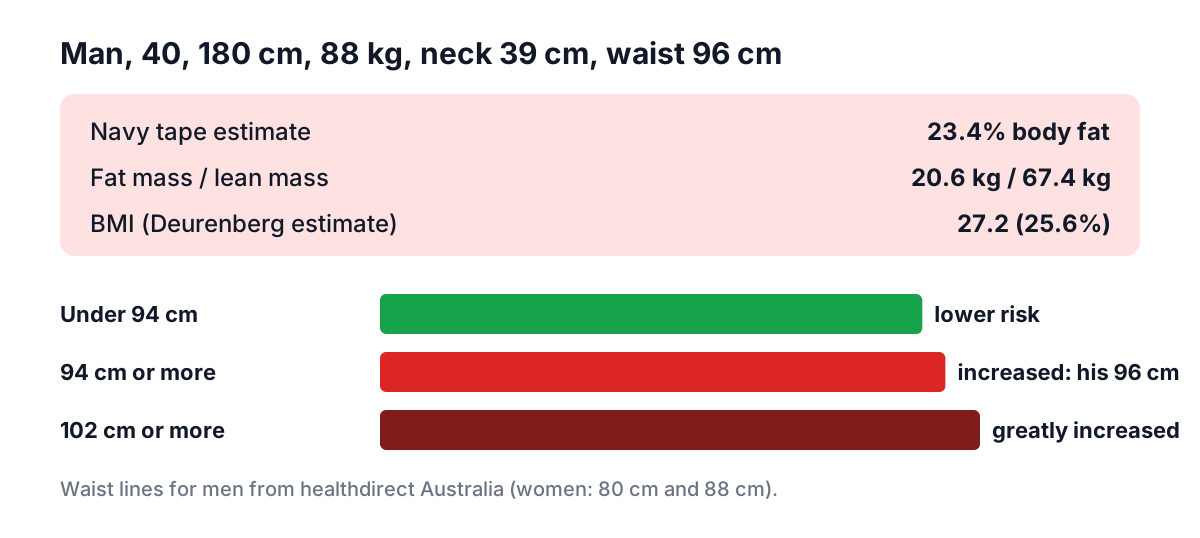
A 40-year-old man, 180 cm and 88 kg, neck 39 cm, waist 96 cm:
| Result | Value |
|---|---|
| Tape estimate | 23.4% body fat ("average" on the ACE bands) |
| Fat mass | 20.6 kg |
| Lean mass | 67.4 kg |
| BMI | 27.2 (overweight) |
| BMI-based (Deurenberg) estimate | 25.6% |
| Waist | 96 cm: increased risk on the healthdirect lines |
Taking a little over 2 cm off his waist, to under 94 cm, would take him out of healthdirect's increased-risk band. That is a smaller and more useful goal than a body weight, and it is the change the tape body fat figure follows most closely.
Worked example: a woman at BMI 25
A woman of 165 cm and 68 kg with a 33 cm neck, 82 cm waist and 100 cm hips comes out at 33.2% body fat, and her BMI is 25.0, the first point of overweight. Her waist is 2 cm over the 80 cm line. The calculator labels 33.2% as "obese" on the American Council on Exercise bands, which start at 32% for women; those are US fitness categories rather than Australian guidance, so the waist reading is the one to act on.
How far to trust the number
A tape estimate's strength is repeatability: same tape, same time, same spot. Bioimpedance readings move with how much you have drunk, so if you use one, use it at the same time each morning.
Healthy weight for your height
The Australian ideal weight calculator gives the weight range for a BMI of 18.5 to 24.9, which healthdirect calls the healthy weight range, and the four classic ideal body weight formulas for comparison. For a woman of 165 cm:
| Measure | Weight |
|---|---|
| Healthy weight range (BMI 18.5 to 24.9) | 50.4 to 67.8 kg |
| Hamwi | 56.6 kg |
| Devine | 56.9 kg |
| Robinson | 57.4 kg |
| Miller | 59.8 kg |
The woman in the example sits 0.2 kg above the top of that range, which is well inside the error of a bathroom scale. Her waist matters more than the 200 g. The formulas date from 1964 to 1983 and were made for dosing medicines; read them as landmarks inside the range rather than targets. If BMI is known to be less accurate for your background, lean on the waist and the tape result.
Protein and energy the Australian way
healthdirect gives protein as grams a day for adults, from the Nutrient Reference Values:
| Age | Men | Women |
|---|---|---|
| 19 to 70 | 52 to 64 g | 37 to 46 g |
| Over 70 | 65 to 81 g | 46 to 57 g |
It also suggests aiming for 10 to 35% of daily energy from protein, and warns against taking too much from supplements without a doctor's or dietitian's advice. Energy on Australian labels is in kilojoules; healthdirect puts the average adult at about 8,700 kJ a day and uses 4.2 kJ per kilocalorie. The calculator converts with the exact 4.184.
Worked example: maintaining weight
A moderately active 32-year-old woman of 65 kg and 166 cm needs about 8,860 kJ (2,118 kcal) a day in the Australian macro calculator. On the balanced 25/45/30 split:
| Macro | Grams | Energy |
|---|---|---|
| Protein | 132 g | 25% |
| Carbohydrate | 238 g | 45% |
| Fat | 71 g | 30% |
132 g of protein is about three times the top of the healthdirect range for her age, and still inside the 10 to 35% energy share. The two figures answer different questions: the gram range covers basic needs, the percentage range is the outer limit of a sensible diet.
Worked example: losing weight with protein by the kilo
A lightly active 40-year-old man of 90 kg and 180 cm who wants to lose weight gets about 8,420 kJ (2,013 kcal). Protein at 1.6 g per kg is 144 g, 28.6% of energy, with no flag. Push it to 2.4 g per kg and protein becomes 216 g, 42.9% of energy, and the calculator flags it as over the 35% limit. In a deficit a fixed protein amount takes a bigger share of fewer kilojoules, so a gram target that looked modest can cross the line.
A routine in metric
- Measure your waist the healthdirect way and compare it with 94 cm or 80 cm.
- Take the Navy tape measurements and record the body fat estimate.
- Check your weight against the healthy range for your height, remembering who BMI suits less well.
- Set energy in kJ with the Australian calorie calculator, then protein by body weight inside 10 to 35% of energy.
- Re-measure every two to four weeks. If the scale falls but the waist does not, add strength work and protein before cutting more kilojoules. The Australian calorie deficit planner gives a daily kJ target for a steady pace.
Tools for this job
- Body fat calculator: tape estimate in centimetres with fat and lean mass in kilograms.
- Ideal weight calculator (Australia): the healthy weight range for your height.
- Macro calculator (Australia): grams and kilojoules, with the protein share checked against 10 to 35%.
- Protein calculator (Australia) and BMI calculator (Australia) for the related checks.
- The Australian BMI guide and TDEE guide go further on BMI limits and energy needs.
Frequently asked questions
What is a healthy waist measurement in Australia?
Under 94 cm for men and under 80 cm for women. healthdirect says risk is increased from those points and greatly increased from 102 cm for men and 88 cm for women, and notes that the figures do not apply to some non-European backgrounds.
How much protein do I need a day in Australia?
healthdirect gives 52 to 64 g for men and 37 to 46 g for women aged 19 to 70, rising to 65 to 81 g and 46 to 57 g over 70, with 10 to 35% of daily energy from protein as a sensible range. People who do regular resistance training often eat more, within that energy share.
How do I convert calories to kilojoules?
Multiply kilocalories by 4.2 for a quick figure, as healthdirect does, or by 4.184 for the exact factor. 2,000 kcal is 8,368 kJ exactly, or 8,400 kJ by the quick rule.
Is BMI accurate for Aboriginal and Torres Strait Islander people?
healthdirect says BMI is less accurate for Aboriginal and Torres Strait Islander peoples, Pacific Islanders, Māori, South Asian, Chinese and Japanese people. Waist measurement and a conversation with a GP or Aboriginal health worker are better guides for those groups.
Sources and further reading
- Body mass index (BMI) and waist circumference, healthdirect Australia. BMI bands, waist lines, how to measure and who BMI suits less well.
- Protein, healthdirect Australia. Daily grams by age and sex and the 10 to 35% energy range.
- Kilojoules, healthdirect Australia. The 8,700 kJ average and 4.2 kJ per kilocalorie.
- International Society of Sports Nutrition Position Stand: protein and exercise, Journal of the International Society of Sports Nutrition, 2017.
- The Origin of the Ideal Body Weight Equations, Annals of Pharmacotherapy. Pai and Paloucek.
- Prediction of Percent Body Fat for U.S. Navy Men from Body Circumferences and Height, US Navy health research report. Hodgdon and Beckett, 1984.
More Fitness Calculators
Every tool in the Fitness Calculators section, free and in your browser.
- BMI Calculator
- Calorie Calculator
- Protein Calculator
- Hydration Calculator
- Calorie Deficit Planner
- Body Fat Calculator
- Ideal Weight Calculator
- Running Pace Calculator
- Target Heart Rate Calculator
- One Rep Max Calculator
- Barbell Plate Calculator
- RPE Calculator
- Interval Timer
- Calories Burned Calculator
- Body Surface Area Calculator
- Waist-to-Hip Ratio Calculator
- VO2 Max Calculator
- Steps to Distance & Calories Calculator