
Body Fat, Ideal Weight and Macros for Indians
Body fat by tape in cm and kg, Asian Indian BMI and waist cut-offs from ICMR-INDIAB, and protein set against the ICMR-NIN 0.83 g per kg RDA.
By Redbison Dev · · 9 min read
India edition. Uses the Asian Indian cut-offs (BMI 23 and 25, waist 90 cm for men and 80 cm for women) from the ICMR-INDIAB study, ICMR-NIN 2020 protein and fat figures, and the Dietary Guidelines for Indians, with height in feet or cm and weight in kg. US edition
A 35-year-old man in Pune who is 170 cm tall and weighs 72 kg has a BMI of 24.9. The WHO chart says normal. The cut-offs used for Indians in the ICMR-INDIAB study say overweight, and if his waist is 92 cm, abdominal obesity as well. For Indian readers the question "am I a healthy weight?" has a different answer from the one most websites give, and body composition is the reason. This guide works through the body fat calculator for Indians, the ideal weight calculator for Indians and a macro split, with the Indian cut-offs and ICMR-NIN figures throughout.
It is general information for healthy adults. If you have diabetes, high blood pressure, thyroid or kidney disease, or are pregnant, take your doctor's or a registered dietitian's advice over any calculator.
Why the Indian cut-offs are lower
The ICMR-NIN expert group that set the 2020 nutrient requirements for Indians notes that body composition among Indians includes relatively more fat, and found that international BMR equations, fitted on a dataset that included young and muscular subjects, overestimate the BMR of Indians by 10 to 12%. More fat at the same weight means more risk at the same BMI.
That is why the ICMR-INDIAB study, which surveyed urban and rural adults in Tamil Nadu, Maharashtra, Jharkhand and Chandigarh, used the WHO Asia-Pacific cut-offs:
| Measure | Cut-off used for Indians | General cut-off elsewhere |
|---|---|---|
| Overweight | BMI 23 to 24.9 | BMI 25 to 29.9 (WHO) |
| Generalised obesity | BMI 25 or more | BMI 30 or more (WHO) |
| Abdominal obesity, men | waist 90 cm or more | 102 cm (Health Canada) |
| Abdominal obesity, women | waist 80 cm or more | 88 cm (Health Canada) |
The study found generalised obesity in 24.6% of adults in Tamil Nadu and 31.3% in Chandigarh, and abdominal obesity in 26.6% and 36.1%, and extrapolated to about 135 million Indians with generalised obesity and 153 million with abdominal obesity from the three states it covered.
Body fat with a tape and a weighing scale
The body fat calculator uses the US Navy tape method in centimetres: height, neck and waist for men, plus hips for women. It also shows a BMI-based estimate (Deurenberg's formula, from BMI, age and sex) for comparison.
Worked example: a man at BMI 24.9
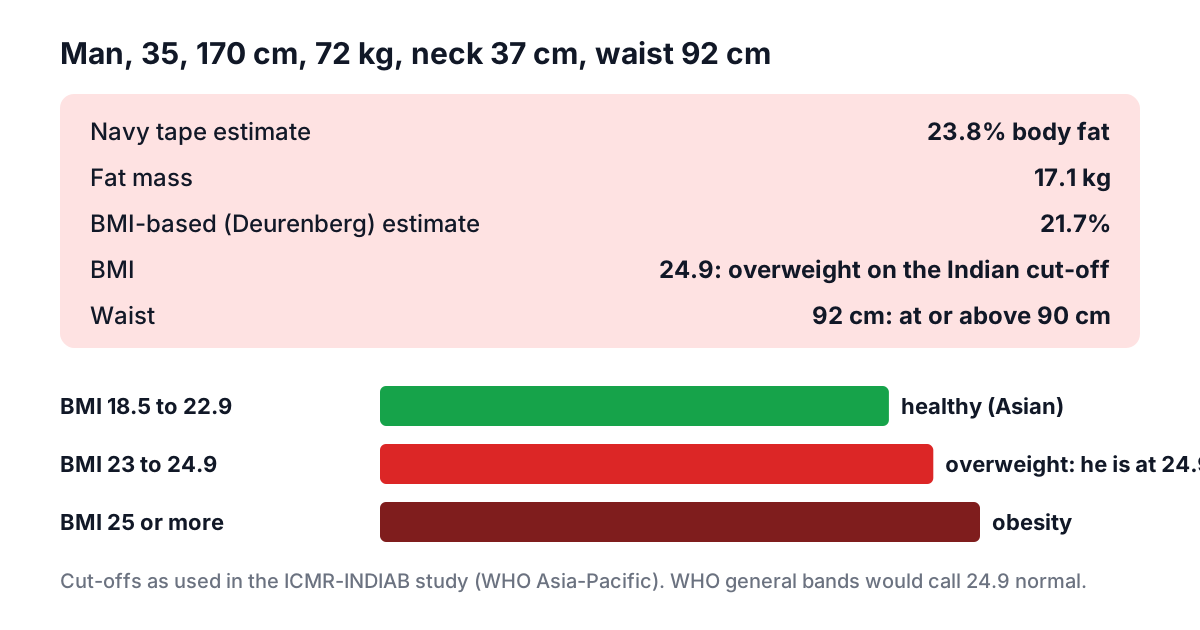
Male, 35, 170 cm, 72 kg, neck 37 cm, waist 92 cm:
| Result | Value |
|---|---|
| Tape estimate | 23.8% body fat |
| Fat mass | 17.1 kg |
| BMI-based estimate | 21.7% |
| BMI | 24.9: normal on WHO, overweight on the Indian cut-off |
| Waist | 92 cm: above the 90 cm line for abdominal obesity |
| Waist-to-height | 0.54 |
The tape reads two points higher than the BMI-based estimate. That gap is what you would expect if he carries more fat than a European of the same BMI, which is the pattern ICMR-NIN describes. The practical target is the waist: bringing it under 90 cm matters more than a particular weight.
Worked example: a woman at BMI 24
Female, 32, 158 cm, 60 kg, neck 32 cm, waist 80 cm, hips 98 cm: the tape gives 33.5% body fat against a BMI-based 30.8%. Her BMI of 24.0 is overweight on the Indian cut-off, and her waist sits exactly on the 80 cm line. Nothing on a WHO chart would flag her.
Measure in the morning before breakfast, tape level on bare skin, at the end of a normal breath out, and take two readings at each site. Body fat machines at gyms and pharmacies use bioimpedance and swing with water intake; use one method and compare it only with itself.
Ideal weight: which range to aim for
Many Indians give their height in feet and inches, so the ideal weight calculator takes either and shows two healthy ranges: the WHO band (BMI 18.5 to 24.9) and the Asian band that stops at 22.9, just below the overweight line of 23.
| Height | WHO range | Asian range | Four formulas (Hamwi to Miller) |
|---|---|---|---|
| 5 ft 2 in woman | 45.9 to 61.8 kg | 45.9 to 56.8 kg | 49.9 to 55.8 kg |
| 5 ft 8 in man | 55.2 to 74.3 kg | 55.2 to 68.3 kg | 67.2 to 69.9 kg |
Look at the 5 ft 8 in man. The classic formulas give 67.2 to 69.9 kg, and two of them (Hamwi at 69.9 kg and Devine at 68.4 kg) sit above the top of the Asian range. Those formulas were written in the US for drug dosing and insurance tables; for an Indian man of that height, 68 kg is already the upper edge, not the middle. For the 5 ft 2 in woman the formulas fall inside the Asian range, but the WHO range would let her reach 61.8 kg before anything looked wrong.
Protein and fat: the ICMR-NIN numbers
The 2020 ICMR-NIN requirements set the protein RDA for healthy adults at 0.83 g per kg of body weight a day, down from the earlier 1 g per kg, based on high-quality protein. For people eating a cereal-based diet with lower-quality protein, the note keeps 1 g per kg. The reference adults are a 65 kg man (54 g a day) and a 55 kg woman (45.7 g a day).
| Person | Weight | ICMR-NIN RDA (0.83 g/kg) |
|---|---|---|
| Reference man | 65 kg | 54.0 g |
| Reference woman | 55 kg | 45.7 g |
| Man in the example | 72 kg | 59.8 g |
| Woman in the example | 60 kg | 49.8 g |
The Dietary Guidelines for Indians (2024) add two points in Guideline 8: get good-quality protein by combining foods, for example cereals and pulses in a ratio of about 3:1, and avoid protein supplements to build muscle, because protein powders are unnecessary for normal healthy life and excess intake over long periods can affect health. People who lift weights often aim higher than the RDA; the International Society of Sports Nutrition gives 1.4 to 2.0 g per kg for people who exercise. That is a sports range, not an Indian national recommendation.
On fat, ICMR-NIN limits visible fat (cooking oil, ghee, butter) to 20 to 50 g a day depending on energy need, with not more than 27 g for a 2,000 kcal diet.
A macro split for the man in the example
Lightly active and maintaining weight, the 72 kg man needs about 2,217 kcal (Mifflin-St Jeor with a 1.375 activity factor). In the base macro calculator, protein at 1.2 g per kg and fat at 25% gives:
| Macro | Grams | Share of energy |
|---|---|---|
| Protein | 86 g | 15.6% |
| Fat | 62 g | 25% |
| Carbohydrate | 329 g | 59.4% |
That protein is about 1.4 times his ICMR-NIN RDA and reachable from dal, curd, paneer, eggs or chicken without powders. Scaling the 27 g per 2,000 kcal visible-fat figure to his 2,217 kcal gives about 30 g of cooking fat, so most of the 62 g of fat has to come from what is already in the food: milk, nuts, paneer, meat. Counting the oil in the kadhai is where most plans go wrong.
Keep in mind the ICMR-NIN finding that international equations overestimate Indian BMR. If your weight creeps up at the calculator's maintenance figure, your real need is lower, and the calorie calculator for India and the Indian TDEE guide show how to adjust.
Putting it together
- Measure waist, neck (and hips for women), height and weight on the same morning.
- Check BMI against 23 and 25, and waist against 90 cm or 80 cm. The waist decides more than the scale.
- Record the tape body fat figure and re-measure every two to four weeks.
- Set protein from body weight: the RDA of 0.83 g per kg as a floor, more if you train.
- Watch visible fat and refined foods, and walk briskly for 30 to 45 minutes a day, as the Dietary Guidelines for Indians suggest.
Tools for this job
- Body fat calculator for Indians: tape method in cm with fat and lean mass in kg.
- Ideal weight calculator for Indians: WHO and Asian healthy ranges for your height.
- Protein calculator (India): grams a day against the ICMR-NIN RDA.
- BMI calculator (India) and waist-to-hip ratio calculator (India) for the screening numbers.
- The BMI guide for Indians goes further into the Asian cut-offs.
Frequently asked questions
What is a healthy BMI for Indians?
18.5 to 22.9. The ICMR-INDIAB study, following the WHO Asia-Pacific cut-offs, treats 23 to 24.9 as overweight and 25 or more as obesity for both men and women, lower than the WHO general cut-offs of 25 and 30.
What waist size is too much for Indian men and women?
A waist of 90 cm or more in men and 80 cm or more in women was the definition of abdominal obesity in the ICMR-INDIAB study. In inches that is about 35.4 in and 31.5 in.
How much protein should an Indian adult eat per day?
The ICMR-NIN 2020 RDA is 0.83 g per kg of body weight, about 54 g for a 65 kg man and 46 g for a 55 kg woman. For a cereal-based diet with lower-quality protein the note keeps 1 g per kg. People who train usually eat more, from food rather than supplements, as the Dietary Guidelines for Indians advise.
Why does my tape body fat come out higher than the BMI estimate?
The BMI-based formula was fitted mostly on European adults and cannot see fat distribution. Indians tend to carry relatively more fat at a given BMI, so the tape, which looks at the waist, often reads higher. When the two disagree, trust the waist measurement.
Sources and further reading
- Prevalence of generalized and abdominal obesity in urban and rural India: the ICMR-INDIAB study, Indian Journal of Medical Research, 2015. Pradeepa, Anjana, Joshi and colleagues: cut-offs and prevalence by state.
- Nutrient Requirements for Indians 2020: brief note, ICMR-National Institute of Nutrition. Protein RDA 0.83 g/kg, reference weights, energy and visible fat.
- Dietary Guidelines for Indians (2024), ICMR-National Institute of Nutrition. Guidelines 8 to 10 on protein, weight and activity.
- International Society of Sports Nutrition Position Stand: protein and exercise, Journal of the International Society of Sports Nutrition, 2017.
- Canadian Guidelines for Body Weight Classification in Adults: quick reference tool, Health Canada. The 102 cm and 88 cm waist cut-offs used for comparison.
- Body mass index as a measure of body fatness: age- and sex-specific prediction formulas, British Journal of Nutrition, 1991. Deurenberg and colleagues.
- Prediction of Percent Body Fat for U.S. Navy Men from Body Circumferences and Height, US Navy health research report. Hodgdon and Beckett, 1984.
More Fitness Calculators
Every tool in the Fitness Calculators section, free and in your browser.
- BMI Calculator
- Calorie Calculator
- Protein Calculator
- Hydration Calculator
- Calorie Deficit Planner
- Body Fat Calculator
- Ideal Weight Calculator
- Running Pace Calculator
- Target Heart Rate Calculator
- One Rep Max Calculator
- Barbell Plate Calculator
- RPE Calculator
- Interval Timer
- Calories Burned Calculator
- Body Surface Area Calculator
- Waist-to-Hip Ratio Calculator
- VO2 Max Calculator
- Steps to Distance & Calories Calculator