
Founder Dilution in Canada: Option Pool and CCPC Status
How a Canadian start-up cap table moves from an angel seed to US-led Series A and B rounds in CA$, what the option pool costs, and when CCPC status is at risk.
By Redbison Dev · · 10 min read

Canada edition. Written for Canadian founders: Canadian dollars, a Canadian angel seed followed by US-led rounds, the option pool shuffle, and the CRA rules that make CCPC status matter for employee stock options and founders' QSBC shares. US edition
Two Canadian founders who start at 45% each, raise a CA$2.5 million angel seed, a CA$12 million Series A from a US fund and a CA$60 million Series B led by a US growth fund end with 14.44% each, fully diluted. By then the two US funds hold 48.70% fully diluted but 56.74% of the issued shares, and that second figure is the one that can end the company's status as a Canadian-controlled private corporation (CCPC). The Canadian version of the Cap Table Calculator opens on this path. This guide walks through each round with its numbers, shows what each option pool top-up costs, and explains why a Canadian cap table needs a second column that a US one does not.
The starting cap table
The founders hold 4,500,000 common shares each and reserve 1,000,000 for an option pool. "Fully diluted" counts every issued share, every option granted and the unallocated pool, which is how term sheets price the company.
| Holder | Shares | Fully diluted |
|---|---|---|
| Founder A | 4,500,000 | 45.00% |
| Founder B | 4,500,000 | 45.00% |
| Unallocated option pool | 1,000,000 | 10.00% |
| Total | 10,000,000 | 100.00% |
Round by round
Every priced round sets one number, the price per share: the pre-money divided by the fully diluted shares before the money, including any new pool shares the term sheet puts in the pre-money. New investor shares are the investment divided by that price.
Seed. Canadian angels invest CA$2,500,000 at a CA$10,000,000 pre-money with a 10% pool after the round. The existing pool would be only 7.78% afterwards, so 285,714 new pool shares come first. The price is CA$0.9722, the angels get 2,571,429 shares (20.00%), the founders fall to 35.00% each, and the effective pre-money is CA$9,722,222.
Series A. After granting 500,000 options, a US fund invests CA$12,000,000 at CA$36,000,000 pre with a 12% pool. The calculator adds 1,513,605 pool shares and prices the round at CA$2.5051. The US fund gets 4,790,249 shares, exactly 25.00%.
Series B. After 800,000 more grants, a US growth fund invests CA$50,000,000 and the Series A fund CA$10,000,000 of pro rata at CA$120,000,000 pre with a 10% pool. That needs 1,617,447 new pool shares at CA$5.7752 a share.
| Holder | After seed | After Series A | After Series B |
|---|---|---|---|
| Founder A | 35.00% | 23.49% | 14.44% |
| Founder B | 35.00% | 23.49% | 14.44% |
| Unallocated option pool | 10.00% | 12.00% | 10.00% |
| Options granted | 0.00% | 2.61% | 4.17% |
| Canadian angels | 20.00% | 13.42% | 8.25% |
| US fund | 25.00% | 20.92% | |
| US growth fund | 27.78% | ||
| Fully diluted shares | 12,857,143 | 19,160,998 | 31,167,667 |
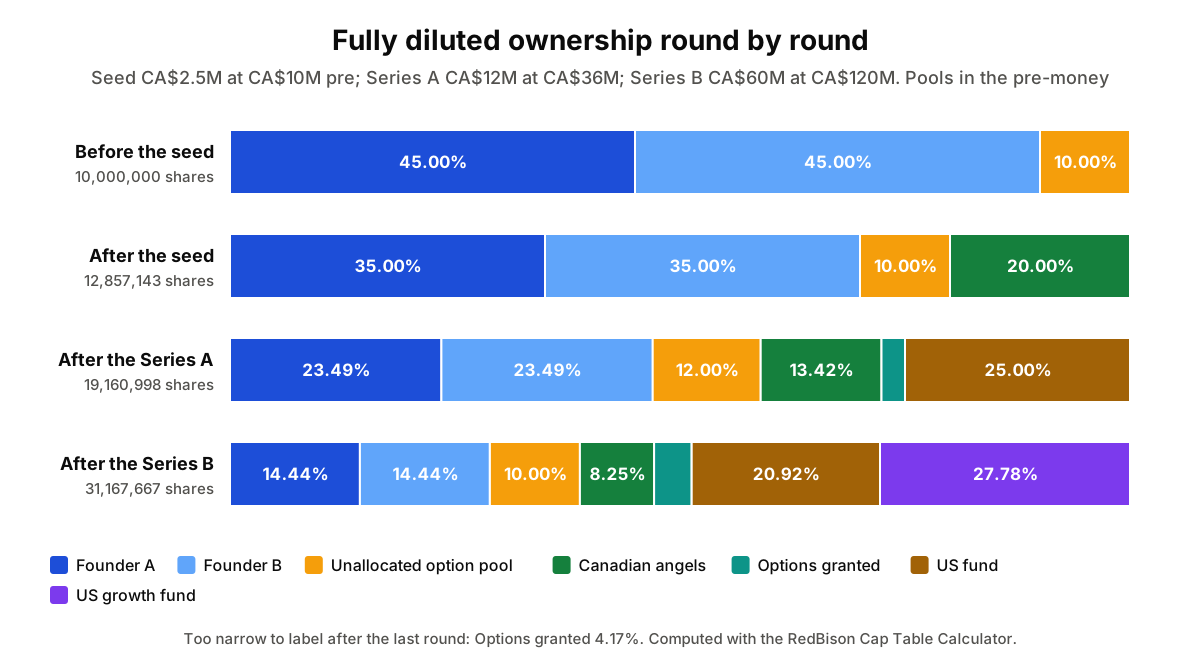
Each founder gives up 67.92% of the starting stake over three rounds. In dollars, though, each founder's 4,500,000 shares are worth CA$4,375,000 at the seed price, CA$11,272,899 at the Series A price and CA$25,988,471 at the Series B price. Dilution reduces your share; a lower price per share is what reduces its value.
What the pool costs at each round
The Canadian Option Pool Shuffle Calculator prices each top-up on its own. Give it each round's pre-money, investment, shares before the round and unallocated pool:
| Round | New pool shares | Effective pre-money | Existing holders keep (pool in pre / after) | Counter-offer headline |
|---|---|---|---|---|
| Seed | 285,714 | CA$9,722,222 | 70.00% / 70.43% | CA$10,277,778 |
| Series A | 1,513,605 | CA$32,208,284 | 63.00% / 64.94% | CA$40,045,455 |
| Series B | 1,617,447 | CA$110,658,895 | 56.67% / 58.35% | CA$129,566,864 |
At the Series A, CA$3,791,716 of the CA$36 million headline pays for pool shares nobody holds yet. The whole 12% post-round pool is worth CA$5,760,000, so the pre-money excluding the whole pool is CA$30,240,000. Quote one figure or the other, and do not subtract the old pool twice. The counter-offer column is the headline that, with the same pool in the pre-money, would leave the existing shares priced at the original figure.
The Canadian column: who controls the company
Why CCPC status matters
The CRA's capital gains guide defines a CCPC as a private corporation that is a Canadian corporation, other than one controlled by non-residents or public corporations, one that would be controlled by one person if all the shares held by non-residents and public corporations were attributed to that person, or one with a class of shares listed on a designated stock exchange. Two things ride on it:
- Employee stock options. If the employer is a CCPC you deal with at arm's length, the CRA lets you report the security option benefit in the year you sell the shares, not the year you exercise. For other employers the benefit is generally reported in the year of exercise, which can mean tax on shares you cannot sell yet. The deferral depends on the company being a CCPC when the option agreement was made, so grants made before control passes keep it.
- Founders' shares. Qualified small business corporation shares must be in a CCPC. The CRA's line 25400 page shows a lifetime capital gains exemption of CA$1,250,000 for dispositions after June 24, 2024 and, under proposed changes, for 2025.
Reading control from the cap table
Control follows votes, not fully diluted percentages. Options and the unallocated pool carry no votes, and preferred shares vote only if their terms say so. After the Series B, the calculator shows the two US funds at 48.70% fully diluted. On issued shares alone they hold 15,179,471 of 26,750,900, or 56.74%. If those shares carry the votes, non-residents would control the company after this round. After the Series A, one US fund at 25.00% does not.
That makes the Series B the round to take to a lawyer and accountant before closing, together with the grant schedule: options granted while the company is still a CCPC keep the deferral.
The CA$200,000 limit does not apply to start-ups
The CRA's T4130 guide applies the CA$200,000 annual vesting limit on the 110(1)(d) stock option deduction only to employers that are not CCPCs and have, or belong to a group with, gross revenues over CA$500 million, for options granted on or after July 1, 2021. A start-up that loses CCPC status stays outside the limit while its group revenue is CA$500 million or less.
This is planning arithmetic, not legal or tax advice. Control for tax purposes includes rules on related persons, voting agreements and options to acquire shares that this table does not apply.
Tools for this job
- Cap Table Calculator (Canada): every holder through each round, with the dilution table.
- Option Pool Shuffle Calculator (Canada): one round's pool top-up, effective pre-money and counter-offer.
- Co-founder Equity Split (Canada): the founders' split and the pool before the first round.
- Percentage Calculator: check a holder's stake by hand.
The Canadian guide to splitting co-founder equity covers a non-resident co-founder and vesting, and the US edition of this guide covers post-money SAFEs.
Frequently asked questions
Can a US venture fund make my company lose CCPC status?
It can if non-residents end up controlling the company. In the example, the US funds hold 56.74% of the issued shares after the Series B. Whether that is control depends on their voting rights and any agreements, so get advice before the round closes.
How are stock options taxed if my employer is a CCPC?
If you deal with the CCPC at arm's length, the CRA says you report the taxable benefit in the year you sell the shares, and you may be able to deduct part of it. For other employers it is generally reported in the year you exercise.
What does the option pool top-up cost at a Series A?
Here, 1,513,605 new pool shares worth CA$3,791,716 sit inside a CA$36 million pre-money, so the effective pre-money is CA$32,208,284. Existing holders keep 63.00% instead of 64.94% with the pool added after the round.
Should I count options when checking control?
No. Control follows voting shares. Options and the unallocated pool count toward fully diluted ownership but carry no votes until exercised.
Sources and further reading
- Guide T4037: Capital Gains, Canada Revenue Agency. CCPC and qualified small business corporation share definitions.
- Line 10100: Employment income, Canada Revenue Agency. Security option benefits for CCPC and other employers.
- T4130: Employers' Guide, Taxable Benefits and Allowances, Canada Revenue Agency. The 110(1)(d) conditions and the CA$200,000 vesting limit.
- Line 25400: Capital gains deduction, Canada Revenue Agency. The CA$1,250,000 lifetime exemption for QSBC shares, shown for 2025 under proposed changes.
- The Option Pool Shuffle, Venture Hacks. The article that named the shuffle.
- NVCA 2020 Term Sheet, National Venture Capital Association. The US model Series A term sheet, with the pool in the pre-money.
Open the Cap Table and Dilution Calculator
More Fundraising & Equity
Every tool in the Fundraising & Equity section, free and in your browser.