
EV vs Gas Car Costs in Canada: Per km, Winter and Rebates
Electric against gas in CA$: cost per 100 km at StatCan pump prices, Ontario overnight rates, winter consumption, the federal EV incentive, break-even and CO2.
By Redbison Dev · · 10 min read
Canada edition. Written for Canadian drivers: kilometres and L/100 km, September 2026 city gas prices from Statistics Canada, Ontario's November 2026 electricity prices, the Electric Vehicle Affordability Program, and ECCC grid intensities by province. US edition
A gas car using 8.0 L/100 km in Toronto, where regular gas averaged 183.7 cents a litre in September 2026, costs about CA$14.70 per 100 km in fuel. An electric car using 19 kWh/100 km costs CA$2.28 per 100 km charged at home at an all-in 12 cents per kWh, and CA$8.55 if every charge is at a 45-cent public fast charger. Driving 16,000 km a year, the EV saves about CA$2,236 a year once upkeep is counted, and with the federal CA$5,000 incentive it recovers a CA$10,000 price difference in a little over two years.
This edition works through the Canadian numbers with the Canadian EV vs gas calculator: pump prices by city, electricity rates, winter consumption, the federal incentive and grid emissions by province. Prices move, so put in your own.
Gas in cents per kilometre
Canada rates fuel use in L/100 km, and Natural Resources Canada's combined rating assumes 55% city and 45% highway driving. Your own fill-up records are a better guide to cost.
litres a year = km x L/100 km / 100 = 16,000 x 8.0 / 100 = 1,280 litres
1,280 x CA$1.837 = CA$2,351 a year, or 14.7 cents a km
Statistics Canada's average for regular unleaded at self-serve stations in September 2026 ranged widely by city:
| City | Gas, cents per litre | Fuel for 16,000 km at 8.0 L/100 km |
|---|---|---|
| Vancouver | 209.5 | CA$2,681.60 |
| Montréal | 198.4 | CA$2,539.52 |
| Halifax | 193.2 | CA$2,472.96 |
| Toronto | 183.7 | CA$2,351.36 |
| Calgary | 167.3 | CA$2,141.44 |
| Edmonton | 162.5 | CA$2,080.00 |
| Canada average | 184.3 |
Electricity: what to enter
Use the all-in price per kWh from your bill: energy plus delivery and regulatory charges, divided by kWh. The Ontario Energy Board's Regulated Price Plan prices from 1 November 2026 show how much the time of charging matters, before delivery charges:
| Ontario plan | Price, cents per kWh |
|---|---|
| Ultra-low overnight | 3.7 |
| Time-of-use off-peak | 9.1 |
| Time-of-use on-peak | 18.9 |
| Ultra-low overnight plan, on-peak | 37.7 |
| Tiered, tier 1 | 11.2 |
An EV charging overnight on the ultra-low overnight plan pays the 3.7-cent rate for its energy; the same charge during that plan's on-peak hours pays 37.7 cents. The examples below use an all-in 12 cents as a placeholder; replace it with your utility's figure.
Winter: the Canadian adjustment
Cabin heating and a cold battery can raise an EV's consumption in winter, and NRCan's guide to the ratings describes no winter adjustment. A simple way to allow for this is to use a higher year-round average. Raising the example EV from 19 to 24 kWh/100 km adds 800 kWh a year and about CA$136 at the blended price, cutting the yearly saving from CA$2,236.08 to CA$2,100.48. Winter costs an EV range and some money, but at Canadian gas prices the saving survives.
The yearly saving, Toronto example
With 85% home charging at 12 cents and 15% at 45-cent public chargers (a blended 16.95 cents), and upkeep assumptions of 6 cents per km for the gas car and 3.5 for the EV:
| 16,000 km a year | Gas car, 8.0 L/100 km | EV, 19 kWh/100 km |
|---|---|---|
| Energy | CA$2,351.36 | CA$515.28 |
| Upkeep | CA$960.00 | CA$560.00 |
| Total a year | CA$3,311.36 | CA$1,075.28 |
| Per km | 20.7 cents | 6.7 cents |
The EV saves CA$2,236.08 a year.
The federal incentive and break-even
Transport Canada's Electric Vehicle Affordability Program started on 31 March 2026 and covers eligible purchases or leases from 16 February 2026. It pays up to CA$5,000 for a battery-electric or fuel cell vehicle in 2026 (CA$2,500 for a plug-in hybrid), falling to CA$4,000 (CA$2,000) in 2027, with the level set by the date the dealer submits the eligibility assessment. The final transaction value must be CA$50,000 or less, with no cap for Canadian-made EVs. Leases of 48 months or more get the full amount; shorter leases from 12 months are pro-rated, so a 39-month lease of a battery-electric car gets CA$4,062. The program runs to 31 March 2031 or until funding runs out. If your province adds a rebate, enter everything you qualify for in the incentives field.
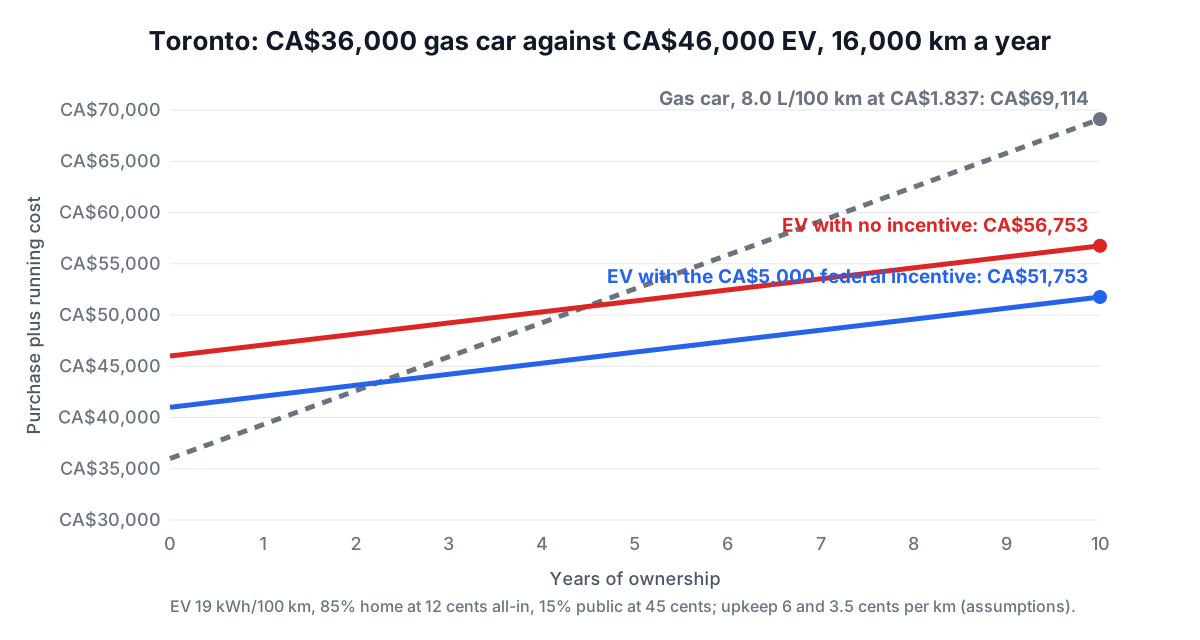
With a CA$36,000 gas car against a CA$46,000 EV:
- With the CA$5,000 incentive: the CA$5,000 gap is recovered in 2.2 years, and after 10 years the EV is CA$17,361 ahead.
- Without it: the CA$10,000 gap takes 4.5 years, and the EV is CA$12,361 ahead after 10 years.
| Change from the Toronto example | Saving a year | Break-even with the incentive |
|---|---|---|
| 25,000 km a year | CA$3,493.88 | 1.4 years |
| 10,000 km a year | CA$1,397.55 | 3.6 years |
| Winter average of 24 kWh/100 km | CA$2,100.48 | 2.4 years |
| All charging at 45-cent public chargers | CA$1,383.36 | 3.6 years |
| Vancouver gas (209.5 cents) | CA$2,566.32 | 1.9 years |
| Calgary gas (167.3 cents) | CA$2,026.16 | 2.5 years |
CO2 by province
Environment and Climate Change Canada publishes electricity consumption intensity by province. The table headed 2026 (applying to reductions in 2027) ranges from 2.6 g CO2e per kWh in Quebec to 760 in Nunavut. For the EV's 3,040 kWh a year against the gas car's 1,280 litres (about 2.97 tonnes using the calculator's factor; ECCC's own factor for motor gasoline is 2,307 g of CO2 per litre):
| Province | Grid g CO2e/kWh | EV tonnes a year |
|---|---|---|
| Quebec | 2.6 | 0.01 |
| British Columbia | 18 | 0.05 |
| Ontario | 73 | 0.22 |
| Alberta | 346 | 1.05 |
| Saskatchewan | 581 | 1.77 |
| Nova Scotia | 628 | 1.91 |
These are the Table 5.4 factors the calculator's province presets use. For reductions in 2026 ECCC's Table 5.3 applies instead, with Quebec at 1.9, Ontario at 59, Alberta at 438, Saskatchewan at 631 and Nova Scotia at 581 g per kWh: on those figures the EV's 3,040 kWh is about 0.18 tonnes in Ontario and 1.33 tonnes in Alberta.
Even on Nova Scotia's grid the EV's running emissions are about two thirds of the gas car's; in Quebec and BC they are close to zero. Battery manufacture is not included.
What the comparison leaves out
- Insurance and depreciation, which vary by model; add any yearly difference to upkeep.
- Financing: interest on the dearer car adds to the gap; the Canadian auto loan calculator shows it.
- A Level 2 charger, with any electrical panel work, as a one-off cost to add to the EV price.
- Winter tires, if you use them, which cost the same on either car.
Tools for this job
- The Canadian EV vs gas calculator runs the scenarios above with your km, prices and province.
- The Canadian fuel cost calculator prices a single trip in gas.
- The Canadian carbon footprint calculator puts the car in a household total.
- The guide on how long an EV takes to charge covers charging times, and the Canadian car loan and debt guide covers paying for the car.
Frequently asked questions
How much is the federal EV incentive in Canada?
Under the Electric Vehicle Affordability Program, up to CA$5,000 for an eligible battery-electric or fuel cell vehicle and CA$2,500 for a plug-in hybrid in 2026, falling to CA$4,000 and CA$2,000 in 2027. The final transaction value must be CA$50,000 or less unless the EV is made in Canada.
Does winter make an EV more expensive to run than gas?
Not at current prices. Raising consumption from 19 to 24 kWh/100 km to allow for winter still leaves the Toronto example about CA$2,100 a year ahead of an 8.0 L/100 km gas car at 183.7 cents a litre.
What does it cost to charge an EV overnight in Ontario?
On the Ontario Energy Board's ultra-low overnight plan, the energy price from 1 November 2026 is 3.7 cents per kWh before delivery and regulatory charges. At 19 kWh/100 km that is about 70 cents of energy per 100 km.
Does an EV cut emissions in Alberta?
Yes. At ECCC's 346 g per kWh for Alberta (Table 5.4, for reductions in 2027), 3,040 kWh a year is about 1.05 tonnes, against about 2.97 tonnes for a gas car burning 1,280 litres. On Table 5.3's 438 g, for reductions in 2026, it is about 1.33 tonnes.
Sources and further reading
- Monthly average retail prices for gasoline and fuel oil, by geography (Table 18-10-0001-01), Statistics Canada. September 2026 regular unleaded prices by city.
- Electricity rates, Ontario Energy Board. Regulated Price Plan prices from 1 November 2026.
- Electric Vehicle Affordability Program: questions and answers, Transport Canada. Amounts, price cap, lease pro-rating and dates.
- Emission factors and reference values, Environment and Climate Change Canada. Electricity intensity by province (Table 5.3 for 2026 reductions, Table 5.4 for 2027) and the gasoline factor.
- Understanding the fuel consumption tables, Natural Resources Canada. Combined ratings and kWh/100 km.
Open the EV vs Gas Cost Calculator
More Energy & Sustainability
Every tool in the Energy & Sustainability section, free and in your browser.