
EV vs Petrol Running Costs in Australia, Solar Included
Electric against petrol in A$: cost per 100 km at current pump prices, grid against rooftop solar charging, break-even on a dearer EV, and CO2 by state.
By Redbison Dev · · 10 min read
Australia edition. Written for Australian drivers: kilometres and L/100 km, AIP retail petrol prices for the week ending 1 November 2026, charging from the grid or your own solar, and the Clean Energy Regulator's 2025-26 state grid factors. US edition
A petrol car using 7.5 L/100 km in Sydney, where unleaded averaged 236.4 cents a litre in the week ending 1 November 2026, costs about A$17.73 per 100 km in fuel. An electric car using 16 kWh/100 km costs A$5.28 per 100 km charged from the grid at 33 cents per kWh, about 96 cents if the energy comes from rooftop solar you would otherwise export at 6 cents, and A$9.60 if every charge is at a 60-cent public fast charger. At 13,000 km a year the EV saves about A$1,900 a year on grid power, and more on solar.
This edition works through the Australian numbers with the Australian EV vs petrol calculator: pump prices by city, grid and solar charging, break-even and CO2 on each state's grid. Pump prices and tariffs move weekly; enter your own.
Petrol in cents per kilometre
litres a year = km x L/100 km / 100 = 13,000 x 7.5 / 100 = 975 litres
975 x A$2.364 = A$2,305 a year, or 17.7 cents a km
The Australian Institute of Petroleum's weekly report for the week ending 1 November 2026 puts the national average retail price of unleaded at 237.4 cents a litre, with the capitals close together:
| City | Unleaded, cents per litre | Fuel for 13,000 km at 7.5 L/100 km |
|---|---|---|
| Brisbane | 237.3 | A$2,313.68 |
| Sydney | 236.4 | A$2,304.90 |
| Melbourne | 236.4 | A$2,304.90 |
| Perth | 228.5 | A$2,227.88 |
| Adelaide | 227.9 | A$2,222.03 |
Use the L/100 km from your own fill-ups. The Green Vehicle Guide's label figures are for comparing models; air conditioning and highway speeds can push real consumption up.
Electricity: grid, solar or public
kWh a year = 13,000 x 16 / 100 = 2,080 kWh
The price per kWh depends on where the energy comes from:
- From the grid at your tariff's usage rate. 33 cents is used here as an example; take the peak, shoulder or off-peak rate from your bill for the hours you charge.
- From your own solar panels during the day, the cost is the feed-in tariff you give up by not exporting that energy. At a 6-cent feed-in tariff, 16 kWh/100 km costs 96 cents per 100 km. This only works if the car is home and plugged in while the sun is up.
- Public fast chargers, at 60 cents in these examples, cost far more than home charging but still less than petrol per km.
| Charging pattern | Price per kWh | Per 100 km | Electricity a year, 13,000 km |
|---|---|---|---|
| 80% home from the grid at 33c, 20% public at 60c | 38.4c blended | A$6.14 | A$798.72 |
| 80% home from solar at 6c, 20% public at 60c | 16.8c blended | A$2.69 | A$349.44 |
| All public at 60c | 60c | A$9.60 | A$1,248.00 |
| Petrol, 7.5 L/100 km at 236.4c | A$17.73 | A$2,304.90 fuel |
The yearly saving and break-even
The calculator adds upkeep per km. These are assumptions to replace with your own service quotes: 7 cents per km for the petrol car and 4 cents for the EV.
| 13,000 km a year | Petrol | EV, grid | EV, solar |
|---|---|---|---|
| Energy | A$2,304.90 | A$798.72 | A$349.44 |
| Upkeep | A$910.00 | A$520.00 | A$520.00 |
| Total a year | A$3,214.90 | A$1,318.72 | A$869.44 |
| Saving against petrol | A$1,896.18 | A$2,345.46 |
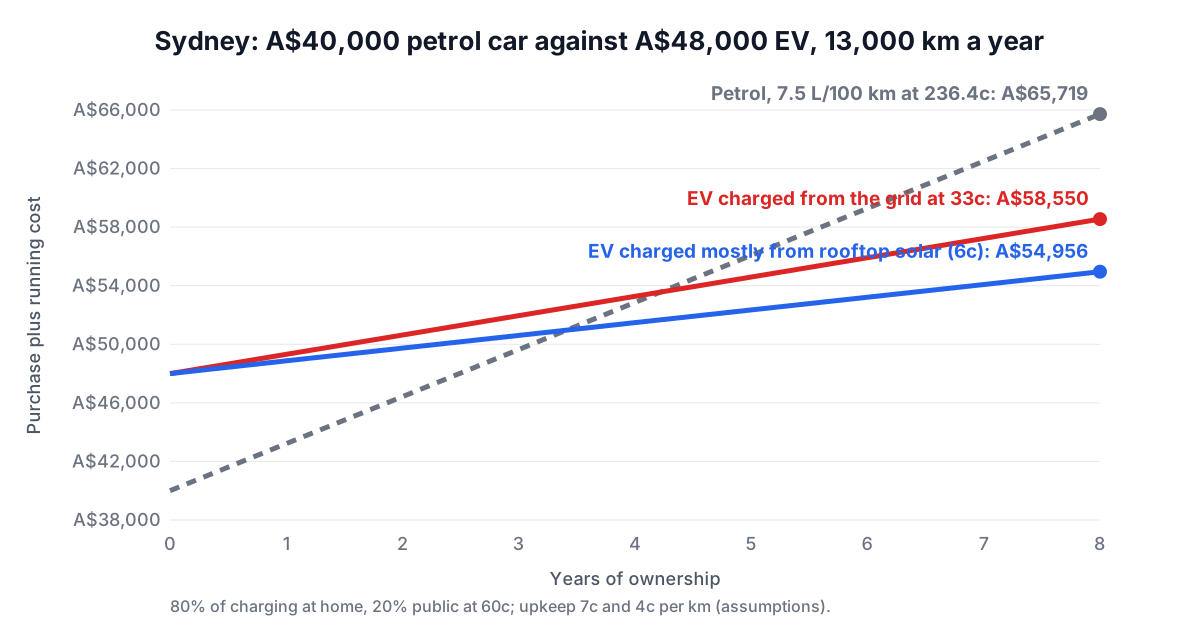
With a A$40,000 petrol car against a A$48,000 EV, the A$8,000 gap is recovered in 4.2 years charging from the grid and 3.4 years charging mostly from solar. After eight years the EV is A$7,169 ahead on grid power and A$10,764 ahead on solar.
| Change from the Sydney grid example | Saving a year | Break-even |
|---|---|---|
| 20,000 km a year | A$2,917.20 | 2.7 years |
| 8,000 km a year | A$1,166.88 | 6.9 years |
| All public charging at 60c | A$1,446.90 | 5.5 years |
| Adelaide petrol (227.9c) | A$1,813.31 | 4.4 years |
| Brisbane petrol (237.3c) | A$1,904.96 | 4.2 years |
The price gap does more than anything else. Registration, stamp duty and any state incentives can differ for EVs from state to state, so compare drive-away prices; and if your employer offers a novated lease, ask how fringe benefits tax applies to an electric car, because that can outweigh everything above.
CO2 on each state's grid
The Clean Energy Regulator's 2025-26 scope 2 factors show how much the answer depends on where you live. The EV's 2,080 kWh against the petrol car's 975 litres, about 2.26 tonnes a year using the calculator's petrol factor:
| State | Grid kg CO2e per kWh, 2025-26 | EV tonnes a year |
|---|---|---|
| Tasmania | 0.20 | 0.42 |
| South Australia | 0.22 | 0.46 |
| Western Australia (SWIS) | 0.50 | 1.04 |
| NSW and ACT | 0.64 | 1.33 |
| Queensland | 0.67 | 1.39 |
| Victoria | 0.78 | 1.62 |
Even on Victoria's grid the EV's running emissions are below the petrol car's; in South Australia and Tasmania they are about a fifth. Charging from your own solar cuts them further, though the calculator keeps using the grid factor. The factors change each year: NSW and ACT fell from 0.68 in 2023-24 to 0.64 in 2025-26, while Tasmania rose from 0.12 to 0.20. Battery manufacture is not included.
What the comparison leaves out
- Insurance and resale value, which vary by model; add any yearly difference to upkeep.
- Financing: interest on the dearer car adds to the gap; the Australian car loan calculator shows it.
- A home charger, and any switchboard work, as a one-off cost added to the EV price.
- Your solar system's cost, which you have paid already; only the lost feed-in income belongs in the comparison.
Tools for this job
- The Australian EV vs petrol calculator runs the scenarios above with your km, prices and state.
- The Australian EV charging calculator gives charge time and cost per session, explained in the guide on how long an EV takes to charge.
- The Australian fuel cost calculator prices a road trip in petrol.
- The Australian electricity cost calculator shows what home charging adds to your bill, and the Australian car loan and debt guide covers paying for the car.
Frequently asked questions
Is an electric car cheaper to run in Australia?
At current prices, yes. At 16 kWh/100 km an EV costs A$5.28 per 100 km on grid power at 33 cents, against A$17.73 for a 7.5 L/100 km petrol car at 236.4 cents a litre. Even all-public charging at 60 cents, A$9.60 per 100 km, is cheaper than petrol.
What does charging from solar really cost?
The feed-in tariff you give up by using the energy instead of exporting it. At 6 cents per kWh, 16 kWh/100 km costs about 96 cents per 100 km. It only applies when the car charges while your panels are generating.
How long does an EV take to pay back its higher price?
Divide the price gap by the yearly saving. An A$8,000 gap takes 4.2 years at 13,000 km a year charging from the grid, 3.4 years mostly on solar, 2.7 years at 20,000 km and 6.9 years at 8,000 km.
Does an EV reduce emissions in Victoria?
Yes, though by less than elsewhere. At the 2025-26 factor of 0.78 kg per kWh, 2,080 kWh a year is about 1.62 tonnes, against about 2.26 tonnes for a petrol car burning 975 litres.
Sources and further reading
- Weekly petrol prices report, week ending 1 November 2026, Australian Institute of Petroleum. National and capital city retail unleaded prices.
- Amendments to National Greenhouse and Energy Reporting legislation, Clean Energy Regulator. State scope 2 electricity factors for 2023-24 to 2025-26.
- Green Vehicle Guide, Australian Government. Fuel and energy consumption labels for new vehicles.
- GHG Emission Factors Hub, US Environmental Protection Agency. The tailpipe CO2 per litre of petrol the calculator uses.
- FOTW #1190: battery electric vehicles have lower scheduled maintenance costs, US Department of Energy. Why EV servicing costs less per km.
Open the EV vs Gas Cost Calculator
More Energy & Sustainability
Every tool in the Energy & Sustainability section, free and in your browser.