
FIRE in Canada: Your Number With RRSP, TFSA, CPP and OAS
Work out a Canadian FIRE number in dollars, then plan the gap to 65 with TFSA and RRSP withdrawals, CPP timing and OAS, with the math shown step by step.
By Redbison Dev · · 6 min read
Canada edition. Canadian edition in CA$, built around TFSA and RRSP withdrawals, CPP from 60 to 70, OAS from 65 and the October to December 2026 benefit rates. US edition
A Canadian FIRE number is your yearly spending in the year you stop, divided by your withdrawal rate: CA$89,157 a year at 4% needs about CA$2.23 million. The good news compared with many countries is access. RRSP money can come out at any age and TFSA money comes out tax-free, so there is no locked pension pot to bridge for most savers. The Canadian questions are different: how much tax your RRSP withdrawals will cost, when to start CPP, and how much OAS and CPP from 65 take off the pressure on your portfolio.
This edition works through those with the FIRE Planner for Canada. It explains a planning method, not personal advice. If you have a defined benefit pension, a locked-in account or a business to sell, a fee-only planner who models your real tax brackets is worth the cost.
The number, in Canadian dollars
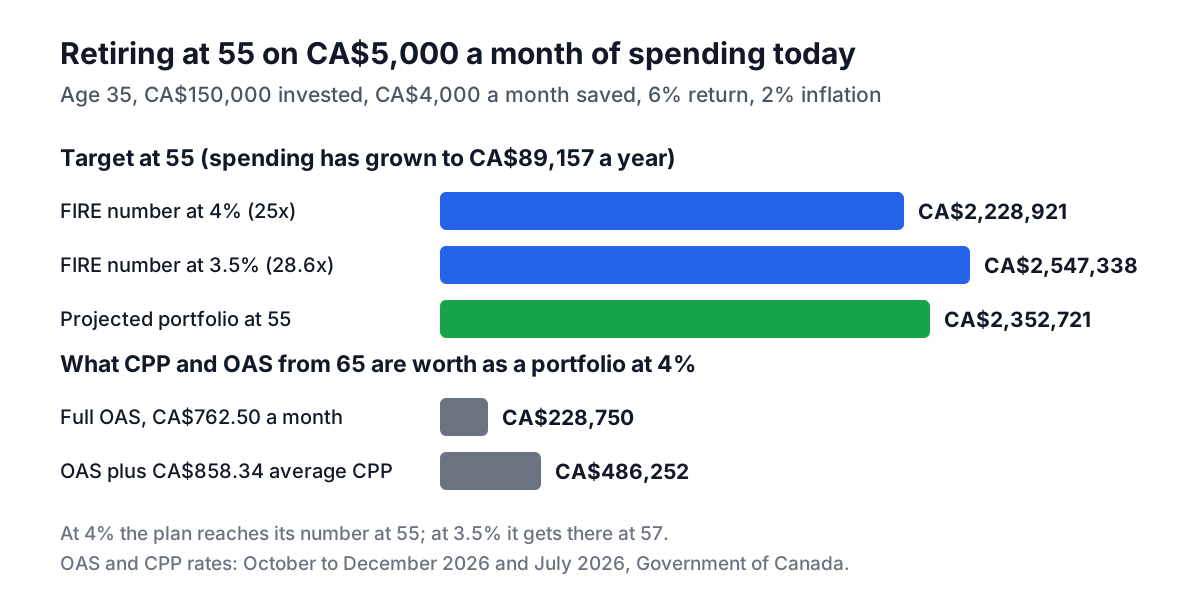
Take a 35-year-old who spends CA$5,000 a month today and wants to stop at 55. At 2% inflation, the Bank of Canada's inflation-control target midpoint, that spending becomes CA$89,157 a year by 55. The withdrawal rate sets the multiple:
| Withdrawal rate | Multiple | FIRE number at 55 |
|---|---|---|
| 4% | 25x | CA$2,228,921 |
| 3.5% | 28.6x | CA$2,547,338 |
The 4% figure comes from William Bengen's 1994 study of US stock and bond returns over 30-year retirements. Retiring at 55 can mean 35 years or more, and a Canadian portfolio is not the US market, so testing 3.5% is sensible. In this example the lower rate moves the date from 55 to 57.
Which accounts count as FIRE money
In Canada most retirement savings are accessible, which keeps the planner simple: everything in these accounts goes in Current Invested Savings.
- TFSA. The CRA says income earned in a TFSA, whether interest, dividends or capital gains, is generally tax-free, even when you make a withdrawal. The 2026 dollar limit is CA$7,000, and the amount you withdraw is added back to your room on January 1 of the next calendar year.
- RRSP. You can withdraw at any age, but your bank withholds tax at source: 10% on amounts up to CA$5,000, 20% over CA$5,000 up to CA$15,000 and 30% above that outside Quebec, according to the CRA's withholding table. Quebec rates are 5%, 10% and 15%, with provincial tax withheld as well. The CRA notes that you may have to pay more tax when you include the withdrawal on your return.
- Non-registered accounts. Accessible at any age, without the shelter of a TFSA or RRSP.
- Locked-in accounts. A LIRA or locked-in RRSP from an old workplace pension has its own unlocking rules, so ask the provider when and how much you can draw. Put it in the planner's pension fields with the age your plan allows, not in Current Invested Savings.
Withholding is a prepayment, not the final bill. Taking CA$20,000 in one withdrawal has CA$6,000 withheld; four withdrawals of CA$5,000 have CA$2,000 withheld in total. Your tax for the year is the same either way, because it depends on your total income. What actually lowers the bill is spreading RRSP withdrawals across low-income years, which is exactly what the years between an early retirement and 65 can be.
A worked example: stopping at 55
Open the FIRE Planner for Canada and enter: age 35, target age 55, take-home pay CA$9,000 a month, spending CA$5,000 a month, CA$150,000 across a TFSA, an RRSP and a non-registered account, 6% return, 2% inflation, 4% withdrawal rate, and CPP and OAS of CA$1,620.84 a month from 65.
- Savings rate: CA$4,000 of CA$9,000, 44.44%.
- FIRE number at 55: CA$2,228,921.
- Projected portfolio at 55: CA$2,352,721, so the plan reaches its number at 55.
- First-year withdrawal at 4% of the portfolio: CA$94,109, against spending of CA$89,157.
- From 65, CPP and OAS add CA$19,450 a year.
Two changes show where the leverage is. Spending CA$4,500 a month instead of CA$5,000 brings financial independence forward to 52. Spending CA$4,000 brings it to 49 and drops the FIRE number at 55 to CA$1,783,137, because every dollar not spent both adds to savings and shrinks the target. Lowering the return from 6% to 5% pushes the date out to 57, the same as moving to a 3.5% withdrawal rate.
CPP and OAS: what they are worth, and when
OAS depends on residence, not work. You need to have lived in Canada for at least 10 years since age 18. The maximum for October to December 2026 is CA$762.50 a month at 65 to 74 and CA$838.75 at 75 and over. Stopping work early does not reduce it. High income can: OAS is subject to a recovery tax above a net income threshold, CA$93,454 for 2025, so very large RRSP withdrawals after 65 can cost OAS as well as income tax.
CPP depends on your contributions, so it is the benefit early retirement touches. The maximum at 65 is CA$1,507.65 a month as of January 2026, but the average for new pensions at 65 was CA$858.34 in July 2026. Twenty years without earnings after 55 will pull your own figure down; your Statement of Contributions in My Service Canada Account gives an estimate.
Start date is your choice between 60 and 70. Each month before 65 cuts the pension by 0.6%, 36% at 60, and each month after 65 raises it by 0.7%, 42% at 70. On the CA$858.34 average that is about CA$549 a month at 60 or CA$1,219 at 70.
As a portfolio, a full OAS of CA$9,150 a year would take CA$228,750 to replace at 4%. OAS plus an average CPP, CA$19,450 a year, would take CA$486,252. The planner adds them as income from the age you enter but does not lower the FIRE number for them, and it holds them flat while your spending grows with inflation. CPP is in fact adjusted every January with the Consumer Price Index, so the plan stays cautious on this point.
An order of withdrawals to test
Here is one sequence worth testing; the planner shows whether the portfolio survives it:
- 55 to 65: live on non-registered money and planned RRSP withdrawals sized to fill the low tax brackets, keeping the TFSA growing.
- 65 onward: OAS starts, CPP starts at the age you chose, and the TFSA covers lumpy costs such as a new roof or car without adding to taxable income.
- By the end of the year you turn 71: remaining RRSP money has to go somewhere: a RRIF, which pays a yearly minimum from the following year, an annuity, or a withdrawal.
Whether filling brackets early beats waiting depends on your province, other income and the OAS threshold. That is the part to take to a planner with your own numbers.
Tools for this job
- FIRE Planner for Canada: FIRE number, projected portfolio and the age you reach it, with CPP and OAS as optional income.
- Retirement Calculator for Canada: a conventional retirement target with CPP and OAS, if retiring at 65 is the plan.
- Compound Interest Calculator: what monthly TFSA saving grows to at a given return.
- Related reading: how much you need to retire in Canada, and the US FIRE number guide for the savings-rate table behind the method.
Frequently asked questions
How much do I need to retire at 55 in Canada?
At a 4% withdrawal rate, about 25 times your yearly spending at 55. Someone spending CA$5,000 a month today will spend about CA$89,157 a year at 55 with 2% inflation, so the target is CA$2,228,921. At 3.5% it rises to CA$2,547,338. CPP and OAS from 65 then cover part of the spending.
Is it better to save for early retirement in a TFSA or an RRSP?
Usually both. An RRSP deduction is worth most while your tax rate is high, and withdrawals in the low-income years after you stop can be taxed lightly. TFSA withdrawals are tax-free and the room comes back on January 1 of the next year. Many plans fill both before a non-registered account.
Does retiring early reduce my OAS?
Not by itself. OAS depends on years of residence in Canada after 18, not on work. It can be reduced by the recovery tax if your net income is above the threshold, CA$93,454 for 2025, which large RRSP withdrawals after 65 can trigger.
Should I start CPP at 60 if I retire early?
It depends on whether your portfolio can cover the gap. Starting at 60 cuts the pension by 36% for life; waiting to 70 raises it by 42%, and CPP amounts are adjusted each January with the Consumer Price Index. If your savings can carry you, a later start buys a larger inflation-protected income.
Sources and further reading
- Tax rates on withdrawals, Canada Revenue Agency. RRSP withholding rates, inside and outside Quebec.
- What is a TFSA, Canada Revenue Agency. Tax treatment of income and withdrawals; see also calculate your contribution room for the CA$7,000 limit for 2026.
- CPP retirement pension: how much you could receive, Government of Canada. Maximum and average amounts at 65.
- CPP retirement pension: when to start, Government of Canada. 0.6% a month reduction before 65, 0.7% a month increase after.
- OAS payment amounts, Government of Canada. October to December 2026 maximums and the recovery tax threshold.
- Inflation-control target, Bank of Canada. The 2% midpoint used for inflation in the example.
- Determining Withdrawal Rates Using Historical Data, Journal of Financial Planning. William Bengen's 1994 study behind the 4% rule.
More Planning Tools
Every tool in the Planning Tools section, free and in your browser.