
FIRE in Ireland: Your Number and the Bridge to 60
Work out a FIRE number in euro, then check whether savings outside your PRSA or company pension can carry you to 60, and what the State Pension adds from 66.
By Redbison Dev · · 6 min read
Ireland edition. Irish edition in euro, built around PRSAs and personal pensions normally accessible from 60, Revenue's age-related relief limits on earnings up to €115,000, the €200,000 tax-free lump sum, ARF minimum withdrawals and the State Pension (Contributory) from 66. US edition
In Ireland your FIRE number is yearly spending divided by a withdrawal rate, so €4,200 a month, €50,400 a year, needs €1.26 million at a 4% withdrawal rate, at today's prices, before inflation is added. What makes early retirement here different is pension access. A PRSA or personal pension is normally payable from 60, and an occupational pension from 60 or 65 under the scheme rules. The number tells you when you have enough in total. The bridge tells you whether you can actually stop, because every year before your pension opens is paid for by savings and investments outside it.
This edition works through both with the FIRE Planner (Ireland), which keeps the pension separate from your other money. It explains a planning method, not personal advice; Irish pension and investment tax rules are detailed and change in each Budget, so check your plan with a qualified financial adviser before you leave work.
Two pots and a locked door
| Pot | Examples | When you can spend it |
|---|---|---|
| Accessible | Savings, shares, funds and ETFs held outside a pension | Any time |
| Locked | PRSA, personal pension, occupational scheme, AVCs | Usually from 60 (some schemes 65) |
The CCPC sets out the exceptions. A PRSA can be accessed from 50 if you retire from employment at 50 or over, and some occupational schemes allow early retirement from 50 with employer or trustee consent. Neither is automatic, so plan on 60 unless your provider or trustees confirm otherwise in writing.
Why the pension is still worth filling
Revenue gives income tax relief on pension contributions up to a share of earnings that rises with age, on earnings of up to €115,000 a year:
| Age | Limit |
|---|---|
| Under 30 | 15% |
| 30 to 39 | 20% |
| 40 to 49 | 25% |
| 50 to 54 | 30% |
| 55 to 59 | 35% |
| 60 and over | 40% |
On gross earnings of €84,000, a 34-year-old can get relief on personal contributions of up to €16,800 a year, €1,400 a month. Contributions above the limit earn no relief that year and are still locked until 60, so for an early retiree the limit is a natural ceiling.
At retirement the first €200,000 taken as a lump sum across all your pensions is tax-free, €200,001 to €500,000 is taxed at 20%, and anything above that through PAYE. If the rest goes into an approved retirement fund (ARF), the CCPC says you must withdraw at least 4% of its value each year up to age 70 and at least 5% after that.
Worked example 1: aiming for 52
A 34-year-old spends €4,200 a month, has €60,000 invested outside a pension and €95,000 in a PRSA, and puts €1,000 a month into it out of €7,000 a month of income. In the planner: target 52, pension access at 60, State Pension of €1,297 a month from 66, 6% growth, 2% inflation and a 4% withdrawal rate.
- Saving: €7,000 − €4,200 = €2,800 a month, a 40% savings rate.
- Spending at 52: €50,400 grows with 2% inflation to €71,984 a year.
- FIRE number at 52: €71,984 ÷ 0.04 = €1,799,590.
- Projected at 52: €1,543,158, short. The plan reaches its number at 55.
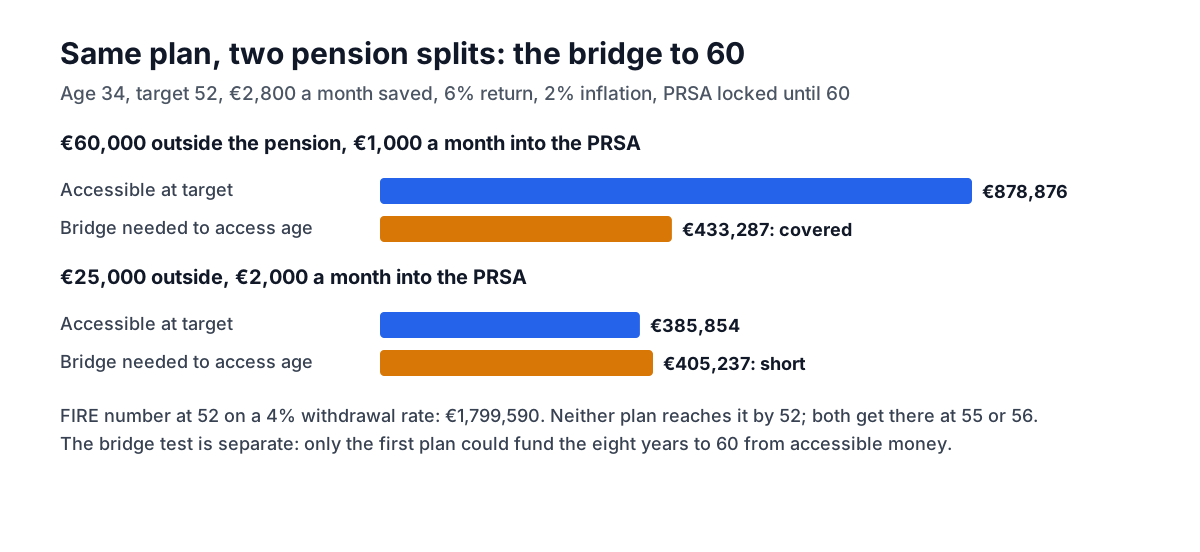
- Bridge: the eight years from 52 to 60 need €433,287 of accessible money, and €878,876 is outside the pension. Covered.
So the bridge is not the problem; the total is. Move the target to 55 and the FIRE number becomes €1,909,740, the projection €1,951,313, and the bridge shrinks to five years: €361,900 needed against €1,119,647 accessible.
Worked example 2: most of the saving into the PRSA
Same person, but €25,000 outside the pension today and €2,000 a month into the PRSA. The projected total at 52 is €1,443,256, reaching the number at 56. Worse, only €385,854 is outside the pension at 52 against €405,237 needed before 60, so the bridge is short as well.
There is a second problem. On €84,000 of gross earnings at age 34, €24,000 a year of personal contributions is above the €16,800 relief limit, so €7,200 a year goes in without relief and is locked anyway. For someone planning to stop before 60, contributing up to the relief limit and investing the rest outside the pension keeps both the relief and the early exit. At exactly the limit, €1,400 a month, the plan still clears its bridge at 52 (€721,628 accessible against €433,287 needed).
Choosing a withdrawal rate
The 4% rule comes from William Bengen's 1994 study of US returns over 30-year retirements. Someone stopping at 55 may need the money for 35 or 40 years, so many Irish FIRE planners test 3.5%. On the first example with a target of 55, 3.5% raises the FIRE number from €1,909,740 to €2,182,560, and the plan reaches it at 58 instead of 55. Treat 4% and 3.5% as the range, not one of them as the answer.
Where the State Pension fits
The State Pension (Contributory) is payable from 66 if you have enough PRSI contributions. The maximum rate for someone under 80 is €299.30 a week; the CCPC says its rates reflect the €10 weekly increase announced in Budget 2027 and lists €309.30 for people aged 80 and over. At €299.30 a week, about €1,297 a month in the planner, it comes to €15,563.60 a year, which at a 4% withdrawal rate is worth about €389,000 of portfolio.
Retiring early affects it through your contribution record. Years with no PRSI after you stop work do not add to it. Voluntary contributions can fill some gaps, and the HomeCaring Periods Scheme covers some years spent caring. If your record will have gaps, enter less than the maximum, or 0, and see whether the plan still works.
Tax on the accessible pot
The planner uses one growth rate for both pots. Pension funds grow free of tax; money outside a pension does not. Deposit interest, dividends and gains are taxed along the way, and funds and ETFs have their own tax treatment in Ireland that differs from shares. Use an after-tax return for the accessible pot, or run the plan once at a lower return to see how much it matters, and take tax advice on how your investments will be taxed before relying on the bridge.
Tools for this job
- FIRE Planner (Ireland): FIRE number, years to FI, and the bridge test with a pension locked until 60.
- Compound Interest Calculator: how a single pot grows; see the compound interest guide.
- Retirement Calculator: a conventional plan to State Pension age for comparison.
- The US version of this guide, Your FIRE number: the 4% rule and years to financial independence, explains where the 4% rule comes from.
Frequently asked questions
Can I draw my PRSA at 50 if I retire early?
Only if you are retiring from employment. A PRSA is normally accessible between 60 and 75, and a PRSA can be accessed from 50 if you retire from employment at 50 or over. Confirm the conditions with your provider before you plan around it; if you are not retiring from a job, plan on 60.
Should I put more into my pension or invest outside it?
Up to your age-related relief limit, the pension usually wins because of the tax relief. Above it, contributions get no relief and stay locked until 60. In the second example, saving €2,000 a month into the PRSA left the bridge to 60 short by about €19,400.
Will retiring early reduce my State Pension?
It can. The State Pension (Contributory) depends on your PRSI record, and years after you stop work add nothing unless you pay voluntary contributions or qualify for credits. Ask the Department of Social Protection for a statement of your record.
How much do I need to retire early in Ireland?
About 25 times your yearly spending at the date you stop at a 4% withdrawal rate. On €4,200 a month that is about €1.8 million by 52 at 2% inflation, plus enough outside the pension to reach 60.
Sources and further reading
- Retiring: what age can you access your pension?, Competition and Consumer Protection Commission. Access ages; €200,000 tax-free lump sum and the bands above it; auto-enrolment.
- Personal pensions, Competition and Consumer Protection Commission. PRSA access from 60, or from 50 on retiring from employment; ARF minimum withdrawals of 4% and 5%.
- State Pension, Competition and Consumer Protection Commission. Payable from 66; maximum €299.30 a week under 80 and €309.30 from 80, rates that reflect Budget 2027's €10 increase; voluntary contributions.
- Tax relief limits on pension contributions, Revenue. Age-related limits and the €115,000 earnings limit.
- Monetary policy strategy, European Central Bank. The 2% inflation target behind the 2% assumption.
- Determining Withdrawal Rates Using Historical Data, Journal of Financial Planning. William Bengen's 1994 study behind the 4% rule.
More Planning Tools
Every tool in the Planning Tools section, free and in your browser.