
FIRE in Australia: Your Number and the Bridge to Super
Work out an Australian FIRE number in dollars, then check whether savings outside super can carry you from your leaving date to preservation age 60.
By Redbison Dev · · 6 min read
Australia edition. Australian edition in A$, built around super preserved until 60, the conditions of release in the SIS Regulations, savings outside super as the bridge, and the RBA's 2 to 3% inflation target. US edition
An Australian FIRE number is your yearly spending at the age you stop, divided by your withdrawal rate. Someone spending A$5,500 a month today who wants out at 50 needs about A$2.39 million by then, counting super and everything else. The number is only half the plan, though. Super is preserved until 60 for anyone born after 30 June 1964, so every year between your last day at work and 60 has to be paid from money outside super: shares, ETFs, savings, the balance in an offset account. If that pot is too small, you are financially independent on paper and still need a job.
This edition works through both checks with the FIRE Planner for Australia, which keeps super separate from your other savings. It explains a planning method, not personal advice. Before you resign on the strength of a projection, a licensed financial adviser can test it against tax, contribution caps and your own situation.
The number, in Australian dollars
The planner grows your spending with inflation to the year you stop, then divides by the withdrawal rate. The Reserve Bank's goal is to keep annual consumer price inflation between 2 and 3 per cent, so 2.5%, the midpoint, is a fair planning figure. At that rate A$5,500 a month today becomes A$95,588 a year after 15 years. Recent inflation has run hotter: the ABS reports the CPI rose 4.3% in the 12 months to September 2026. Test a higher figure too; at 3.5% a year the same plan needs A$2,764,326 at 50 and gets there at 53.
| Withdrawal rate | Multiple of spending | FIRE number at 50 |
|---|---|---|
| 4% | 25x | A$2,389,692 |
| 3.5% | 28.6x | A$2,731,077 |
The 4% rule comes from William Bengen's 1994 study of US returns, tested over 30-year retirements. Stopping at 50 could mean 40 years or more of withdrawals, and an Australian portfolio is not the US market, so testing 3.5% is prudent. In this example it moves the date from 51 to 53.
Two pots: what you can touch and what you cannot
Super. Under the Superannuation Industry (Supervision) Regulations 1994, regulation 6.01, the preservation age is 55 for people born before 1 July 1960, rising a year at a time to 60 for anyone born after 30 June 1964. Super can then be released on retirement, and in any case on reaching 65, both listed in Schedule 1 as conditions of release with no cashing restriction.
The definition of retirement has a detail that matters to early retirees. If you are 60 or over, any employment arrangement that ends after you turn 60 counts. If you stopped work at 50 and have not worked since, the fund instead needs to be reasonably satisfied that you intend never to be gainfully employed again, full-time or part-time. For most FIRE plans that is a declaration, not a barrier, but it is a reason not to count on super before 60 if you expect to pick up paid work in your fifties.
Everything else. Shares and ETFs held in your own name, cash, and money sitting in an offset account can be spent at any age. This is the bridge.
A worked example: leaving at 50
Enter in the FIRE Planner for Australia: age 35, target age 50, income A$10,000 a month, spending A$5,500 a month, A$150,000 outside super, A$180,000 in super, A$1,000 a month of the saving going into super, access age 60, 7% return, 2.5% inflation and a 4% withdrawal rate. Count employer super after contributions tax in the income figure if you enter it as money paid into super.
- Savings rate: A$4,500 of A$10,000, 45%.
- FIRE number at 50: A$2,389,692.
- Projected total at 50: A$2,362,435, so the plan is just short at 50 and reaches its number at 51.
- Outside super at 50: A$1,543,153.
- Bridge: ten years from 50 to 60 need A$784,788 at 50. Covered with room to spare.
Aiming for 52 instead lifts the target to A$2,510,670 and the projection to A$2,824,357, and the bridge shrinks to eight years.
Now route more of the same A$4,500 into super, the way salary sacrifice tempts you to: A$30,000 outside super and A$250,000 in super today, and A$3,000 a month into super. Super's concessional tax treatment is real, but the planner grows both pots at the same return to show the access problem on its own. The total at 50 is A$2,224,484, yet only A$566,756 sits outside super against a bridge of A$738,961.
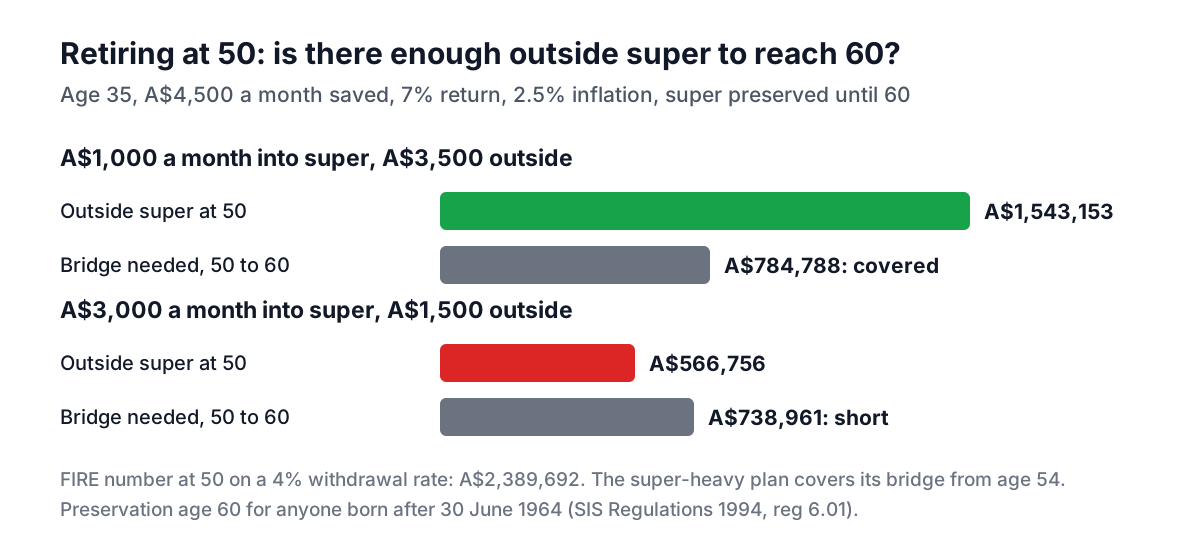
For the super-heavy saver, the leaving date decides everything:
| Leave at | Years to 60 | Outside super | Bridge needed | Covered? |
|---|---|---|---|---|
| 50 | 10 | A$566,756 | A$738,961 | No |
| 52 | 8 | A$688,747 | A$737,685 | No |
| 54 | 6 | A$828,415 | A$685,671 | Yes |
| 55 | 5 | A$905,664 | A$634,763 | Yes |
So the choice is not super or no super. It is how much tax saving you will trade for four extra years of freedom. One approach is to build the outside-super bridge first, sized to the years before 60, then direct everything else into super.
The Age Pension
The Age Pension is paid from Age Pension age and is means-tested on income and assets. A household with a FIRE-sized portfolio may receive little or nothing until the portfolio has been drawn down, so the planner's Age Pension field is set to 0 by default. Add an amount only after checking your likely entitlement with Services Australia. Keep your home out of the starting balance too: home equity does not pay for groceries.
What the projection leaves out
- Tax. The planner works with spending, not tax. Investment income outside super is taxable, so add an allowance for it to your spending.
- Contribution caps. Concessional super contributions are capped each financial year, so a plan that relies on large salary sacrifice should be checked against the current cap with the ATO.
- Sequence of returns. The planner assumes a steady return. A share-market fall in your first years off work, while you are drawing on the bridge, does the most damage. Flexible spending and a cash buffer both help.
- Private health insurance and car replacement. Both continue after work stops; build them into monthly spending.
Tools for this job
- FIRE Planner for Australia: FIRE number, super and non-super pots, and whether the bridge to 60 is covered.
- Retirement Calculator for Australia: a conventional retirement target if you plan to work to 67.
- Compound Interest Calculator: what monthly ETF investing grows to at a given return.
- Related reading: how much super you need to retire in Australia, and the US FIRE number guide for the savings-rate table behind the method.
Frequently asked questions
Can I access my super if I retire at 50?
Not normally. For anyone born after 30 June 1964 the preservation age is 60, and super is generally released when you retire after that age or when you turn 65. Money outside super has to fund the years in between, which is why the planner checks the bridge separately.
How much do I need to retire at 50 in Australia?
At a 4% withdrawal rate, about 25 times your yearly spending at 50, counting super and other savings. On A$5,500 a month today and 2.5% inflation, that is A$2,389,692 by 50. On top of that test, you need enough outside super to cover the ten years until 60; in the worked example, A$784,788.
Should I salary sacrifice into super or invest outside super for FIRE?
Both, in an order set by your leaving date. Super is taxed concessionally but locked until preservation age; investments outside super can fund early retirement. In the example, putting A$3,000 a month into super instead of A$1,000 leaves the bridge short at 50 and covered only from 54.
Do I have to stop working forever to access super at 60?
Not necessarily. Once you are 60, an employment arrangement that ends after you turn 60 counts as retirement under the SIS Regulations, even if you take another job later. If you stopped work before 60, the fund needs to be reasonably satisfied that you intend never to work again.
Sources and further reading
- SIS Regulations 1994, Volume 1 (Compilation No. 158), Federal Register of Legislation. Regulation 6.01: preservation ages and the meaning of retirement.
- SIS Regulations 1994, Volume 2 (Compilation No. 158), Federal Register of Legislation. Schedule 1 conditions of release, including retirement and attaining age 65.
- Inflation overview, Reserve Bank of Australia. The 2 to 3 per cent inflation target.
- Determining Withdrawal Rates Using Historical Data, Journal of Financial Planning. William Bengen's 1994 study behind the 4% rule.
- Consumer Price Index, Australia, September 2026, Australian Bureau of Statistics, released 28 October 2026. CPI up 4.3% in the 12 months to September 2026.
More Planning Tools
Every tool in the Planning Tools section, free and in your browser.