
FIRE in the UK: Your Number and the ISA Bridge to 57
Work out a UK FIRE number in pounds, then check the harder part: whether your ISAs can pay the bills until your pension unlocks at 57 from April 2028.
By Redbison Dev · · 6 min read
United Kingdom edition. UK edition in pounds, built around ISAs, SIPPs and workplace pensions, the minimum pension age of 57 from 6 April 2028, the new State Pension and Pensions UK's retirement budgets. US edition
In the UK your FIRE number is the same sum as anywhere else, yearly spending divided by a withdrawal rate, so £32,700 a year needs about £934,000 at 3.5%. What makes early retirement here different is that most savers hold part of that money in a pension they cannot touch before 55, and before 57 from 6 April 2028. The number tells you when you have enough in total. The bridge tells you whether you can actually stop, because the years between your leaving date and pension access are paid for by ISAs and other accessible money alone.
This edition works through both with the UK FIRE Planner, which keeps a locked pension pot separate from your ISAs. It explains a planning method, not personal advice. If you have a defined benefit pension, protected pension age rights or a large tax bill on the way out, a regulated financial adviser is worth the fee.
What to aim for: spending, not salary
Start from what you will spend once work stops, not what you earn now. Pension contributions, student loan repayments, commuting and often the mortgage disappear, and the target shrinks with them.
If you have no record of your own spending yet, the Retirement Living Standards from Pensions UK give a reasonable sense of scale. They are annual spending budgets for a retired household that owns its home outright, and the site notes that income may be taxed, so you may need more coming in than these figures. Here is what each one needs as a FIRE pot:
| Budget (one person) | Spending a year | Pot at 4% | Pot at 3.5% | Pot at 3% |
|---|---|---|---|---|
| Minimum | £13,900 | £347,500 | £397,143 | £463,333 |
| Moderate | £32,700 | £817,500 | £934,286 | £1,090,000 |
| Comfortable | £45,400 | £1,135,000 | £1,297,143 | £1,513,333 |
A couple on the moderate budget spends £45,400 between them, the same as one person on the comfortable budget. These budgets describe life after State Pension age. An early retiree also pays rent or a mortgage if one is still running, more car and travel costs, and sometimes private health or dental cover, so an early retiree may need to plan above the moderate line.
Why 3.5%? The 4% rule comes from William Bengen's 1994 study of US returns over 30-year retirements. Someone stopping at 52 may need the money for 40 years, and UK portfolios hold different assets, so many British FIRE planners test 3% to 3.5%. Going from 4% to 3.5% adds about a seventh to the pot, and from 3.5% to 3% about a sixth.
Two pots and a locked door
UK savings for early retirement normally sit in two places:
- Accessible money: stocks and shares ISAs, cash ISAs, a Lifetime ISA (with its own withdrawal rules) and general investment accounts. You can spend it at any age. In the 2026 to 2027 tax year you can put up to £20,000 into ISAs, according to GOV.UK.
- Locked money: workplace pensions and SIPPs. GOV.UK says personal pensions are not normally drawn before 55, and HMRC's policy paper on the normal minimum pension age raises that to 57 with effect from 6 April 2028. Members who already had a right to take benefits at a lower age before 4 November 2021 may keep it, so check your scheme rules rather than assuming.
Pensions win on tax. Contributions get tax relief, and you can usually take up to 25% of the pot tax-free, with a cap of £268,275 on the tax-free amount per GOV.UK. ISAs win on access. A FIRE plan that ignores the split can show you reaching your number at 48 and still leave you unable to pay the council tax at 50.
A worked example: leaving at 52
Enter these in the UK FIRE Planner: age 32, target age 52, take-home pay £5,200 a month, spending £2,400 a month, £80,000 in ISAs, £60,000 in a SIPP, £1,200 a month of the saving paid into the pension, pension access at 57, 5% return, 2% inflation and a 3.5% withdrawal rate.
- Savings rate: £2,800 of £5,200, 53.85%. The £1,600 a month going to ISAs is £19,200 a year, inside the £20,000 allowance.
- Spending at 52, after 20 years of 2% inflation: £42,795 a year.
- FIRE number at 52: £1,222,722.
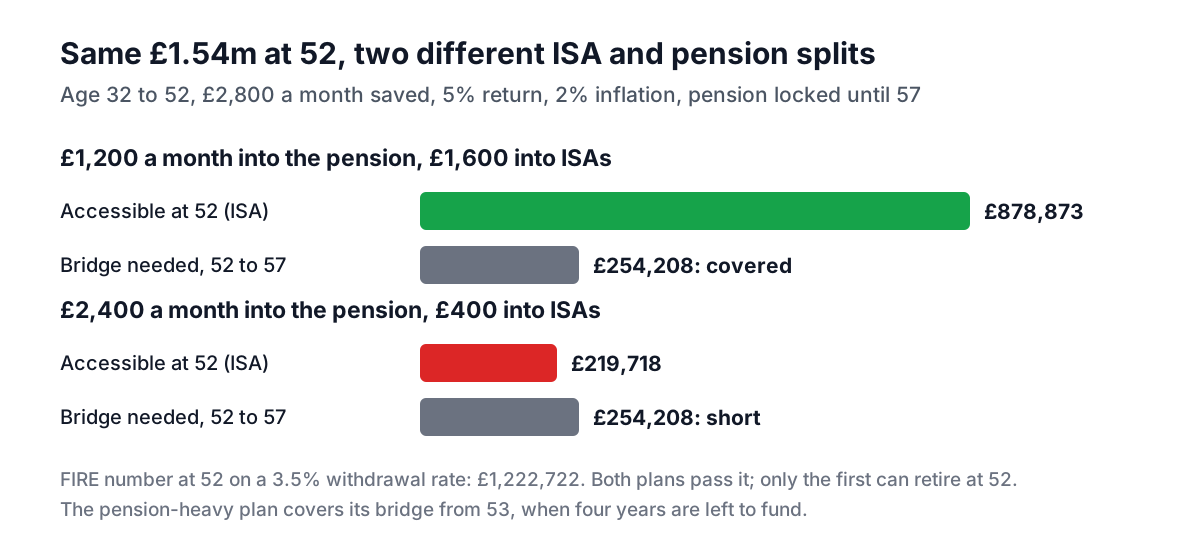
- Projected total at 52: £1,538,029, of which £878,873 is in ISAs.
- Bridge: five years from 52 to 57 need £254,208 of accessible money at 52. Covered more than three times over.
Now keep the same £2,800 a month but route £2,400 of it into the pension, with £20,000 in ISAs and £120,000 in the SIPP today. The total at 52 is identical, £1,538,029, because the planner grows both pots at the same return. But only £219,718 is accessible, against the same £254,208 bridge. On paper this saver is financially independent; in practice the money runs out before 57.
Moving the leaving date shows how quickly the problem fades. For the pension-heavy saver:
| Leave at | Years to bridge | Accessible at that age | Bridge needed | Covered? |
|---|---|---|---|---|
| 50 | 7 | £189,920 | £299,086 | No |
| 52 | 5 | £219,718 | £254,208 | No |
| 53 | 4 | £235,744 | £221,315 | Yes |
| 55 | 2 | £270,240 | £130,526 | Yes |
One extra year at work, or a few hundred pounds a month switched from pension to ISA in the last years, closes the gap. The real choice is between pension tax relief and the freedom to leave early; you can see the trade in pounds before you commit.
Two refinements the planner leaves to you. It grows both pots at one return, but pension contributions in the example are entered including tax relief, which is what actually lands in the SIPP. And it treats the bridge as withdrawals at your chosen rate; if you plan to spend less before 57 and more after, the bridge shrinks.
Where the State Pension fits
The full new State Pension is £241.30 a week, according to GOV.UK, for people with 35 qualifying years on their National Insurance record if it started after April 2016. That is £12,547.60 a year. Replacing that income from a pot at 3.5% would take £358,503, so a full State Pension is worth a large share of a moderate retirement.
It starts at your State Pension age, which the government reviews from time to time. Two cautions for early retirers:
- Gaps in your record. Stopping work at 52 can leave years without National Insurance contributions. Check your forecast on GOV.UK and whether voluntary contributions make sense for you before counting on the full rate.
- Timing. The State Pension arrives 15 years or more after a typical FIRE date. The planner adds it as income from the age you enter but does not shrink the FIRE number for it, so a figure at today's rate leaves the plan on the cautious side.
Tax on the way out
The planner works with spending, not tax. ISA withdrawals are tax-free. Pension withdrawals above the tax-free part are taxed as income, so if your plan draws heavily on a pension after 57, add the tax you expect to pay to your spending. One sequence worth testing is to live on ISAs to 57, then draw pension income up to the level that keeps tax low, with the State Pension filling in later. Whether that order suits you depends on your other income and on rules that change, which is where an adviser earns their fee.
Tools for this job
- UK FIRE Planner: FIRE number, projected pots, and the ISA bridge to your pension access age.
- UK Pension Calculator: a conventional retirement target built on the State Pension, if early retirement is not the goal.
- Compound Interest Calculator: what regular ISA saving grows to at a given return.
- Related reading: how much pension you need to retire in the UK and the US FIRE number guide for the savings-rate table behind the method.
Frequently asked questions
Can I retire at 50 in the UK if most of my money is in a pension?
Only if your accessible money covers the years to your pension access age, 57 for most people from 6 April 2028. In the worked example, a saver with £219,718 in ISAs at 52 falls short of the £254,208 needed to reach 57, even though the total pot passes the FIRE number. Leaving at 53 covers it.
Should I pay into an ISA or a pension for early retirement?
Usually both, in proportions set by your leaving date. Pension contributions get tax relief and 25% of the pot is usually tax-free, but the money is locked until 55, rising to 57. ISA money has no relief going in but can be spent at any age. One way to split it: enough in ISAs to cover the bridge, then the rest in the pension.
Does the 25x rule work for UK early retirees?
Twenty-five times spending is the 4% rule, which came from US data over 30-year retirements. A retirement starting at 50 can last 40 years or more, so many UK planners use 3% to 3.5%, which means 28.6 to 33.3 times spending. On the Pensions UK moderate budget of £32,700 that is £934,286 to £1,090,000.
Will retiring early reduce my State Pension?
It can. The full new State Pension of £241.30 a week needs 35 qualifying years if your record started after April 2016. Years without work or credits after you stop may leave gaps, so check your forecast on GOV.UK and whether voluntary contributions would fill them.
Sources and further reading
- The new State Pension: what you'll get, GOV.UK. Full rate of £241.30 a week; 35 qualifying years for records starting after April 2016.
- Increasing normal minimum pension age, HM Revenue and Customs. Rise from 55 to 57 with effect from 6 April 2028, and protection for earlier rights.
- Personal pensions: how you can take your pension, GOV.UK. Not normally before 55; up to 25% tax-free, at most £268,275.
- Individual Savings Accounts, GOV.UK. £20,000 ISA allowance in the 2026 to 2027 tax year.
- Check your State Pension age, GOV.UK. Your own State Pension age and forecast.
- Retirement Living Standards, Pensions UK. Minimum, moderate and comfortable spending budgets for one and two people.
- Determining Withdrawal Rates Using Historical Data, Journal of Financial Planning. William Bengen's 1994 study behind the 4% rule.
More Planning Tools
Every tool in the Planning Tools section, free and in your browser.