
FIRE in New Zealand: Your Number and the Bridge to 65
Work out a FIRE number in NZ dollars, then the harder test: whether money outside KiwiSaver can carry you to 65, and what NZ Super is worth once you get there.
By Redbison Dev · · 6 min read
New Zealand edition. New Zealand edition in NZ dollars, built around KiwiSaver being locked until the NZ Super age of 65, the KiwiSaver contribution changes from 1 April 2026, NZ Super rates from 1 April 2026 and its residence rules. US edition
In New Zealand your FIRE number is the same sum as anywhere else, yearly spending divided by a withdrawal rate, so a couple spending NZ$84,000 a year at today's prices needs about NZ$2.1 million at 4% before inflation is added. What makes early retirement here different is KiwiSaver. Retiring early is not one of the reasons you can take KiwiSaver money out, so whatever sits in it stays locked until 65. The number tells you when you have enough in total. The bridge tells you whether you can actually stop, because every year between your leaving date and 65 is paid for by money outside KiwiSaver.
This edition works through both with the FIRE Planner (New Zealand), which keeps KiwiSaver separate from your other savings. It explains a planning method, not personal advice. Before you resign, a licensed financial adviser is worth the fee, especially if you have a defined benefit scheme, overseas pensions or a large property portfolio.
Two pots and a locked door
Inland Revenue says you become eligible to withdraw all your KiwiSaver savings at the age of eligibility for NZ Super, currently 65. Before that, the early withdrawal grounds it lists are a first home, moving overseas permanently (but not to Australia), serious illness, a life-shortening congenital condition and significant financial hardship. Stopping work at 52 is not on the list.
So an early retiree has two pots:
| Pot | Examples | When you can spend it |
|---|---|---|
| Accessible | Managed funds and shares outside KiwiSaver, term deposits, savings | Any time |
| Locked | KiwiSaver | From 65 |
The planner's FIRE number counts both pots, but the bridge test only counts the accessible one for the years before 65.
What KiwiSaver gives you, and what changed in 2026
KiwiSaver is still worth having, because some of the money going in is not yours:
- The default employee and employer contribution rates rose from 3% to 3.5% from 1 April 2026, and rise again to 4% from 1 April 2028.
- From 1 July 2025 the government contributes 25 cents for every dollar you contribute in a year, up to NZ$260.72. If your taxable income is over NZ$180,000 you do not qualify.
- At 65 the government contribution stops, but you can keep contributing.
The employer's contribution and the government's are the reason most early retirees keep contributing at the default rate. Saving more than that into KiwiSaver earns no extra employer or government money, and locks the extra until 65.
Worked example 1: a couple aiming for 53
A couple, both 38, spending NZ$7,000 a month between them. They have NZ$250,000 invested outside KiwiSaver and NZ$180,000 in their two KiwiSaver accounts. Their combined income, counting the employers' KiwiSaver contributions, is NZ$13,500 a month, and NZ$1,400 a month of their saving goes into KiwiSaver. In the planner: target age 53, KiwiSaver access age 65, NZ Super of NZ$3,701 a month from 65, 6.5% growth, 2.5% inflation and a 4% withdrawal rate.
- Saving: NZ$13,500 − NZ$7,000 = NZ$6,500 a month, a 48% savings rate.
- Spending at 53: NZ$84,000 grows with 2.5% inflation to NZ$121,657 a year.
- FIRE number at 53: NZ$121,657 ÷ 0.04 = NZ$3,041,426.
- Projected at 53: NZ$3,114,704, so the plan reaches its number at 53.
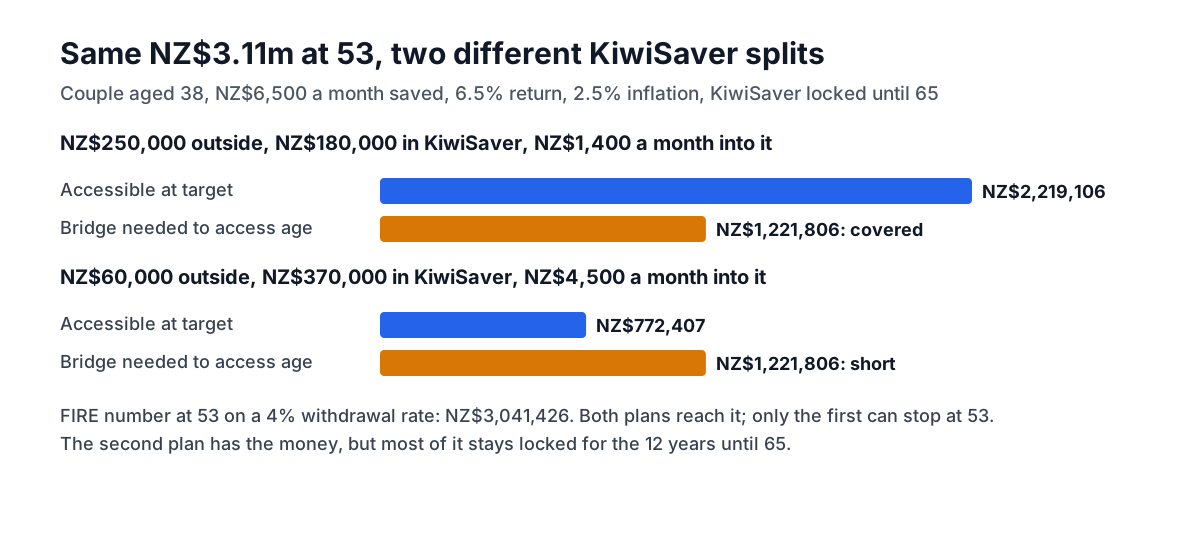
- Bridge: the 12 years from 53 to 65 need NZ$1,221,806 of accessible money at 53, and the plan has NZ$2,219,106 outside KiwiSaver. Covered.
Worked example 2: the same money, locked
Now the same couple with the same income, spending and total savings, but with most of it in KiwiSaver: NZ$60,000 outside, NZ$370,000 inside, and NZ$4,500 a month into KiwiSaver.
The total at 53 is the same NZ$3,114,704, and the FIRE number is passed on time. But only NZ$772,407 is outside KiwiSaver, against NZ$1,221,806 needed for the 12 years to 65. The plan has the money and cannot spend it. When the bridge is short, the planner caps withdrawals at what the accessible pot can pay until KiwiSaver opens.
That is the central lesson for New Zealand FIRE: contribute enough to KiwiSaver to collect the employer and government money, and build the bridge outside it.
Worked example 3: a single saver at 50
The planner's own example: a 35-year-old spending NZ$5,200 a month, with NZ$120,000 outside KiwiSaver, NZ$85,000 in it, NZ$9,500 a month of income and NZ$700 a month into KiwiSaver, at 7% growth and 2.5% inflation.
| Target 50 | Target 53 | |
|---|---|---|
| FIRE number | NZ$2,259,345 | NZ$2,433,068 |
| Projected | NZ$1,953,025 | NZ$2,570,041 |
| Bridge needed to 65 | NZ$882,464 (15 years) | NZ$984,732 (12 years) |
| Outside KiwiSaver | NZ$1,492,648 | NZ$1,977,163 |
At 50 the bridge is covered but the total is short; the plan reaches its number at 53. Moving the target to 53 is the honest version of this plan.
Choosing a withdrawal rate
The 4% rule comes from William Bengen's 1994 study of US returns over 30-year retirements. Someone stopping at 50 may need the money for 40 years or more, so many planners test 3.5%. On the single saver's plan, 3.5% raises the FIRE number at 50 from NZ$2,259,345 to NZ$2,582,109, and the plan reaches it at 55 instead of 53. Run your plan at both rates and treat the gap as the range of reasonable answers.
What NZ Super is worth
NZ Super starts at 65 and, as Work and Income puts it, doesn't depend on your income or your assets, although other income can change your tax code. From 1 April 2026 it pays these fortnightly amounts after tax on the M tax code:
| Situation | A fortnight | About a month |
|---|---|---|
| Single, living alone | NZ$1,110.30 | NZ$2,405 |
| Single, sharing | NZ$1,024.90 | NZ$2,220 |
| Couple, both qualifying | NZ$854.08 each | NZ$3,701 together |
For a single person living alone that is NZ$28,867.80 a year. Valued like a portfolio at a 4% withdrawal rate, it is worth about NZ$721,700; for a couple, NZ$44,412.16 a year is worth about NZ$1.11 million. NZ Super does not shrink your FIRE number at the date you stop, but it is why the planner's withdrawals can fall from 65.
The residence rule
To qualify you must have lived in New Zealand for a set number of years from age 20: 20 years if you were born on or after 1 July 1977, fewer for earlier birth dates, and 5 of those years must be from age 50. That matters to early retirees who plan to spend long periods overseas, since time abroad after 50 can leave you short. Years in a country with a social security agreement may count. If you are unsure, enter 0 for NZ Super and see whether the plan still works.
Tax and the accessible pot
Money outside KiwiSaver is taxed as it earns: interest and dividends each year, and some overseas share holdings under their own rules. The planner uses a single growth rate, so use an after-tax figure for the accessible pot if your investments are taxed along the way. Inland Revenue's tax rate tables show what your marginal rate is.
Tools for this job
- FIRE Planner (New Zealand): FIRE number, years to FI, and the bridge test with KiwiSaver locked until 65.
- Compound Interest Calculator: how a single pot grows; see the compound interest guide.
- Retirement Calculator: a conventional plan to 65 for comparison.
- The US version of this guide, Your FIRE number: the 4% rule and years to financial independence, goes further into where the 4% rule comes from.
Frequently asked questions
Can I take my KiwiSaver out if I retire early?
No. Inland Revenue says you can withdraw all your KiwiSaver savings at 65, the NZ Super age. Before then the grounds are a first home, permanent emigration (not to Australia), serious illness, a life-shortening congenital condition and significant financial hardship.
Should early retirees put more into KiwiSaver?
Usually only up to the rate that earns the full employer contribution and government contribution. Extra money goes in on the same terms but stays locked until 65. In the second example, putting NZ$4,500 a month into KiwiSaver left the couple NZ$449,399 short of the money they needed outside it.
Will NZ Super be paid if I live overseas after retiring early?
It depends on your residence. You need 20 years in New Zealand from age 20 if born on or after 1 July 1977, including 5 years from age 50. Long periods abroad after 50 can affect that; check with Work and Income before you plan on it.
How much do I need to retire early in New Zealand?
About 25 times your yearly spending at the date you stop at a 4% withdrawal rate, or about 28.6 times at 3.5%. A couple spending NZ$7,000 a month today needs about NZ$3.04 million by 53 at 2.5% inflation, plus enough outside KiwiSaver to reach 65.
Sources and further reading
- Getting my KiwiSaver savings when I retire, Inland Revenue. Withdraw all savings at the age of eligibility, currently 65; no government contribution after 65.
- Getting my KiwiSaver savings early, Inland Revenue. The early withdrawal grounds.
- KiwiSaver changes, Inland Revenue. 3.5% default from 1 April 2026 and 4% from 1 April 2028; government contribution of 25 cents per dollar up to NZ$260.72; NZ$180,000 income cap.
- NZ Super, Work and Income. You can work while you get NZ Super, and it doesn't depend on your income or assets; other income may change your tax code.
- How much you can get for NZ Super, Work and Income. Fortnightly rates from 1 April 2026.
- Who can get NZ Super, Work and Income. Age 65; residence years from 20 by date of birth; 5 years from 50.
- Tax rates for individuals, Inland Revenue. Marginal tax rates.
- Determining Withdrawal Rates Using Historical Data, Journal of Financial Planning. William Bengen's 1994 study behind the 4% rule.
More Planning Tools
Every tool in the Planning Tools section, free and in your browser.