
Running Pace, Heart Rate Zones and 1RM: A Canadian Guide
Pace for a 10K in km and miles, half marathon predictions, heart rate zones for Canada's 150-minute guideline, 1RM in pounds and Calories for winter sports.
By Redbison Dev · · 10 min read

Canada edition. Written for Canadian runners: the Canadian 24-Hour Movement Guidelines (150 minutes a week plus strength twice a week), running and shovelling through winter with Health Canada's cold-weather advice, body weight and gym loads in pounds, and Calories as on Canadian labels. US edition
A 10K in 55:00 is 5:30 per kilometre, or 8:51 per mile, and Riegel's formula predicts a half marathon of about 2:01:21 from it, provided you build the long runs first and race in similar conditions. This edition follows one runner, a 52-year-old who weighs 180 lb and has a resting heart rate of 62, through a Canadian training year: pace and race predictions, heart rate zones set beside the Canadian 24-Hour Movement Guidelines, strength work with the bar loaded in pounds, and the Calories in a winter of running, skiing and shovelling. The numbers come from the Running Pace Calculator, the Target Heart Rate Calculator (Canada), the One Rep Max Calculator and the Calories Burned Calculator (Canada).
This is general fitness information. If you have a heart condition or take medication that affects your heart rate, talk to your doctor before training to heart rate targets or taking on heavy snow clearing.
What the Canadian guidelines ask for
The Canadian 24-Hour Movement Guidelines for adults aged 18 to 64, published by the Canadian Society for Exercise Physiology, set out a whole day rather than just a workout (CSEP adult guidelines):
| Part of the day | Guideline |
|---|---|
| Moderate to vigorous aerobic activity | At least 150 minutes a week |
| Muscle strengthening | Major muscle groups, at least twice a week |
| Light activity | Several hours, including standing |
| Sedentary time | 8 hours or less, with no more than 3 hours of recreational screen time |
| Sleep | 7 to 9 hours of good-quality sleep |
The guidelines lump moderate and vigorous together, so a hard run and a brisk walk both count toward the 150 minutes. They give no heart rate for the moderate bar. The simple check is the talk test: at moderate intensity you can talk but not sing (CDC, measuring physical activity intensity). The heart rate bands below give you a number to set beside it.
Pace in kilometres and miles
If your race is measured in kilometres but a training plan, watch or treadmill speaks in miles, you need both. Pace is time divided by distance, and a mile is exactly 1.609344 km:
| What you type | Result |
|---|---|
| 10 km in 55:00 | 5:30 per km |
| Per mile (× 1.609344) | 8:51 per mile |
| Speed (3,600 / 330 s) | 10.9 km/h, about 6.8 mph |
| Halfway split at even pace | 27:30 |
From a 10K to a half marathon and a marathon
Peter Riegel's power law, T2 = T1 × (D2 / D1)^1.06, slows pace a little over 4% each time distance doubles. From the 55:00 10K, the pace calculator gives:
| Race | Predicted time | Pace per km | Pace per mile |
|---|---|---|---|
| 5K | 26:23 | 5:17 | 8:29 |
| 10K (input) | 55:00 | 5:30 | 8:51 |
| Half marathon | 2:01:21 | 5:45 | 9:15 |
| Marathon | 4:13:01 | 6:00 | 9:39 |
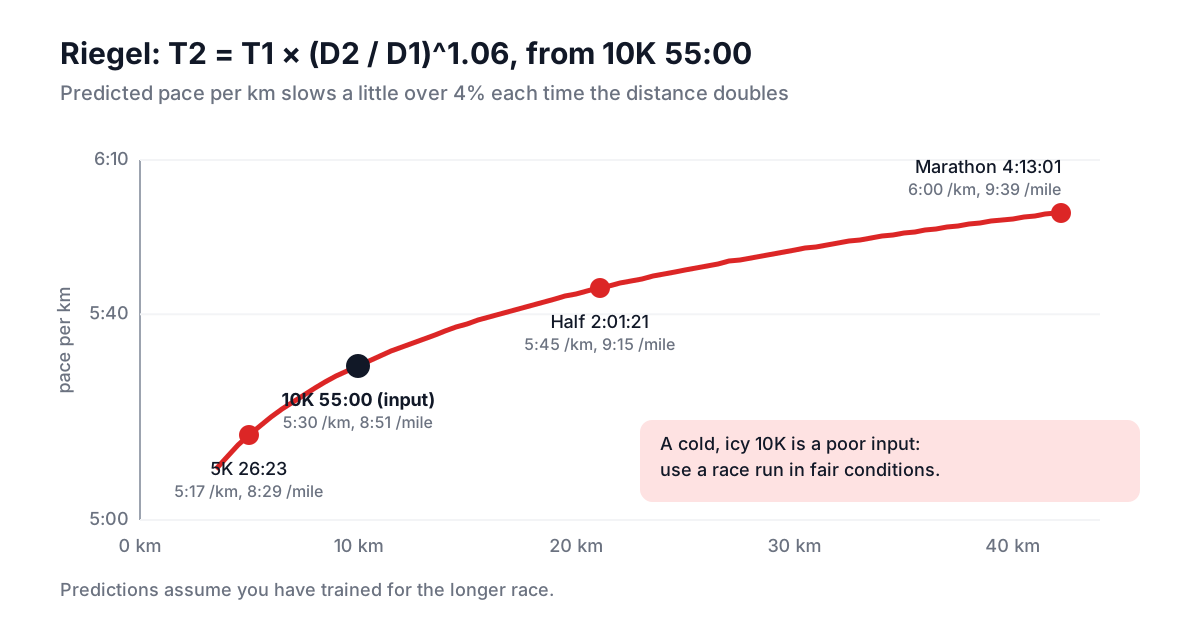
Trust the half marathon row most; it is close to the input. The marathon row assumes you have trained for it, and a common rule of thumb is to add 5 to 10% for recreational runners, which puts this runner between 4:25:40 and 4:38:19.
Season matters in Canada in a way the formula cannot see. A 10K run in January on packed snow, or into a cold headwind, understates your fitness; feed it into Riegel and every prediction comes out slow. Use a result from a race run in fair conditions, and treat winter runs as effort-based training rather than pace tests.
Running and shovelling in the cold
Health Canada's extreme cold advice is broadly encouraging about winter sport: being active outdoors in winter is "a great way to stay healthy" (Health Canada, extreme cold). Its practical points translate directly to a winter runner:
- Wind chill: the risk of frostbite and windburn rises when the wind chill drops below -27. Cover the nose, ears and hands, which freeze first.
- Layers: a wind-resistant outer layer over insulating layers, with synthetic or wool fabrics. Take a layer off before you start sweating and change out of wet clothing quickly, because wet skin loses heat faster.
- Shovelling: Health Canada suggests people with a heart condition consider skipping strenuous tasks such as shovelling snow.
For pacing, run by effort and heart rate in the cold and on ice, not by minutes per kilometre.
Heart rate zones for a 52-year-old
The heart rate bands most often quoted come from the American Heart Association, which puts moderate at about 50 to 70% of maximum heart rate and vigorous at about 70 to 85%. The Karvonen method applies the same percentages to heart rate reserve (maximum minus resting) and adds them to the resting rate, which gives higher numbers; those are training zones, not the AHA bands. With a resting heart rate of 62 bpm, measured on waking, the Target Heart Rate Calculator (Canada) gives:
| Method | Maximum | 50 to 70% | 70 to 85% |
|---|---|---|---|
| % of maximum, Tanaka (the AHA moderate and vigorous bands) | 172 bpm | 86 to 120 bpm | 120 to 146 bpm |
| % of heart rate reserve (Karvonen), Tanaka | 172 bpm | 117 to 139 bpm | 139 to 155 bpm |
| % of heart rate reserve (Karvonen), 220 minus age | 168 bpm | 115 to 136 bpm | 136 to 152 bpm |
| % of heart rate reserve (Karvonen), Gulati (women) | 160 bpm | 111 to 131 bpm | 131 to 146 bpm |
At 52, the formulas start to disagree: 220 minus age gives 168 bpm, Tanaka's 208 minus 0.7 × age gives 172. The bigger difference is the scale: the reserve figures come out 9 to 31 bpm higher than the same percentages of maximum, so do not count guideline minutes against them. Each formula has a spread of about 10 bpm, so a chest strap reading at the end of a hard race is better evidence of your maximum than any of them.
For the 150-minute guideline, go by the talk test: a 45-minute easy run in zone 2 (128 to 139 bpm), at a pace where this runner can talk but not sing, counts in full as moderate activity.
Estimating a one-rep max in pounds
Strength work twice a week is the half of the guideline that is easiest to skip. Programs are often set as percentages of a one-rep max, which you can estimate from a heavier set taken close to failure. The equations work in any unit, so a gym with plates in pounds needs no conversion.
Say the runner benches 225 lb for 5 reps. The One Rep Max Calculator gives 253.1 lb (Brzycki and O'Conner) up to 267.8 lb (Mayhew), with an average of 259.9 lb across seven formulas. A training max at 90% is 233.9 lb, and working back from the average, a set of 8 would be about 207 lb.
With 3 to 6 reps the formulas agree within about 6%. At 15 reps they diverge widely, because a long set tests endurance as much as strength, so keep test sets heavy.
Calories for a Canadian winter
Canadian nutrition facts tables show the Calories in a serving (Health Canada, nutrition facts table), and the Calories Burned Calculator (Canada) uses the same unit. It applies METs from the 2024 Adult Compendium of Physical Activities: Calories per minute = MET × 3.5 × kg / 200. At 180 lb (81.6 kg):
| Session | MET | Total | Above resting |
|---|---|---|---|
| 10K in 55:00 (about 6.7 mph) | 10.5 | 825 Calories | 747 Calories |
| Shovelling snow by hand, 40 minutes | 5.3 | 303 Calories | 246 Calories |
| Cross-country skiing, moderate, 60 minutes | 8.5 | 729 Calories | 643 Calories |
Use the "above resting" column if you add exercise to a daily Calorie budget, because your resting burn is already counted in your maintenance figure. Treat every figure as an estimate within about 20%: the Compendium values are averages, and heavy wet snow or deep powder costs far more than a groomed trail. For the food side, see the Canadian calorie deficit guide and the Canadian TDEE guide.
A year of training in four lines
- Spring and fall: race a 5K or 10K in fair weather and update your predictions.
- Summer: build long runs toward the half marathon, keeping easy runs in zone 2.
- Winter: run by effort, add skiing or skating, and count shovelling as activity, not training.
- All year: strength twice a week, using the 1RM estimate to set loads.
Tools for this job
- Running Pace Calculator: pace per km and per mile, splits and Riegel predictions.
- Target Heart Rate Calculator (Canada): Karvonen and percentage zones, with the AHA moderate and vigorous bands set on maximum heart rate.
- One Rep Max Calculator: seven 1RM formulas, in pounds or kilograms.
- Calories Burned Calculator (Canada): Calories for running, shovelling, skiing, skating and hockey.
The US edition of this guide covers the history of each formula in more depth.
Frequently asked questions
Does shovelling snow count toward the 150 minutes?
Yes, when it is hard enough. Shovelling by hand is 5.3 MET in the 2024 Compendium, a moderate effort on the MET scale, where 3 to 5.9 MET is moderate (CDC, measuring physical activity intensity), and 40 minutes burns about 303 Calories at 180 lb. People with heart conditions should take Health Canada's advice and consider skipping strenuous snow clearing.
What half marathon time does a 55-minute 10K predict?
About 2:01:21, or 5:45 per kilometre (9:15 per mile), using Riegel's formula. It assumes you have built up long runs and race in similar conditions; a hot or icy day will be slower.
Should I trust pace in the winter?
Not as a fitness test. Snow, ice, wind and heavy clothing slow every kilometre. Run winter sessions by effort or heart rate, and save pace targets for races and spring time trials.
How many Calories does cross-country skiing burn?
At moderate speed it is 8.5 MET, so a 180 lb skier burns about 729 Calories in an hour, of which about 643 are above resting. Deep snow and hills push the real figure up.
Can I use a 1RM calculator with pound plates?
Yes. The formulas multiply the weight lifted by a factor that depends only on the reps, so the result comes out in whatever unit you entered. 225 lb for 5 reps averages about 260 lb.
Sources and further reading
- Canadian 24-Hour Movement Guidelines for Adults aged 18 to 64, Canadian Society for Exercise Physiology. 150 minutes of moderate to vigorous activity, strength twice a week, sleep and sedentary time.
- Extreme cold, Health Canada. Wind chill and frostbite, layering, and shovelling with a heart condition.
- Nutrition facts tables, Health Canada. How Calories and % Daily Value appear on labels.
- Measuring Physical Activity Intensity, US CDC. The talk test, and 3 to 5.9 MET as moderate intensity.
- Age-predicted maximal heart rate revisited, Journal of the American College of Cardiology. Tanaka, Monahan and Seals, 2001.
- Strength Testing: Predicting a One-Rep Max from Reps-to-Fatigue, Journal of Physical Education, Recreation and Dance. Brzycki, 1993.
- 2024 Adult Compendium of Physical Activities, Journal of Sport and Health Science. Herrmann and colleagues.
- Book of Rules, World Athletics. Official road race distances.
Open the Running Pace Calculator
More Fitness Calculators
Every tool in the Fitness Calculators section, free and in your browser.
- BMI Calculator
- Calorie Calculator
- Protein Calculator
- Hydration Calculator
- Calorie Deficit Planner
- Body Fat Calculator
- Ideal Weight Calculator
- Running Pace Calculator
- Target Heart Rate Calculator
- One Rep Max Calculator
- Barbell Plate Calculator
- RPE Calculator
- Interval Timer
- Calories Burned Calculator
- Body Surface Area Calculator
- Waist-to-Hip Ratio Calculator
- VO2 Max Calculator
- Steps to Distance & Calories Calculator