
Running Pace, Heart Rate Zones and Kilojoules in Australia
Pace per km, a City2Surf time from your half marathon, heart rate zones for Australia's activity guidelines, 1RM in kg, and exercise energy in kilojoules.
By Redbison Dev · · 10 min read

Australia edition. Written for Australian runners: kilometre pace and the 14 km City2Surf, Australia's 150 to 300 minute activity guidelines from healthdirect, sun and the 10% rule, and exercise energy in kilojoules as on Australian food labels. US edition
If you ran a half marathon in 2:05:00, you averaged 5:55 per kilometre, and Riegel's formula predicts 56:39 for a 10K and about 1:20:56 for a flat 14 km; on the hilly City2Surf course, expect slower. This edition follows one runner, a 58-year-old weighing 75 kg with a resting heart rate of 64, through pace, race predictions, heart rate zones set beside Australia's physical activity guidelines, strength work in kilograms, and exercise energy in kilojoules, the unit on Australian food labels. The figures come from the Running Pace Calculator (Australia), the Target Heart Rate Calculator (Australia), the One Rep Max Calculator and the Kilojoules Burned Calculator.
This is general fitness information. healthdirect suggests that people over 40 consider seeing a doctor before they start running, and anyone on heart medication should ask their GP before training to heart rate targets.
Australia's guidelines in minutes
healthdirect gives adults a range rather than a single number: 2 hours 30 minutes to 5 hours of moderate activity a week, or 1 hour 15 minutes to 2 hours 30 minutes of intense activity (healthdirect, cardiovascular exercise). Moderate activity "makes your heart rate go up but does not make you feel breathless"; intense activity "will make you breathe heavily". Its strength training page adds that the Australian physical activity guidelines suggest adults do strength training at least 2 times a week (healthdirect, strength training for beginners).
Its running advice adds three rules worth building a plan around (healthdirect, running tips):
- increase your distance by no more than 10% a week;
- let your body rest for 24 to 48 hours between runs;
- drink extra water before and after running, and wear sunscreen and a hat.
Pace per kilometre and the half marathon
If your races, watch and treadmill work in kilometres, pace per km is the number to learn. Pace is time divided by distance:
| What you type | Result |
|---|---|
| 21.0975 km in 2:05:00 | 5:55 per km |
| Treadmill speed (3,600 / 355.5 s) | 10.1 km/h |
| 10 km split at even pace | 59:15 |
| Per mile, for overseas plans (× 1.609344) | 9:32 per mile |
Predicting a 10K, the City2Surf and a marathon
Peter Riegel's formula, T2 = T1 × (D2 / D1)^1.06, slows pace a little over 4% each time the distance doubles. From the 2:05:00 half, the Running Pace Calculator (Australia) gives:
| Race | Predicted time | Pace per km |
|---|---|---|
| 10K | 56:39 | 5:40 |
| 14 km, flat | 1:20:56 | 5:47 |
| Half marathon (input) | 2:05:00 | 5:55 |
| Marathon (42.195 km) | 4:20:37 | 6:11 |
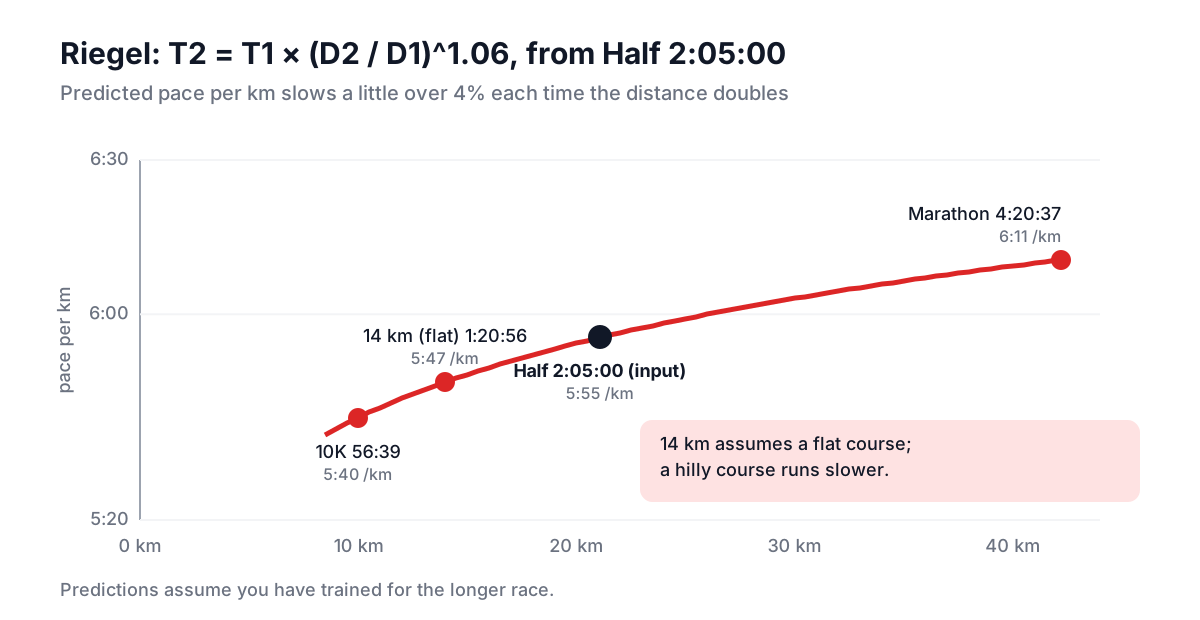
The City2Surf is a 14 km run from Sydney's CBD to Bondi, and its course includes Heartbreak Hill (City2Surf). Riegel's 1:20:56 assumes flat ground, so treat it as the best case. On the day, hold your effort up the hill and let the pace fall, rather than chasing 5:47 per km on the climb.
Predicting down (from a half to a 10K) is usually more reliable than predicting up, because you have already shown the endurance. The marathon row is the weak one: a common rule of thumb is to add 5 to 10% for runners without a long marathon build-up, which puts this runner at 4:33:39 to 4:46:41. Summer heat slows every row too; a result from a cool winter race overpredicts a hot one.
Heart rate zones at 58
healthdirect describes moderate and intense activity by how they feel, not by heart rate. The heart rate bands most often quoted come from the American Heart Association, which puts moderate at about 50 to 70% of maximum heart rate and vigorous at about 70 to 85%. The Karvonen method applies the same percentages to heart rate reserve (maximum minus resting) and adds them to the resting rate, which gives higher numbers; those are training zones, not the AHA bands. With a resting heart rate of 64 bpm, measured on waking, the Target Heart Rate Calculator (Australia) gives:
| Method | Maximum | 50 to 70% | 70 to 85% |
|---|---|---|---|
| % of maximum, Tanaka (the AHA moderate and vigorous bands) | 167 bpm | 84 to 117 bpm | 117 to 142 bpm |
| % of heart rate reserve (Karvonen), Tanaka | 167 bpm | 116 to 136 bpm | 136 to 152 bpm |
| % of heart rate reserve (Karvonen), 220 minus age | 162 bpm | 113 to 133 bpm | 133 to 147 bpm |
| % of heart rate reserve (Karvonen), Gulati (women) | 155 bpm | 109 to 128 bpm | 128 to 141 bpm |
By 58 the formulas have drifted apart: 220 minus age gives 162 bpm, Tanaka's 208 minus 0.7 × age gives 167. The scale matters even more: the reserve figures start 32 bpm above the AHA moderate band, so do not count guideline minutes against them. Each formula has a spread of about 10 bpm, so if your chest strap regularly shows higher numbers at the end of hard races, believe the strap.
Against the guidelines, go by how the effort feels: this runner's easy runs in zone 2 (126 to 136 bpm) count as moderate when they raise the heart rate without making them breathless, and a hard parkrun-style 5K that makes them breathe heavily counts as intense. Three 45-minute easy runs come to 135 moderate minutes; add one 25-minute hard effort and the week is well inside the 150 to 300 minute range, because one intense minute counts roughly as two moderate ones in the guideline ranges.
One-rep max in kilograms
Strength programmes are written as percentages of a one-rep max. Rather than test a true single, use a heavier set close to failure. Say the runner deadlifts 140 kg for 3 reps. The One Rep Max Calculator gives estimates from 148.2 kg (Brzycki) to 159.6 kg (Mayhew), averaging 153.0 kg across seven formulas. A training max at 90% is 137.7 kg, and a set of 5 would be about 133.6 kg.
With 3 to 6 reps the formulas stay close. At 15 reps or more they spread widely, because a long set tests endurance as much as strength.
Kilojoules, not calories
Australian food labels list energy in kilojoules, per 100 g and sometimes per serving, and healthdirect gives about 8,700 kJ a day as a typical adult intake (healthdirect, kilojoules). So the useful question is how many kilojoules a session uses. The Kilojoules Burned Calculator uses METs from the 2024 Adult Compendium of Physical Activities (energy per minute = MET × 3.5 × kg / 200 kcal, then × 4.184 for kJ). For a 75 kg person:
| Session | MET | Total | Above resting |
|---|---|---|---|
| Run, 30 minutes at about 6:13 per km (10 min/mile) | 9.3 | 1,530 kJ | 1,370 kJ |
| Brisk walk, 45 minutes (5.6 to 6.3 km/h) | 4.8 | 1,190 kJ | 940 kJ |
healthdirect rounds the conversion to 4.2 kJ per kcal; the calculator uses the exact 4.184, a difference of under half a per cent. More important is which column you use. If you add exercise to a daily kilojoule budget, take the "above resting" figure, because your resting use is already in your maintenance estimate. And treat both as estimates within about 20%: the Compendium values are averages. The run above is about 18% of an 8,700 kJ day.
For the food side, the Australian calorie deficit guide and the Australian TDEE guide work in kilojoules too.
A week that follows healthdirect's rules
- Monday: strength session, deadlifts and squats from the 1RM estimate.
- Tuesday: easy 45-minute run in zone 2.
- Wednesday: strength session.
- Thursday: a hard 5K or tempo run, early before the heat.
- Saturday: long easy run, growing by no more than 10% a week as a 14 km race or half marathon approaches.
No two runs fall on consecutive days, so there is a full rest day between runs, in line with healthdirect's 24 to 48 hours of rest, and the week hits both the aerobic and strength targets.
Tools for this job
- Running Pace Calculator (Australia): pace per km, splits, treadmill speed and Riegel predictions for any distance, including 14 km.
- Target Heart Rate Calculator (Australia): Karvonen and percentage zones, with the AHA moderate and vigorous bands set on maximum heart rate.
- One Rep Max Calculator: seven 1RM formulas side by side.
- Kilojoules Burned Calculator: kJ for running, walking, surfing, mowing and more.
The US edition of this guide explains the research behind each formula.
Frequently asked questions
How long will the City2Surf take me?
Enter a recent race into the pace calculator and read the time for 14 km. From a 2:05:00 half marathon, Riegel predicts 1:20:56 for a flat 14 km. The real course has Heartbreak Hill, so plan for a few minutes more.
How many kilojoules does a 30-minute run burn?
At about 10-minute-mile pace (9.3 MET), a 75 kg runner uses about 1,530 kJ in total, of which about 1,370 kJ is above resting. A heavier or faster runner uses more.
How many minutes of exercise should Australian adults do?
healthdirect gives 2 hours 30 minutes to 5 hours of moderate activity a week, or 1 hour 15 minutes to 2 hours 30 minutes of intense activity, or a mix. healthdirect also says the Australian guidelines suggest strength training at least 2 times a week.
How fast can I increase my running distance?
healthdirect advises no more than 10% a week, with 24 to 48 hours of rest between runs. From 30 km a week, the next week's ceiling is 33 km.
What is my maximum heart rate at 58?
About 167 bpm by Tanaka's formula and 162 by 220 minus age. Individual maximums vary by roughly 10 bpm either side, so a measured figure from a hard race beats both.
Sources and further reading
- Cardiovascular exercise, healthdirect Australia. Weekly guidelines for moderate and intense activity and how each feels.
- Running tips, healthdirect Australia. The 10% rule, rest between runs, water and sun protection.
- Strength training for beginners, healthdirect Australia. The Australian physical activity guidelines' strength training at least 2 times a week.
- Kilojoules, healthdirect Australia. 4.2 kJ per kcal, about 8,700 kJ a day for an average adult, and kJ on food labels.
- City2Surf, City2Surf. The 14 km course from Sydney's CBD to Bondi, including Heartbreak Hill.
- Age-predicted maximal heart rate revisited, Journal of the American College of Cardiology. Tanaka, Monahan and Seals, 2001.
- 2024 Adult Compendium of Physical Activities, Journal of Sport and Health Science. Herrmann and colleagues.
- Strength Testing: Predicting a One-Rep Max from Reps-to-Fatigue, Journal of Physical Education, Recreation and Dance. Brzycki, 1993.
Open the Running Pace Calculator
More Fitness Calculators
Every tool in the Fitness Calculators section, free and in your browser.
- BMI Calculator
- Calorie Calculator
- Protein Calculator
- Hydration Calculator
- Calorie Deficit Planner
- Body Fat Calculator
- Ideal Weight Calculator
- Running Pace Calculator
- Target Heart Rate Calculator
- One Rep Max Calculator
- Barbell Plate Calculator
- RPE Calculator
- Interval Timer
- Calories Burned Calculator
- Body Surface Area Calculator
- Waist-to-Hip Ratio Calculator
- VO2 Max Calculator
- Steps to Distance & Calories Calculator