
Calorie Deficit and Weight Loss in Pounds: A Canadian Guide
Why Canada's obesity guideline calls the 3,500-calorie rule not valid, how appetite pushes back as you lose, and how to plan a deficit in pounds.
By Redbison Dev · · 6 min read
Canada edition. Plans in pounds and inches with calories, and reads the planner against the Canadian Adult Obesity Clinical Practice Guidelines (Obesity Canada) and Health Canada's weight classification rather than US guidance. US edition
A deficit of 500 calories a day is still the most common advice for losing about a pound a week, and the Canadian calorie deficit planner uses it to give you a target and a date. Canada's own clinical guideline is blunter about that rule than most websites. The medical nutrition therapy chapter of the Canadian Adult Obesity Clinical Practice Guidelines, published by Obesity Canada, says the common recommendation that a 500-calorie daily deficit produces 1 lb of loss a week "is not valid", because weight loss is not linear. This guide explains why, shows what the planner's numbers mean in pounds, and how to use them without being misled.
It is general information, not medical advice. If you take insulin or diabetes pills that can cause low blood sugar, are pregnant, or have a history of disordered eating, plan any change with your family doctor or a registered dietitian.
What the Canadian guideline says about cutting calories
The chapter, by Brown, Clarke, Johnson Stoklossa and Sievenpiper (version 2, October 2022), makes four points worth knowing before you set a number:
- Calorie restriction works in the short term but is hard to sustain. Calorie-restricted diets can reduce weight over the first 6 to 12 months, but the change has often not been sustained beyond 12 months.
- The body pushes back. It cites Polidori and colleagues, who estimated that appetite rises by about 100 calories a day for every kilogram of weight lost.
- The size of the cut has names. Trials fall into moderate-calorie (1,300 to 1,500 calories a day), low-calorie (900 to 1,200) and very low-calorie (under 900) diets.
- Very low-calorie diets need support. In a meta-analysis, a very low-calorie diet inside a behavioural program gave more weight loss at 12 months than the behavioural program alone, and there was no evidence that one works without behavioural support.
The guideline also tells clinicians to judge success by health outcomes such as waist circumference, blood sugar, lipids and blood pressure, not weight alone. That is worth copying at home: measure your waist when you weigh yourself.
Worked example: 210 lb to 190 lb
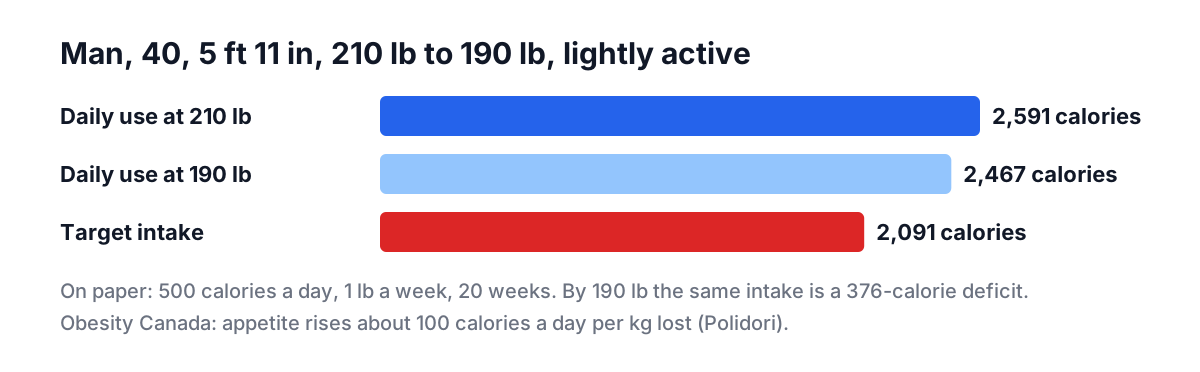
A 40-year-old man, 5 ft 11 in (71 in), 210 lb, lightly active, goal 190 lb, moderate deficit:
| Step | Value |
|---|---|
| BMR (Mifflin-St Jeor) | 1,885 calories |
| Daily use (x 1.375) | 2,591 calories |
| Target intake | 2,091 calories |
| Deficit | 500 calories a day |
| Pace on paper | 1 lb a week |
| Time on paper | 20 weeks |
Twenty pounds is about 9.5% of his weight, just inside the planner's 10% limit for a first goal. His BMI falls from 29.3 to 26.5, still in Health Canada's overweight band, so this is stage one.
Now the two effects the guideline warns about. First, his body uses less as it shrinks: run the planner again at 190 lb and his daily use is 2,467 calories, 124 fewer. If he kept eating 2,091, his deficit would be down to about 376 calories by the end. Second, appetite: 20 lb is about 9 kg, and on Polidori's estimate that is roughly 900 extra calories a day of appetite pressure by the time he gets there. The planner's 20 weeks is the earliest possible date. Re-running every 10 lb and expecting the last stretch to be the hardest is the honest plan.
Worked example: a smaller deficit for a smaller body
A 45-year-old woman, 5 ft 5 in (65 in), 175 lb, sedentary, goal 160 lb:
| Setting | Target intake | Deficit | Pace | Time on paper |
|---|---|---|---|---|
| Conservative | 1,478 calories | 250 | 0.5 lb/week | about 30 weeks |
| Moderate | 1,228 calories | 500 | 1 lb/week | about 15 weeks |
Her sedentary daily use is only 1,728 calories. The moderate setting puts her at 1,228, just above the 1,200 floor the planner will not cross and just below the moderate-calorie band (1,300 to 1,500) in the Obesity Canada chapter. That is a large share of her intake to cut: 29%. The conservative plan is slow, but it sits in the moderate-calorie band and is far easier to keep. Adding activity moves her daily use up and is the better way to speed it up.
How the planner's floor and limits work
- Intake is never set below 1,200 calories for women or 1,500 for men.
- A first goal larger than 10% of current weight, or more than 44 lb, is rejected with a prompt to set a smaller one.
- The weekly pace is judged against 0.5 to 1.5 lb a week.
- The date uses 3,500 calories per pound, which the Canadian guideline says does not describe real, non-linear loss. Treat it as a lower bound.
Pounds, kilograms and labels
Most Canadians weigh themselves in pounds, while health records often use kilograms. The planner works in either: switch the unit and enter height in inches or centimetres. The same woman in kilograms (79.4 kg to 72.6 kg, 165 cm) gets a target within a calorie of the pound version. On Canadian nutrition facts tables, calories are listed per serving, and the % Daily Value guide is that 5% or less is a little and 15% or more is a lot, which helps when you are looking for lower-calorie swaps.
Common mistakes
- Choosing a pace from the date you want. Pick a deficit you can keep for months, then accept the date.
- Not re-running the plan. Your maintenance number falls as you lose; re-run every 10 lb.
- Over-rating activity. "Moderate" for a desk job with weekend walks inflates daily use; the Canadian TDEE guide shows how to choose.
- Cutting protein with calories. Keep protein up to protect muscle; the Canadian protein calculator gives a target.
Tools for this job
- Calorie deficit planner (Canada): target calories, pace in pounds a week and a goal date.
- Calorie calculator (Canada): your maintenance estimate.
- Macro calculator (Canada): turns the target into grams against Health Canada's ranges.
- Ideal weight calculator (Canada): the normal-weight range in pounds for your height. The Canadian body composition guide adds the 102 cm and 88 cm waist cut-offs.
Frequently asked questions
Is the 3,500-calorie rule true?
As a measure of the energy stored in a pound of fat tissue it is a fair estimate. As a forecast it is not: the Canadian obesity guideline's nutrition chapter calls the idea that a 500-calorie daily deficit gives 1 lb a week "not valid", because loss is not linear and appetite rises as weight falls.
How long will it take to lose 20 lb?
On a steady 500-calorie deficit, 20 weeks on paper. In practice expect longer: daily energy use falls as you lose, and appetite pushes back by roughly 100 calories a day per kilogram lost, on the estimate the guideline cites.
Is 1,200 calories a day too low?
It is the lowest target the planner sets for women, and the Obesity Canada chapter classes 900 to 1,200 calories a day as a low-calorie diet. For a small, sedentary person it may be the only way to reach a 500-calorie deficit, which is a good reason to add activity instead.
What should I track besides weight?
Waist circumference, and if you have them, blood sugar, cholesterol and blood pressure. The Canadian guideline asks clinicians to focus on health outcomes and quality of life, not weight change alone.
Sources and further reading
- Canadian Adult Obesity Clinical Practice Guidelines: Medical Nutrition Therapy in Obesity Management, Obesity Canada. Brown, Clarke, Johnson Stoklossa and Sievenpiper, version 2, 2022.
- Canadian Guidelines for Body Weight Classification in Adults: quick reference tool, Health Canada. BMI bands and waist cut-offs.
- Nutrition facts tables, Health Canada. Calories per serving and the 5% and 15% Daily Value guide.
- Quantification of the effect of energy imbalance on bodyweight, The Lancet, 2011. Hall and colleagues.
- A new predictive equation for resting energy expenditure in healthy individuals, The American Journal of Clinical Nutrition, 1990. Mifflin, St Jeor and colleagues.
- Caloric Equivalents of Gained or Lost Weight, The American Journal of Clinical Nutrition, 1958. Wishnofsky.
Open the Calorie Deficit Planner
More Fitness Calculators
Every tool in the Fitness Calculators section, free and in your browser.
- BMI Calculator
- Calorie Calculator
- Protein Calculator
- Hydration Calculator
- Calorie Deficit Planner
- Body Fat Calculator
- Ideal Weight Calculator
- Running Pace Calculator
- Target Heart Rate Calculator
- One Rep Max Calculator
- Barbell Plate Calculator
- RPE Calculator
- Interval Timer
- Calories Burned Calculator
- Body Surface Area Calculator
- Waist-to-Hip Ratio Calculator
- VO2 Max Calculator
- Steps to Distance & Calories Calculator