
Running Pace, Heart Rate Zones and 1RM: A UK Guide
After Couch to 5K: your pace in min/km and min/mile, 10-mile and half marathon predictions, heart rate zones for the UK 150-minute target, 1RM and kcal.
By Redbison Dev · · 10 min read

United Kingdom edition. Written for UK runners: Couch to 5K and a first 10-mile race, pace in kilometres and miles, the UK Chief Medical Officers' 150 and 75 minute targets with the talk test, body weight in stones and energy in kcal. US edition
You finished the NHS Couch to 5K plan, kept going, and now run 5 km in 27:30. That is 5:30 per kilometre or 8:51 per mile, and Riegel's formula turns it into about 1:35 for a 10-mile race and 2:06:30 for a half marathon, provided you train for the longer distance first. This edition follows that runner, a 47-year-old weighing 12 st 6 lb, through pace, race predictions, heart rate zones, strength work and calories, with the UK's own activity guidelines alongside. Each number comes from the Running Pace Calculator (UK), the Target Heart Rate Calculator (UK), the One Rep Max Calculator or the Calories Burned Calculator (UK), so you can repeat it with your own figures.
This is general fitness information. If you have a heart condition, take medicines that affect your heart rate, or have been told to limit exercise, ask your GP before you train to heart rate targets.
Kilometres, miles and the UK habit of using both
The NHS describes Couch to 5K as a 9-week plan of three runs a week that ends with 30 minutes of running without stopping (NHS Couch to 5K). Note that the plan finishes on time, not distance. If your 30 minutes covers 4.6 km, you have finished the plan and not yet run a 5K, and that is normal.
Once you start timing a set 5 km, the UK habit of mixing units shows up. Your watch may be set to kilometres, your running club may talk in minutes per mile, and races are sold as "5K", "10K", "10 miles" and "half marathon". Pace is time divided by distance, and the conversion is fixed because a mile is exactly 1,609.344 m:
| What you type | Result |
|---|---|
| 5 km in 27:30 | 5:30 per km |
| Same pace per mile (× 1.609344) | 8:51 per mile |
| Treadmill speed (3,600 / 330 s) | 10.9 km/h |
| Mile splits for the 5K | 8:51, 17:42, 26:33, finish 27:30 |
If your treadmill shows km/h, 10.9 is the number to set for this pace. If your watch beeps every mile and you know your goal in minutes per kilometre, print the split table in the unit the course marks.
From a 5K to a 10-mile race and a half marathon
Peter Riegel's power law predicts a time at one distance from a race at another: T2 = T1 × (D2 / D1)^1.06. The exponent means pace slows a little over 4% each time the distance doubles. From the 27:30 5K the pace calculator gives:
| Race | Predicted time | Average pace |
|---|---|---|
| 10K | 57:20 | 5:44 per km |
| 10 miles (16.09 km) | 1:34:57 | 5:54 per km, 9:30 per mile |
| Half marathon (21.0975 km) | 2:06:30 | 6:00 per km |
| Marathon (42.195 km) | 4:23:45 | 6:15 per km |
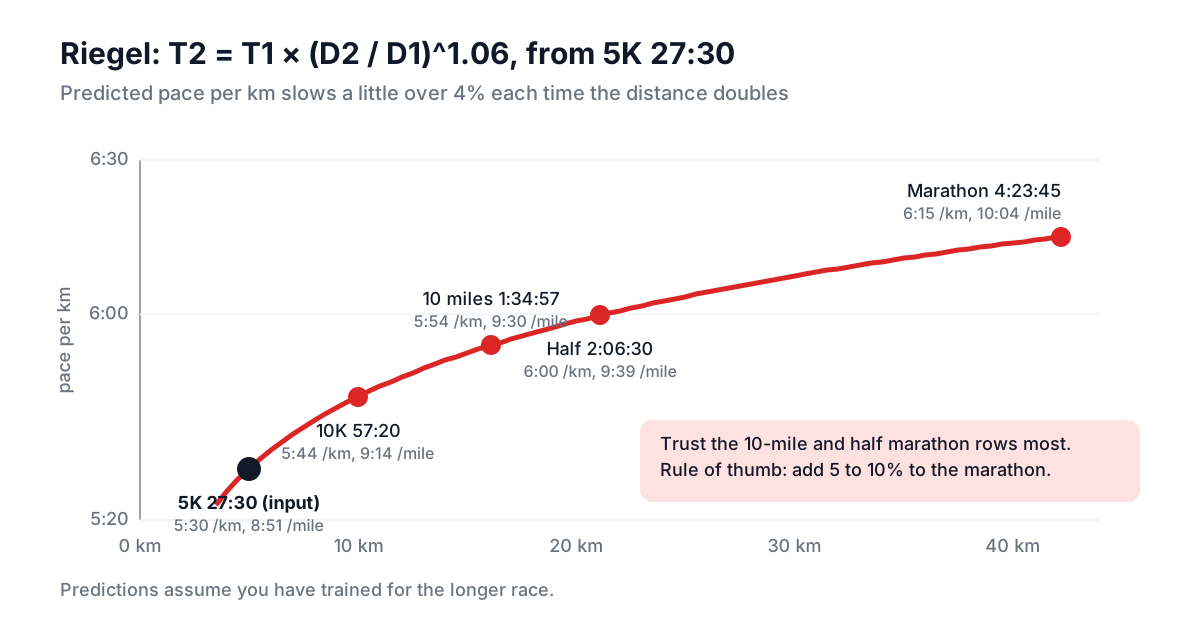
The 10-mile and half marathon rows are the ones to trust here, because they are close to the input and fall inside the range of efforts Riegel fitted. The marathon row is the weak one. A runner three months out of Couch to 5K has rarely done the long runs a marathon needs, and a common rule of thumb is to add 5 to 10% to a marathon prediction for runners on modest weekly mileage, which puts this runner at 4:36:57 to 4:50:08. Two practical rules follow:
- Use a real effort as the input. A timed 5K run hard on a flat course predicts; an easy Sunday jog predicts nothing.
- Pace the first half honestly. For a 2:06:30 half marathon the 10 km mark should come up at about 1:00:00. Going through in 57 minutes because it feels easy is how the last 5 km becomes a walk.
Heart rate zones and the UK 150-minute target
The UK Chief Medical Officers ask adults to build up at least 150 minutes of moderate activity or 75 minutes of vigorous activity each week, plus muscle strengthening on at least two days (UK CMOs' physical activity guidelines). They define intensity with a talk test rather than a heart rate: being able to talk but not sing means moderate, and having difficulty talking without pausing means vigorous. The NHS guidelines page lists running among its vigorous examples and brisk walking among the moderate ones.
Neither the CMOs nor the NHS give a heart rate for either level. The heart rate bands most often quoted come from the American Heart Association, which puts moderate at about 50 to 70% of maximum heart rate and vigorous at about 70 to 85%. Those bands are percentages of maximum. The Karvonen method takes the same percentages of heart rate reserve (maximum minus resting) and adds them to your resting rate, which gives a different, higher set of numbers; the calculator uses them for its five training zones. Our runner is 47 with a resting heart rate of 60 bpm, measured on waking:
| Method | Maximum | 50 to 70% | 70 to 85% |
|---|---|---|---|
| % of maximum, Tanaka (the AHA moderate and vigorous bands) | 175 bpm | 88 to 123 bpm | 123 to 149 bpm |
| % of heart rate reserve (Karvonen), Tanaka | 175 bpm | 118 to 141 bpm | 141 to 158 bpm |
| % of heart rate reserve (Karvonen), 220 minus age | 173 bpm | 117 to 139 bpm | 139 to 156 bpm |
| % of heart rate reserve (Karvonen), Gulati (women) | 165 bpm | 112 to 133 bpm | 133 to 149 bpm |
Three things stand out. First, the scale matters more than the formula: the same percentages of heart rate reserve come out 9 to 30 bpm higher than percentages of maximum, so a Karvonen figure is not the AHA band and should not be used to count guideline minutes. Second, Tanaka's 208 minus 0.7 × age and the old 220 minus age differ by only 2 bpm at 47, but they part company as you get older. Third, every age formula has a spread of roughly 10 bpm either way, so a hard parkrun finish that shows 182 on a chest strap tells you more about your maximum than any formula.
For the weekly target, let the talk test sort the runs. An easy 40-minute run in Karvonen zone 2 (129 to 141 bpm for this runner), at a pace where they can still talk but not sing, counts as moderate; a hard 5K where they can only say a few words before pausing for breath counts as vigorous. The NHS says 75 vigorous minutes can give similar benefits to 150 moderate minutes, so a week of two easy 40-minute runs and one 27-minute hard 5K comes to 80 moderate and 27 vigorous minutes, which is the same as 134 moderate minutes. One brisk 20-minute walk to the station tips it over 150.
Beta blockers, heat, dehydration and caffeine all shift heart rate at a given effort. On those days the talk test is the better guide.
Strength work: the other half of the guideline
The two strengthening days in the CMO guidelines are easy to skip when you are focused on running. Many gym programmes set loads as a percentage of a one-rep maximum (1RM), which you can estimate from a heavier set taken close to failure rather than by testing a true single.
Say the runner squats 80 kg for 6 good reps. The One Rep Max Calculator runs seven published equations:
| Formula | Estimated 1RM |
|---|---|
| Epley (1985) | 96.0 kg |
| Brzycki (1993) | 92.9 kg |
| O'Conner (1989) | 92.0 kg |
| Mayhew (1992) | 97.2 kg |
| Average of all seven | 94.8 kg |
From 3 to 6 reps the formulas stay within about 5% of each other. A training max of 90% of the average (85.4 kg) is a sensible base for a programme, and working back from the average gives about 82.8 kg for a set of 5 and 75.6 kg for a set of 8. High-rep sets are the trap: 40 kg for 15 reps gives estimates from 52.4 to 65.5 kg, a spread of a quarter, because 15 reps tests endurance as much as strength.
Calories in kcal, body weight in stones
Many people in the UK still know their weight in stones and pounds, while calculators and food diaries work in kilograms and kcal. The Calories Burned Calculator (UK) works in kilograms, so convert first: 12 st 6 lb is 174 lb, or 78.9 kg.
The calculator uses METs from the 2024 Adult Compendium of Physical Activities (Herrmann and colleagues): kcal per minute = MET × 3.5 × kg / 200. For our runner:
| Session | MET | Total | Above resting |
|---|---|---|---|
| 5K in 27:30 (about 9 min/mile, "running, 6.7 mph") | 10.5 | 399 kcal | 361 kcal |
| Brisk walk, 45 minutes (5.6 to 6.3 km/h) | 4.8 | 298 kcal | 236 kcal |
If you add exercise to a daily calorie budget, use the "above resting" column, because your resting burn is already counted in your maintenance figure. And treat both columns as estimates within 20% or so: the Compendium values are averages for adults, and your own economy, terrain and wind on the day all move the real figure. The numbers are most useful for comparing sessions, for example that the 5K costs about a third more than a longer brisk walk.
A UK training week that uses all four
Put together, the runner's week could look like this:
- Monday: strength session, squats at 75 to 85% of the 94.8 kg estimate.
- Tuesday: easy 40-minute run in zone 2 (129 to 141 bpm), conversational pace.
- Thursday: strength session.
- Saturday: a hard 5K, timed. Every six to eight weeks, use the result to update your race predictions.
- Sunday: long easy run, adding no more than a few minutes each week as the 10-mile race approaches.
That meets the CMO aerobic target, both strengthening days, and gives you the real result each prediction depends on.
Tools for this job
- Running Pace Calculator (UK): pace in min/km and min/mile, splits, treadmill speed and Riegel predictions for 10 miles and the half marathon.
- Target Heart Rate Calculator (UK): Karvonen or percentage zones, with the AHA moderate and vigorous bands set on maximum heart rate.
- One Rep Max Calculator: seven 1RM formulas side by side, with loads for other rep counts.
- Calories Burned Calculator (UK): kcal by Compendium activity, total and above resting.
For the food side, the UK guide to calorie deficits and the UK edition of the TDEE guide take the same kcal figures further. The US edition of this guide covers the history of each formula in more depth.
Frequently asked questions
What pace is a 27:30 5K per mile?
8:51 per mile, from 5:30 per kilometre multiplied by 1.609344. On a treadmill it is 10.9 km/h. Your mile splits would be 8:51, 17:42 and 26:33, with the last 0.1 mile taking you to 27:30.
How do I predict my 10-mile time from a parkrun or other 5K?
Put a hard 5K into Riegel's formula with 16.09 km as the target distance. A 27:30 5K predicts 1:34:57, or 9:30 per mile. It assumes you have trained for the longer distance, so add a few minutes if your longest run is well short of 10 miles.
Does running count as vigorous activity in the UK guidelines?
Yes. The NHS lists running as a vigorous activity, and the CMO guidelines say 75 vigorous minutes a week give similar benefits to 150 moderate minutes. An easy jog where you can still hold a conversation is closer to moderate, so judge each run by the talk test.
How do I use stones in a calories burned calculator?
Multiply the stones by 14, add the pounds, and multiply by 0.45359237 to get kilograms. 12 st 6 lb is 174 lb, which is 78.9 kg. Then enter the kilograms with the activity and minutes.
Is 220 minus age accurate?
It is a rough average. Tanaka's 208 minus 0.7 × age fitted data from about 18,700 adults better, especially past 40, but both have a spread of about 10 bpm. If your watch, with a chest strap, regularly shows higher values in hard efforts, use those.
Sources and further reading
- Get running with Couch to 5K, NHS. The 9-week plan, three runs a week, ending with 30 minutes of running without stopping.
- UK Chief Medical Officers' physical activity guidelines, Department of Health and Social Care. 150 minutes moderate or 75 vigorous, strength on 2 days, and the talk test.
- Physical activity guidelines for adults aged 19 to 64, NHS. Moderate and vigorous examples, running listed as vigorous.
- Age-predicted maximal heart rate revisited, Journal of the American College of Cardiology. Tanaka, Monahan and Seals, 2001.
- Strength Testing: Predicting a One-Rep Max from Reps-to-Fatigue, Journal of Physical Education, Recreation and Dance. Brzycki, 1993.
- 2024 Adult Compendium of Physical Activities, Journal of Sport and Health Science. Herrmann and colleagues. MET values for each activity.
- Book of Rules, World Athletics. Official road race distances.
Open the Running Pace Calculator
More Fitness Calculators
Every tool in the Fitness Calculators section, free and in your browser.
- BMI Calculator
- Calorie Calculator
- Protein Calculator
- Hydration Calculator
- Calorie Deficit Planner
- Body Fat Calculator
- Ideal Weight Calculator
- Running Pace Calculator
- Target Heart Rate Calculator
- One Rep Max Calculator
- Barbell Plate Calculator
- RPE Calculator
- Interval Timer
- Calories Burned Calculator
- Body Surface Area Calculator
- Waist-to-Hip Ratio Calculator
- VO2 Max Calculator
- Steps to Distance & Calories Calculator