
Running Pace, Heart Rate and Calories: A Guide for India
Pace per km for a city 10K, half marathon predictions, heart rate zones for the ICMR-NIN brisk walk, 1RM in kg and calories burned, with heat-wave timing.
By Redbison Dev · · 10 min read

India edition. Written for Indian runners and walkers: a 10K in kilometres, the ICMR-NIN advice of a minimum 30 to 45 minutes of brisk walking or moderate activity for adults, IMD heat-wave rules for when to run, yoga in the calorie table, and kg and kcal throughout. US edition
If you ran a city 10K in 62:00, your pace was 6:12 per kilometre, and Riegel's formula predicts about 2:16:48 for a half marathon run at 6:29 per km, provided you build up the long runs first and race in similar weather. This edition follows one runner, a 38-year-old weighing 70 kg with a resting pulse of 70, through pace, race predictions, heart rate zones, strength work and calories, and adds what matters most for running in India: the ICMR-NIN activity advice and the heat. Every figure comes from the Running Pace Calculator, the Target Heart Rate Calculator (India), the One Rep Max Calculator or the Calories Burned Calculator (India).
This is general fitness information. If you have diabetes, high blood pressure, a heart condition, or take medicines such as beta blockers, check with your doctor before training to heart rate targets.
How much activity the Indian guidelines ask for
The ICMR-National Institute of Nutrition's Dietary Guidelines for Indians (Guideline 10) say that "a minimum 30–45 minutes brisk walk / physical activity of moderate intensity among adults helps in maintaining good health", and that children need 60 minutes a day (ICMR-NIN Dietary Guidelines for Indians). The same guideline names yoga as "a holistic, structured and planned physical activity". The WHO's global recommendation is at least 150 minutes of moderate activity a week (WHO fact sheet).
The ICMR-NIN line sets the length of a session, 30 to 45 minutes, but gives no weekly total for adults, so the WHO's 150 minutes is the weekly yardstick here: 30 minutes on five days meets it. Morning walks, two runs and a yoga class can cover both. The rest of this guide puts numbers on each of those.
Pace per kilometre for a 10K
Pace is time divided by distance. If your race, app and treadmill all work in kilometres, you need per-mile figures only for training plans written abroad.
| What you type | Result |
|---|---|
| 10 km in 62:00 | 6:12 per km |
| Treadmill speed (3,600 / 372 s) | 9.68 km/h |
| Same pace per mile (× 1.609344) | 9:59 per mile |
| 5 km split at even pace | 31:00 |
A 9.7 km/h treadmill setting holds this pace indoors, which is one way to keep training through the hottest weeks.
Predicting a half marathon from a 10K
Peter Riegel's formula, T2 = T1 × (D2 / D1)^1.06, slows pace by a little over 4% each time the distance doubles. From the 62:00 10K the pace calculator predicts:
| Race | Predicted time | Average pace |
|---|---|---|
| 5K | 29:44 | 5:57 per km |
| 10K (input) | 1:02:00 | 6:12 per km |
| Half marathon (21.0975 km) | 2:16:48 | 6:29 per km |
| Full marathon (42.195 km) | 4:45:13 | 6:46 per km |
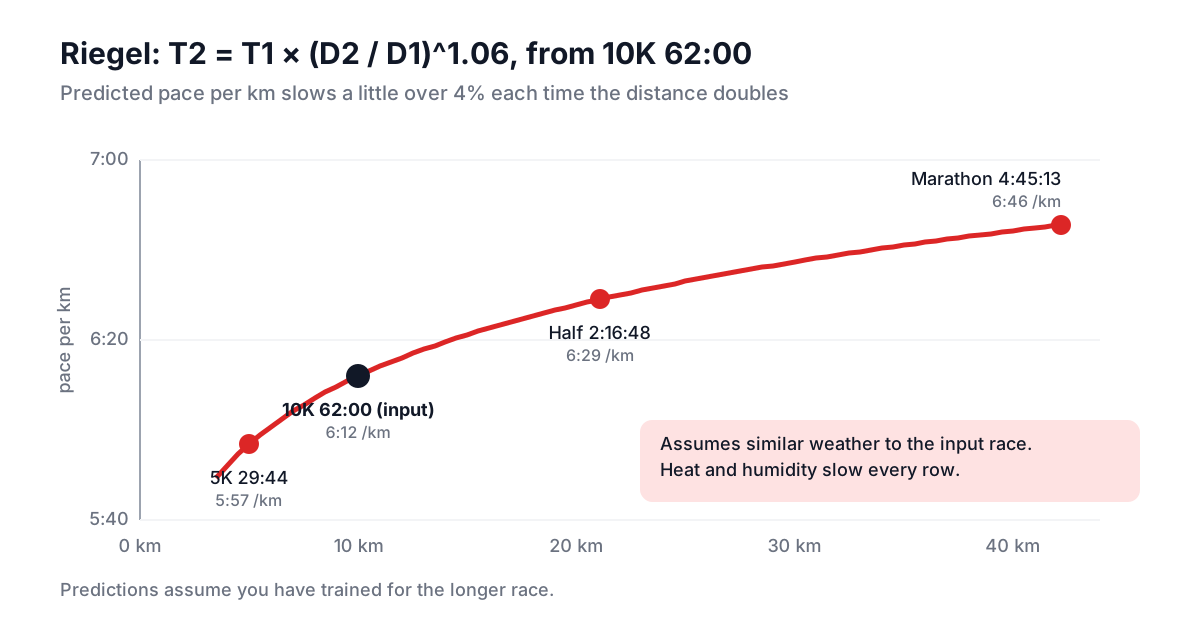
The half marathon row is the useful one: it is close to the input and inside the range of efforts Riegel fitted. The full marathon row is optimistic for most recreational runners. A common rule of thumb is to add 5 to 10% for runners without a long build-up, which gives 4:59:28 to 5:13:44 here.
Weather is the other correction, and in India it is often the bigger one. Riegel assumes both races are run in similar conditions. A 10K run on a cool January morning predicts a half marathon in March poorly, because heat and humidity raise the effort of every kilometre. Use a recent result from similar weather, or plan to run slower than the table.
When it is too hot to run
The India Meteorological Department declares a heat wave on the plains when the maximum temperature reaches at least 40 °C and is 4.5 °C or more above normal, or when it reaches 45 °C whatever the normal; in hilly regions the threshold is 30 °C (IMD heat wave FAQ). The same FAQ notes that high humidity makes heat waves worse because sweat evaporates less, and its advice for the public includes avoiding going out in the sun between 12 noon and 3 pm and avoiding strenuous activity when the outside temperature is high.
For a runner that means three practical rules:
- Run early. Finish before the sun is high, or run after sunset once the ground has cooled.
- Slow down, do not push the pace. Keep the effort and heart rate where they would be on a cool day and let the minutes per kilometre drift.
- Avoid dehydration, as the IMD advises: drink water before and after the run, and stop if you feel unwell.
The heat index guide for India explains how humidity pushes the "feels like" temperature above the thermometer reading.
Heart rate zones for a brisk walk and a run
Heart rate zones are percentages of something, so you first need a maximum. The ICMR-NIN guideline gives no heart rate for moderate activity. The bands most often quoted come from the American Heart Association, which puts moderate at about 50 to 70% of maximum heart rate and vigorous at about 70 to 85%. The Karvonen method applies the same percentages to heart rate reserve (maximum minus resting) and adds them to your resting pulse, which gives higher numbers; those are training zones, not the AHA bands. Our runner is 38 with a resting pulse of 70 bpm, measured on waking:
| Method | Maximum | 50 to 70% | 70 to 85% |
|---|---|---|---|
| % of maximum, Tanaka (the AHA moderate and vigorous bands) | 181 bpm | 91 to 127 bpm | 127 to 154 bpm |
| % of heart rate reserve (Karvonen), Tanaka | 181 bpm | 126 to 148 bpm | 148 to 165 bpm |
| % of heart rate reserve (Karvonen), Gulati (women) | 173 bpm | 121 to 142 bpm | 142 to 157 bpm |
Tanaka's 208 minus 0.7 × age and the older 220 minus age agree closely at 38 (181 against 182 bpm). The bigger difference is the scale: a percentage of heart rate reserve comes out 11 to 35 bpm higher than the same percentage of maximum for this runner. The Target Heart Rate Calculator (India) shows both, and labels only the % of maximum figures as the AHA bands.
For the ICMR-NIN brisk walk, the AHA moderate band for this person is 91 to 127 bpm. The simpler check is the talk test: at moderate effort you can talk but not sing. A hard 10K, where you can only say a few words before pausing for breath, is vigorous. Every age formula has a spread of about 10 bpm, so a chest strap reading in a hard race beats any formula.
Estimating a one-rep max in kilograms
Gym programmes are often written as percentages of a one-rep maximum. Rather than testing a true single, lift a heavier set close to failure and estimate. Say the runner bench-presses 60 kg for 8 clean reps. The One Rep Max Calculator gives 72.0 kg (O'Conner) to 76.6 kg (Wathan), with an average of 74.8 kg across seven formulas. A training max of 90% of that is 67.3 kg, and a set of 5 would be about 65.3 kg.
Keep the test set heavy: 3 to 8 reps. The formulas agree within a few per cent there, but at 15 reps or more they spread widely, because a long set tests endurance as much as strength.
Calories burned: walk, run and yoga
The Calories Burned Calculator (India) uses METs from the 2024 Adult Compendium of Physical Activities: kcal per minute = MET × 3.5 × kg / 200. For a 70 kg person:
| Session | MET | Total | Above resting |
|---|---|---|---|
| Brisk walk, 40 minutes (5.6 to 6.3 km/h) | 4.8 | 235 kcal | 186 kcal |
| 10K run in 62:00 (about 10 min/mile) | 9.3 | 706 kcal | 630 kcal |
| Hatha yoga, 40 minutes | 2.3 | 113 kcal | 64 kcal |
Use the "above resting" column if you add exercise to a daily calorie budget, because your resting burn is already counted in it. Expect an error of 20% or more either way: the Compendium figures are averages for adults, and heat raises effort in a way the MET does not capture. Hatha yoga is light activity in energy terms; the ICMR-NIN guidelines value it as a structured activity that also includes breathing exercises and relaxation, not as a calorie burner. For the food side, the India calorie deficit guide and the India TDEE guide use the same kcal.
A week that meets the guideline and trains for a half
- At least five mornings: 30 to 45 minutes of brisk walking or an easy run, before the heat.
- Twice a week: strength work, using the 1RM estimate to set loads.
- Once a week: a long easy run, growing by a few minutes each week towards the half marathon.
- One or two evenings: yoga for mobility and recovery.
- Every six to eight weeks: a timed 5K or 10K in fair weather, to update the predictions.
Tools for this job
- Running Pace Calculator: pace per km, splits, treadmill speed and Riegel predictions.
- Target Heart Rate Calculator (India): Karvonen and percentage zones for the brisk walk and harder runs.
- One Rep Max Calculator: seven 1RM formulas and loads for other rep counts.
- Calories Burned Calculator (India): kcal for walking, running, yoga, cricket and badminton.
The US edition of this guide covers the research behind each formula in more detail.
Frequently asked questions
What should my heart rate be on a brisk walk?
The ICMR-NIN guideline asks for moderate intensity but gives no heart rate. The American Heart Association puts moderate at about 50 to 70% of maximum heart rate, which for a 38-year-old on Tanaka's maximum of 181 is 91 to 127 bpm. Percentages of heart rate reserve (Karvonen) give higher numbers and are not the same band. If you can talk but not sing, you are at moderate effort.
Is 30 minutes of walking a day enough?
It meets the WHO minimum of 150 minutes a week if you walk five days. The ICMR-NIN guidelines ask Indian adults for 30 to 45 minutes of brisk walking or moderate activity, so stretching some walks to 45 minutes, or adding runs, gets you there.
How long will a half marathon take me if I run 10K in an hour?
Riegel's formula predicts 2:12:23 from a 60:00 10K, or about 6:16 per kilometre. Use it as the best case for a race in similar weather after you have built up long runs.
Is it safe to run during a heat wave?
The IMD advises avoiding strenuous activity when the temperature is high and staying out of the sun between 12 noon and 3 pm. Run early in the morning, slow your pace, drink water, and stop if you feel unwell.
How many calories does yoga burn?
Hatha yoga is 2.3 MET in the 2024 Compendium, so a 70 kg person burns about 113 kcal in 40 minutes, of which about 64 kcal is above resting. Power yoga is rated 4.0 MET.
Sources and further reading
- Dietary Guidelines for Indians, ICMR-National Institute of Nutrition. Guideline 10: "a minimum 30–45 minutes brisk walk / physical activity of moderate intensity among adults helps in maintaining good health", and 60 minutes per day for children.
- FAQ on heat wave, India Meteorological Department. Heat-wave criteria and advice to avoid the sun from 12 noon to 3 pm.
- Physical activity fact sheet, World Health Organization. At least 150 minutes of moderate activity a week for adults.
- Age-predicted maximal heart rate revisited, Journal of the American College of Cardiology. Tanaka, Monahan and Seals, 2001.
- Strength Testing: Predicting a One-Rep Max from Reps-to-Fatigue, Journal of Physical Education, Recreation and Dance. Brzycki, 1993.
- 2024 Adult Compendium of Physical Activities, Journal of Sport and Health Science. Herrmann and colleagues.
- Book of Rules, World Athletics. Official road race distances.
Open the Running Pace Calculator
More Fitness Calculators
Every tool in the Fitness Calculators section, free and in your browser.
- BMI Calculator
- Calorie Calculator
- Protein Calculator
- Hydration Calculator
- Calorie Deficit Planner
- Body Fat Calculator
- Ideal Weight Calculator
- Running Pace Calculator
- Target Heart Rate Calculator
- One Rep Max Calculator
- Barbell Plate Calculator
- RPE Calculator
- Interval Timer
- Calories Burned Calculator
- Body Surface Area Calculator
- Waist-to-Hip Ratio Calculator
- VO2 Max Calculator
- Steps to Distance & Calories Calculator