
Compound Interest in Canada: GICs, TFSAs and Mortgages
How compound interest works in Canadian dollars: compounding GICs and annual tax on accrued interest, TFSA timing, and why mortgages compound semi-annually.
By Redbison Dev · · 6 min read
Canada edition. Written for Canadians: examples in Canadian dollars, compounding and simple-interest GICs, the annual accrual rule for GIC interest, TFSA contribution timing, semi-annual compounding under the Interest Act, the 35% criminal rate and CDIC coverage. US edition
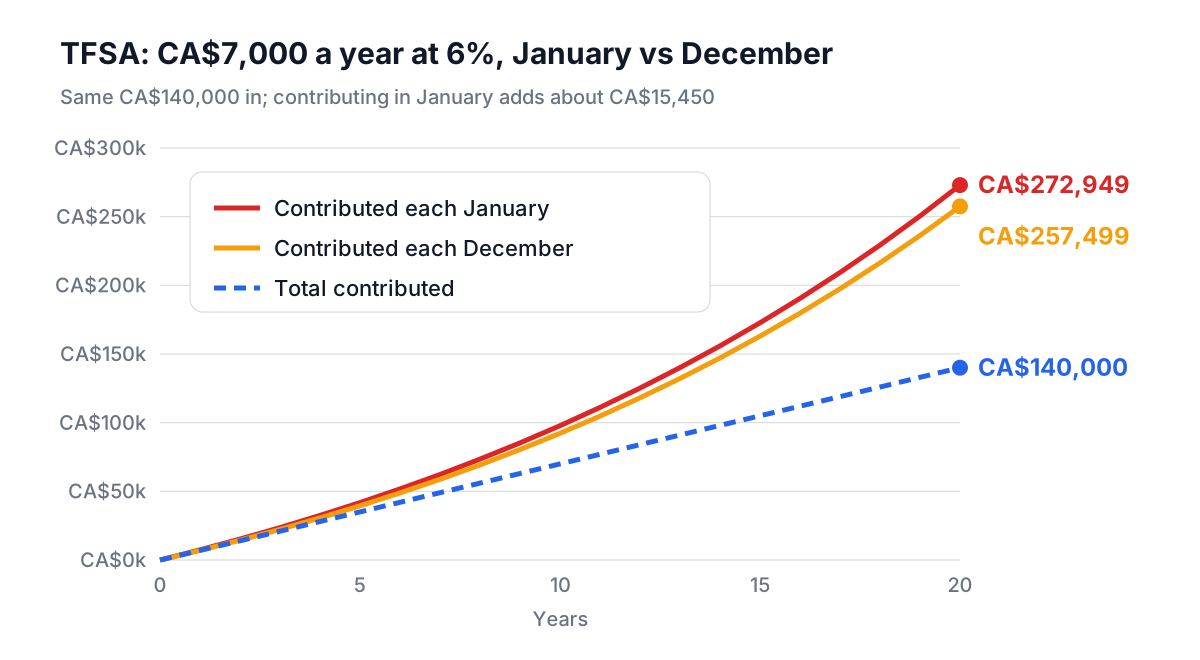
Put CA$7,000 into a TFSA every January for 20 years at 6% a year and you end with CA$272,949.09 from CA$140,000 contributed. Make the same contributions every December and you end with CA$257,499.14. The money is identical; the only difference is how long each dollar compounds. That is compound interest in a Canadian setting: it shows up in when you contribute to a TFSA, in the choice between a compounding GIC and one that pays interest out, and, working against you, in how your mortgage and credit card rates are compounded.
This edition explains the arithmetic with figures in Canadian dollars from the Canadian compound interest calculator and the Canadian interest calculator. It is about the math, not advice on any product.
The formula and what each part means
A = P × (1 + r/n)^(n × t)
P is the starting amount, r the annual rate as a decimal, n how many times a year interest is compounded, and t the number of years. The rate per period is r/n and the number of periods is n × t. Adding regular contributions adds a second term, an annuity, which the calculator handles for you, including whether contributions arrive at the start or the end of each period.
GICs: compounding or interest paid out
Canadian banks and credit unions usually offer a GIC in two forms: interest compounded and paid at maturity, or interest paid out annually (or more often) to your chequing account. The paid-out version earns simple interest because the interest never joins the balance.
For a CA$10,000 five-year GIC at 3.5%:
| GIC type | Interest over 5 years | Value at maturity |
|---|---|---|
| Interest paid out annually | CA$1,750.00 (CA$350 a year) | CA$10,000 returned |
| Compounded annually, paid at maturity | CA$1,876.86 | CA$11,876.86 |
The compounding GIC earns CA$126.86 more because each year's interest earns 3.5% for the remaining years.
The tax catch: you report compound GIC interest every year
Outside a registered account, the compounding GIC does not let you defer the tax. Under subsection 12(4) of the Income Tax Act, if you hold an investment contract on an anniversary day, you include the interest accrued to that day in your income, even though you receive nothing until maturity. In the example, about CA$350 of interest is taxable in the first year, CA$362.25 in the second, and so on, each year at your full marginal rate.
That is one reason interest-bearing savings are often held inside a TFSA, where the interest is never taxed, or an RRSP, where it is taxed only on withdrawal.
TFSA timing: why January beats December
The TFSA dollar limit is CA$7,000 for 2026, according to the CRA. Contribution timing changes how long each contribution compounds.
| Contribution timing | Value after 20 years at 6% | Contributed | Growth |
|---|---|---|---|
| Each January (start of the year) | CA$272,949.09 | CA$140,000 | CA$132,949.09 |
| Each December (end of the year) | CA$257,499.14 | CA$140,000 | CA$117,499.14 |
Contributing in January adds CA$15,449.95, which is exactly 6% more: every contribution gets one extra year at 6%. To reproduce this in the Canadian compound interest calculator, set principal to 0, a yearly contribution of CA$7,000, 6% a year compounded annually, 20 years, and switch Deposits Paid In between the start and the end of each period.
The 6% is an assumption for illustration. A TFSA holding a GIC earns the GIC rate; one holding an ETF earns whatever the market gives, which is not steady.
How much compounding frequency matters
Here is CA$10,000 at a nominal 4% for five years:
| Compounding | Value after 5 years | Effective annual rate |
|---|---|---|
| Annually | CA$12,166.53 | 4.00% |
| Semi-annually | CA$12,189.94 | 4.04% |
| Quarterly | CA$12,201.90 | 4.06% |
| Monthly | CA$12,209.97 | 4.07% |
| Daily | CA$12,213.89 | 4.08% |
Monthly compounding adds CA$43.44 over annual on CA$10,000 over five years; daily adds CA$3.92 more. The frequency matters most in one place Canadians meet every month: the mortgage.
Mortgages: semi-annual compounding under the Interest Act
Section 6 of the Interest Act requires a blended-payment mortgage to state its interest rate calculated yearly or half-yearly, not in advance. In practice, Canadian fixed-rate mortgages are compounded semi-annually, while US mortgages compound monthly.
A 5% rate compounded semi-annually has an effective annual rate of 5.0625%. The same 5% compounded monthly would be 5.1162%. On CA$100,000 for one year, that is CA$5,062.50 of interest against CA$5,116.19. Your lender converts the semi-annual rate to a monthly one for your payments: (1.025)^(1/6) − 1 = 0.4124% a month, slightly less than 5% / 12 = 0.4167%. This is why a US mortgage calculator gives a payment a few dollars too high for a Canadian fixed-rate mortgage. Variable-rate mortgages are often compounded monthly; the contract says which.
Credit cards and the 35% criminal rate
Compound interest works against borrowers, and Canadian law sets an upper limit. Since January 1, 2025, section 347 of the Criminal Code defines the criminal rate as an annual percentage rate of interest that exceeds 35% on the credit advanced, calculated using generally accepted actuarial practices. That cap applies to the effective cost of the credit, not just the nominal rate.
Ordinary credit card rates are well below it but still compound. A card at 20.99% a year compounded monthly has an effective rate of about 23.13%: CA$1,000 left unpaid for a year becomes CA$1,231.32. By the rule of 72, an unpaid balance at that rate roughly doubles in about three years. For paying down a loan rather than letting it grow, see the EMI and loan amortization guide.
The rule of 72 and the 2% target
Divide 72 by the annual rate to estimate the years for money to double: at 6%, about 12 years; at 3.5%, about 20.6. It works in reverse for prices. The Bank of Canada aims to keep total CPI inflation at the 2% midpoint of a 1% to 3% range, and the framework has been renewed for January 2027 to December 2031. At 2% inflation, prices double in about 36 years. A non-registered GIC at 3.5%, taxed at a 30% marginal rate, compounds at about 2.45% after tax, only just ahead of a 2% target.
Mistakes Canadians make with compound interest
- Using monthly compounding for a fixed-rate mortgage. Use semi-annual unless your contract says otherwise.
- Assuming a compounding GIC defers tax. Outside a TFSA or RRSP, accrued interest is reported every year.
- Rounding terms. An 18-month GIC is 1.5 years, not 1 or 2.
- Ignoring CDIC limits. CDIC covers eligible deposits, including GICs, up to CA$100,000 per insured category at each member institution; TFSA, RRSP and FHSA deposits are separate categories. Stocks, ETFs and mutual funds are not covered.
Tools for this job
- Canadian compound interest calculator: TFSA contributions, GICs and effective rates, with start or end timing.
- Canadian interest calculator: GICs with interest paid out against compounding.
- Canadian savings goal calculator: the monthly amount needed for a target.
- Canadian investment calculator: monthly contributions or a lump sum in a TFSA or RRSP at an assumed return.
The US edition of this guide covers the same formula with US terms (APY and APR).
Frequently asked questions
Do I pay tax every year on a compound GIC?
Yes, if it is held outside a TFSA or RRSP. Subsection 12(4) of the Income Tax Act requires you to include the interest accrued to each anniversary of the contract in that year's income, even though the interest is paid only at maturity. Inside a TFSA the interest is tax-free; inside an RRSP it is taxed only when withdrawn.
How is mortgage interest compounded in Canada?
Fixed-rate mortgages are normally compounded semi-annually, not in advance, because section 6 of the Interest Act requires blended-payment mortgages to state the rate calculated yearly or half-yearly. A 5% rate compounded semi-annually is an effective 5.0625% a year.
Should I contribute to my TFSA in January or spread it over the year?
If you have the money and invest it at a steady return, January gives every contribution an extra year of growth: CA$7,000 a year at 6% for 20 years reaches CA$272,949.09 from January contributions against CA$257,499.14 from December ones. Spreading contributions monthly falls between the two.
What is the highest interest rate a lender can charge in Canada?
Section 347 of the Criminal Code makes it an offence to lend at an annual percentage rate above 35% on the credit advanced, calculated using generally accepted actuarial practices. The 35% limit took effect on January 1, 2025, with some exemptions set by regulation.
What is CA$10,000 at 4% compounded monthly for five years?
CA$12,209.97, which is CA$2,209.97 of interest, before tax. With annual compounding the same deposit reaches CA$12,166.53, so monthly compounding adds CA$43.44 over five years.
Sources and further reading
- Income Tax Act, section 12, Justice Laws Website. Subsection 12(4): accrued interest on investment contracts included on each anniversary day.
- Interest Act, section 6, Justice Laws Website. Mortgage rates calculated yearly or half-yearly, not in advance.
- Criminal Code, section 347, Justice Laws Website. Criminal rate: an annual percentage rate above 35% on the credit advanced.
- MP, DB, RRSP, DPSP, ALDA, TFSA limits, YMPE and the YAMPE, Canada Revenue Agency. TFSA dollar limit of CA$7,000 for 2026.
- What's covered, Canada Deposit Insurance Corporation. CA$100,000 per insured category.
- Inflation-control target, Bank of Canada. 2% midpoint of a 1% to 3% range, renewed for January 2027 to December 2031.
- 6.4 Compound Interest, OpenStax.
Open the Compound Interest Calculator
More Calculators
Every tool in the Calculators section, free and in your browser.
- Investment Calculator
- Compound Interest Calculator
- Simple Interest Calculator
- Interest Calculator
- EMI Calculator
- Retirement Calculator
- Time-Weighted Return Calculator
- Savings Goal Calculator
- Inflation Calculator
- CAGR Calculator
- ROI Calculator
- Present and Future Value Calculator
- NPV and IRR Calculator
- 401(k) Calculator
- Roth IRA Calculator
- APY and CD Calculator
- SIP Calculator
- Annuity Calculator
- Bond Price and Yield Calculator
- Currency Converter
- Dividend Calculator
- Stock Average Calculator
- RMD Calculator