
ETF Charges, Dividends and Investing Monthly in the UK
What fund charges, platform fees, accumulation units and inflation do to a monthly UK ETF plan over 30 years, in pounds, inside and outside an ISA.
By Redbison Dev · · 6 min read
United Kingdom edition. Written for UK investors: pounds, the ongoing charge (OCF) plus platform fees, accumulation and income units, the £20,000 ISA allowance, dividend and Capital Gains Tax rates for 2026 to 2027, and reporting fund status for offshore ETFs. US edition
Put £300 a month into a global equity ETF for 30 years and assume 6% a year before charges. With no charges at all it would reach £293,148. With a total charge of 0.25% a year it reaches £280,223; at 0.75%, £256,261; at 1.5%, £224,567. Those are the same £108,000 paid in, and the difference between the cheapest and dearest is more than £68,000, almost twice the £38,856 of charges actually deducted at 1.5%.
For a UK investor the charge is rarely one number: there is the fund's ongoing charge, the platform's account fee and sometimes dealing costs, and the wrapper decides whether dividends and gains are taxed along the way. This edition works through each with the UK ETF investment calculator. It uses steady returns to show the mechanics; real markets are lumpier, and none of this is advice to buy a particular fund.
Adding up the real yearly charge
A UK ETF's ongoing charges figure (OCF), shown in the fund's documents, is taken from the fund's assets, so you never see a bill and the fund's published returns are already after it. The platform you hold it on usually charges separately, as a percentage of what you hold, a flat fee, or both. For a projection, add them:
total yearly charge = fund OCF + platform fee as a % of your holding
0.12% OCF + 0.25% platform fee = 0.37% a year
A flat platform fee is cheap on a large pot and expensive on a small one: £60 a year is 0.6% of £10,000 but 0.06% of £100,000. If you are starting small, convert the flat fee into a percentage of what you will hold in the first few years.
Then run the £300 a month plan with each total:
| Total yearly charge | Value after 30 years | Charges deducted | Lost against no charge |
|---|---|---|---|
| 0% | £293,148 | £0 | £0 |
| 0.10% | £287,899 | £3,049 | £5,249 |
| 0.25% | £280,223 | £7,488 | £12,925 |
| 0.75% | £256,261 | £21,180 | £36,887 |
| 1.50% | £224,567 | £38,856 | £68,581 |
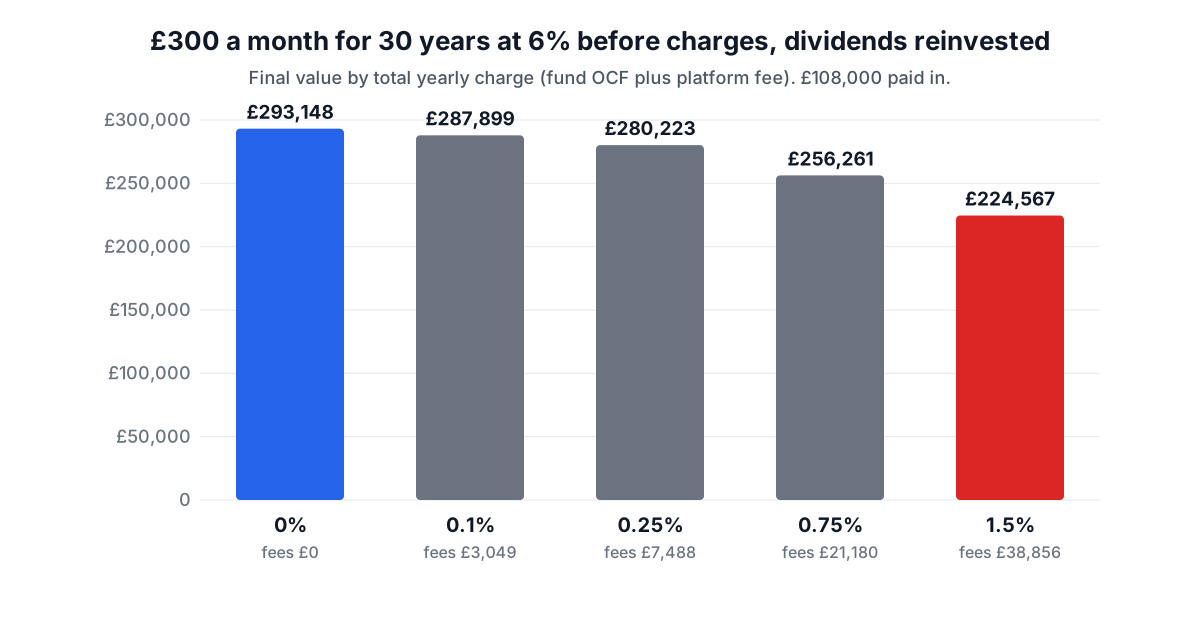
The lost value is about 1.7 to 1.8 times the charges paid, because every pound taken in charges also stops compounding. Between 0.1% and 0.25% the gap is £7,676 over 30 years; between 0.25% and 1.5% it is £55,656. Cheap index trackers are close enough to each other that the platform fee and the wrapper often matter more than which tracker you pick.
One trap: do not double count. A fund's published past returns are already after its OCF, so if you use one as your assumption, enter only the platform fee in the calculator's charge box.
Accumulation or income units
Many UK-available ETFs and funds come in two share classes. Accumulation (Acc) units keep the dividends inside the fund, so the unit price rises instead. Income (Inc or Dist) units pay them out to your account. The calculator's "Reinvest Dividends" switch models the difference.
At a 2% yield inside the 6% total return and a 0.25% charge, £300 a month for 30 years with dividends reinvested reaches £280,223. Take the dividends as cash instead and the holding ends at £197,309, with £47,631 of dividends paid to you along the way. The reinvested plan is £82,914 ahead, nearly twice what the income units paid out, which is compounding on the dividends themselves. Income units make sense when you need the income, or when you want to reinvest it somewhere else.
Tax on accumulation units. Outside an ISA or pension, the income kept inside an accumulation unit is still taxable each year. HMRC's helpsheet HS284 calls it a notional distribution and lets you add it to the cost of your units, so it is not taxed again as a gain when you sell.
The wrapper: ISA, pension or general account
Inside a stocks and shares ISA or a pension, dividends and gains are not taxed, so the calculator's figures are what you keep. The ISA allowance for the 2026 to 2027 tax year is £20,000 across all your ISAs; £300 a month uses £3,600 of it.
In a general investment account, for 2026 to 2027:
- Dividends above the £500 dividend allowance are taxed at 10.75% (basic rate), 35.75% (higher) or 39.35% (additional).
- Capital gains above the £3,000 annual exempt amount are taxed at 18% within the basic rate band and 24% above it, from 6 April 2026.
At £300 a month the dividends in the example pass £500 a year in year 7 (£549) and reach £5,266 in year 30, so a general account starts paying dividend tax long before you sell. The UK edition of the dividend yield guide works through the same tax on a single holding over 20 years.
Offshore ETFs and reporting fund status
An ETF domiciled outside the UK, for example in Ireland or Luxembourg, is an offshore fund for UK tax. HMRC's Investment Funds Manual (IFM13100) explains the split. With a reporting fund, you are taxed each period on your share of the fund's income, including any it did not pay out, and a gain on sale is a capital gain. With a non-reporting fund, a gain on sale is taxed as if it were income, an "offshore income gain", at your income tax rate rather than the lower Capital Gains Tax rates. HMRC publishes a monthly list of funds with reporting fund status, last updated on 4 November 2026. Inside an ISA or SIPP none of this matters.
Inflation: reading the result at today's prices
Thirty years of 2% inflation more than halves what a pound buys: divide by 1.02^30, or 1.811. The £280,223 from the 0.25% plan is about £154,703 at today's prices, and the 1.5% plan's £224,567 is about £123,977. The calculator's UK version uses 2% by default; change it to your own view. When you compare a projection with a pension or retirement target, put both in the same terms.
A lump sum shows the effect over the same period: £20,000 left for 30 years at 6% before a 0.25% charge grows to £107,014, or about £59,079 at today's prices.
Monthly, fortnightly or a lump sum
The calculator spreads each year's contributions evenly, so on average half of a year's money earns that year's return. Choosing weekly or fortnightly changes how £300 a month is split, not the yearly total, so the projection does not move. In practice the choice matters for costs: if your platform charges per trade, small and frequent purchases cost more, so check its dealing charges for regular investing. The UK guide to SIP and lump sum investing compares investing a sum at once against drip-feeding it.
Common mistakes
- Counting only the OCF. Add the platform fee, or the cheapest fund on the dearest platform can cost more than a dearer fund on a cheap one.
- Double counting charges by subtracting the OCF from a return that is already net of it.
- Ignoring tax outside an ISA. The projection is gross; in a general account dividends are taxed along the way and gains when you sell.
- Reading nominal pounds as real. Check the "at today's prices" figure before deciding a plan is enough.
Tools for this job
- The UK ETF investment calculator runs the fee, dividend and inflation scenarios above.
- The UK dividend calculator applies the £500 allowance and your band's dividend rate.
- The UK compound interest calculator shows the growth arithmetic step by step, explained in the UK compound interest guide.
- The UK retirement calculator and the UK FIRE planner put the result next to a spending target.
Frequently asked questions
Is the OCF the total cost of holding an ETF?
No. The OCF covers the fund's own running costs and is taken from its assets. Your platform's account fee, any dealing charges and the spread when you buy and sell come on top, so add the platform fee to the OCF when you project the total.
Do I pay tax on accumulation units if I never receive the dividend?
Outside an ISA or pension, yes. HMRC treats the income kept in the fund as a notional distribution taxable in the year it arises, and HS284 lets you add it to the cost of your units for Capital Gains Tax. In an ISA there is nothing to report.
What happens if my ETF does not have reporting fund status?
HMRC's manual says a gain when you sell is taxed as if it were income (an offshore income gain), at your income tax rate rather than as a capital gain. Check HMRC's list of reporting funds before buying an offshore ETF for a general account.
How much can I put into a stocks and shares ISA?
£20,000 in the 2026 to 2027 tax year, across all your ISAs. £300 a month uses £3,600 of it; filling the whole allowance monthly is about £1,666 a month.
Sources and further reading
- Individual Savings Accounts (ISAs), GOV.UK. The £20,000 allowance for 2026 to 2027.
- Tax on dividends, GOV.UK. The £500 allowance and the 2026 to 2027 dividend rates.
- Capital Gains Tax: allowances, GOV.UK. The £3,000 annual exempt amount.
- Capital Gains Tax: rates, GOV.UK. 18% and 24% from 6 April 2026.
- IFM13100: offshore funds, background to the treatment of UK investors, HMRC Investment Funds Manual. Reporting and non-reporting funds.
- Offshore funds: list of reporting funds, HM Revenue and Customs. Updated monthly.
- HS284 Shares and Capital Gains Tax (2025), HM Revenue and Customs. Accumulation units and notional distributions.
Open the ETF Investment Simulator
More Analysis Tools
Every tool in the Analysis Tools section, free and in your browser.