
Steel Sheet Weight: kg per m², SWG and Sheet Sizes
Work out the weight of steel, stainless and aluminium sheet in kg from mm or SWG, for 2500 x 1250 and 8 x 4 sheets, and why a US "16 gauge" chart is 7% light.
By Redbison Dev · · 9 min read
United Kingdom edition. Written for UK fabricators and buyers: metric sheet sizes, British SWG rather than US gauges, and HSE manual handling guidance for heavy sheets. US edition
A 2500 x 1250 mm sheet of 2 mm mild steel weighs 49.06 kg. The quickest way to get there is to multiply the thickness in millimetres by 7.85, which gives the weight of one square metre in kilograms (15.7 kg/m² here), then multiply by the area (3.125 m²). The same rule works for any metal with its own density. Where UK work goes wrong is less the arithmetic than the inputs: a thickness given as "16 gauge" off an American chart, an old drawing in feet, or a sheet that is perfectly light on paper and still too awkward for two people. This edition works through those cases in kilograms with the UK sheet metal weight calculator, which opens on a 2500 x 1250 x 2 mm sheet and can read British SWG.
The rule in one line
For a flat sheet, weight is area times thickness times density. With thickness in millimetres and density in grams per cubic centimetre, the product is kilograms per square metre:
kg/m²  = thickness (mm) x density (g/cm³)
kg     = length (m) x width (m) x kg/m²
For mild steel at 7,850 kg/m³ (7.85 g/cm³), that gives:
| Thickness | kg/m² | 2000 x 1000 | 2500 x 1250 | 3000 x 1500 |
|---|---|---|---|---|
| 1 mm | 7.85 | 15.70 kg | 24.53 kg | 35.33 kg |
| 2 mm | 15.70 | 31.40 kg | 49.06 kg | 70.65 kg |
| 3 mm | 23.55 | 47.10 kg | 73.59 kg | 105.98 kg |
These are three common metric sheet sizes, and 2500 x 1250 is the one the calculator starts on. Stainless 304 at 7,930 kg/m³ is about 1% heavier than mild steel; aluminium 5052 at 2,680 kg/m³ is about a third of the weight, so a 2500 x 1250 x 1.5 mm aluminium sheet is 12.56 kg.
SWG, not the American "gauge"
Gauge numbers still appear on UK drawings, quotes and stock lists, and in Britain they normally mean the Standard Wire Gauge. SWG was fixed by Order in Council in 1883 and later published as BS 3737:1964, now withdrawn; the current standard for wire and sheet sizes, BS 6722:1986, is metric only, as the history of the Standard Wire Gauge records. Each SWG is a round number of thousandths of an inch, and a UK stockholder's SWG to mm chart gives the same values: 16 SWG is 0.064 in or 1.626 mm, 18 SWG 1.219 mm, 20 SWG 0.914 mm, 22 SWG 0.711 mm.
Most charts online are American, and their 16 gauge for steel is 1.519 mm. The same number, read from the wrong table, moves the weight:
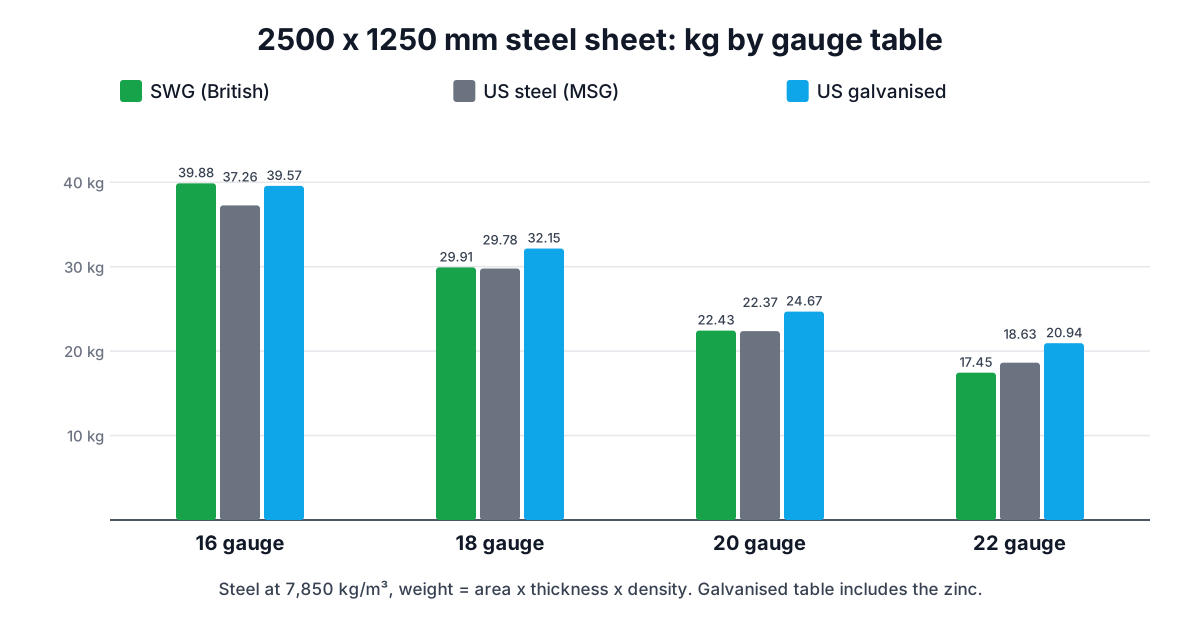
| 2500 x 1250 mm, steel | SWG | US steel gauge | Difference |
|---|---|---|---|
| 16 gauge | 1.626 mm, 39.88 kg | 1.519 mm, 37.26 kg | SWG 7% heavier |
| 18 gauge | 1.219 mm, 29.91 kg | 1.214 mm, 29.78 kg | under 0.5% |
| 20 gauge | 0.914 mm, 22.43 kg | 0.912 mm, 22.37 kg | under 0.5% |
| 22 gauge | 0.711 mm, 17.45 kg | 0.759 mm, 18.63 kg | US 7% heavier |
The tables agree closely at 18 and 20 and part at 16 and 22, in opposite directions. On a pack of twenty 16 gauge sheets, reading SWG as US gauge understates the load by about 52 kg.
There is one more reason not to borrow American weight tables. The US steel gauge was built from a weight of 41.82 lb per square foot per inch of thickness, as the sheet metal reference notes, which is a density of about 8,040 kg/m³. US gauge weight charts therefore read about 2% above a 7,850 kg/m³ calculation. SWG is defined purely as a thickness, so an SWG weight is just thickness times density, with no such offset.
Worked examples for UK jobs
An old drawing in feet: 8 x 4 sheet in 18 SWG
Imperial sizes survive in older drawings and in "8 x 4" as shorthand. A true 8 x 4 ft sheet is 2438.4 x 1219.2 mm. In 18 SWG (1.219 mm) mild steel:
area      = 2.4384 x 1.2192 = 2.9729 m²
kg/m²     = 1.2192 x 7.85   = 9.571
weight    = 2.9729 x 9.571  = 28.45 kg (62.73 lb)
Read as a US 18 gauge sheet it would be 28.33 kg, a trivial difference. At 16 gauge the gap would be 7%.
Stainless guards with a window cut out
Twelve machine guard panels in 304 stainless, 1250 x 1000 x 1.5 mm, each with a 600 x 400 mm opening for mesh and four 10 mm fixing holes. In the calculator, set stainless 304, enter the sheet, then one rectangular cut-out and four round holes:
gross area     = 1.25 m²
cut-outs       = 0.24 + 4 x π/4 x 0.010² = 0.24031 m²
net area       = 1.00969 m²
kg/m²          = 1.5 x 7.93 = 11.895
each           = 12.01 kg
twelve         = 144.12 kg
The opening removes 19% of the blank, so weighing the gross sheet (14.87 kg each) would overstate the finished parts by almost 3 kg apiece. The offcut is still steel you pay for, which is why the stockholder bills the full sheet.
A large 3 mm sheet and the manual handling question
A 3000 x 1500 x 3 mm mild steel sheet weighs 105.98 kg (233.6 lb). A 2500 x 1250 x 2 mm sheet is 49.06 kg, and a pack of twenty of those is 981.25 kg, just under a tonne.
The Health and Safety Executive's manual handling guidance says the weight of a load matters but that the law does not set specific weight limits. What it asks is an assessment that considers the task, the load, the working environment and individual capability, and HSE's assessment page points to the MAC tool for lifting, carrying and team handling. A large sheet is also awkward: it flexes, has sharp edges and catches the wind outdoors. The calculated weight is the input to that assessment, not the answer to it. For packs, use the total with an allowance for tolerance, packing and the pallet when choosing a forklift or slings.
Where real weights differ from the calculation
- Thickness tolerance. Sheet is rolled to a tolerance band set by its product standard, and weight follows thickness directly, so the same tolerance in mm matters more on thin sheet.
- Theoretical or weighbridge weight. Some stockholders price on theoretical weight from nominal size, others on what the scale says. If you are comparing prices per kilogram, ask which.
- Zinc and paint. Pre-galvanised and coated sheet weighs more than the bare steel. Take the coating mass per square metre from the mill certificate and multiply by the sheet area.
- Tread plate and perforated sheet. Patterns and holes change the weight per square metre. Use the stockholder's published figure for these.
Shop-floor checks without a calculator
Remember one figure per metal, the kilograms in a square metre of 1 mm sheet: steel 7.85, stainless about 7.9, aluminium about 2.7. Then:
- a 2500 x 1250 sheet is 3.125 m², so steel weighs 24.5 kg per mm of thickness;
- a 2000 x 1000 sheet is 2 m², so steel weighs 15.7 kg per mm;
- a tonne of 3 mm mild steel covers 1,000 / 23.55 = 42.5 m².
For beams, angles, box section and bar, the UK steel weight calculator uses the same density. For a folded part, weigh the flat blank, which the bend allowance calculator gives you, and for brake capacity the press brake tonnage calculator takes the same thickness. The punch force calculator covers the holes.
Frequently asked questions
How much does a 2500 x 1250 x 3 mm steel sheet weigh?
73.59 kg in mild steel at 7,850 kg/m³: 3 x 7.85 = 23.55 kg/m², times 3.125 m². In 304 stainless it is 74.34 kg and in 5052 aluminium 25.13 kg.
Is 16 gauge in the UK the same as 16 gauge in the US?
No. In Britain "16 gauge" normally means 16 SWG, 1.626 mm. The US steel gauge 16 is 1.519 mm, so a 2500 x 1250 sheet weighs 39.88 kg in SWG and 37.26 kg in the US table. Ask for the thickness in millimetres on any order.
What is the weight of an 8 x 4 sheet of steel?
An 8 x 4 ft sheet is 2.973 m². In 18 SWG (1.219 mm) mild steel it weighs 28.45 kg; in 2 mm it weighs 46.67 kg; in 3 mm, 70.01 kg. Multiply the area by the thickness in mm and by 7.85 for any other thickness.
Is there a maximum weight one person can lift at work in the UK?
The law sets no specific weight limit. HSE guidance asks employers to assess the task, the load, the environment and the person, and offers the MAC tool for lifting, carrying and team handling. A sheet's size and edges matter as well as its weight.
Why do US gauge weight charts give a slightly higher weight?
Because the US steel gauge was defined from 41.82 lb per square foot per inch, equivalent to about 8,040 kg/m³. A calculation at the usual 7,850 kg/m³ for steel comes out about 2% lower. SWG is a pure thickness, so it does not have this offset.
Sources and further reading
- SWG to mm conversion chart, The Metal Store (UK). SWG sizes in inches and millimetres.
- Manual handling at work, Health and Safety Executive. No specific weight limits in law.
- Assessing manual handling, Health and Safety Executive. Task, load, environment and individual; the MAC tool.
- Standard wire gauge, Wikipedia. The 1883 Order in Council, BS 3737:1964 and BS 6722:1986.
- Sheet metal: gauge, Wikipedia. The 41.82 lb per square foot per inch basis of the US steel gauge.
- Steel material properties, SteelConstruction.info. Design properties of structural steel used in the UK.
Open the Sheet Metal Weight Calculator
More Sheet Metal & Welding
Every tool in the Sheet Metal & Welding section, free and in your browser.