
Steel Sheet and Plate Weight Formula in kg
Weight of MS, GI and stainless sheet and plate in kg from size and thickness or SWG, with 8 x 4 sheets, PS 4798 plate, base plates and the zinc on GI counted.
By Redbison Dev · · 9 min read

Pakistan edition. Written for Pakistani fabricators and buyers: SWG gauges, sheet widths from a local mill, PS 4798 structural plate, PSQCA sheet standards and loads in kg per truck. US edition
The weight of a steel sheet or plate in kilograms is length (m) x width (m) x thickness (mm) x 7.85. A 1500 x 6000 mm plate 10 mm thick is 9 m² x 78.5 = 706.5 kg; a 2440 x 1219 mm GI sheet in 26 SWG is 10.68 kg of steel before the zinc. That one line covers almost every job, from checking a delivery against the weighbridge slip to working out how many plates a truck can take. What changes the answer in practice is the gauge table behind a thickness, the zinc on galvanised sheet, and holes in fabricated parts. This edition works through those with the sheet and plate weight calculator, which opens on a 2440 x 1220 mm sheet in 20 SWG.
The formula and the 7.85 rule
For steel at 7,850 kg/m³, one square metre of 1 mm sheet weighs 7.85 kg. So:
kg per m²   = thickness (mm) x 7.85
kg          = area (m²) x kg per m²
| Thickness | kg/m² | 2440 x 1219 sheet | 1500 x 6000 plate |
|---|---|---|---|
| 0.457 mm (26 SWG) | 3.59 | 10.68 kg | |
| 0.50 mm | 3.93 | 11.67 kg | |
| 0.914 mm (20 SWG) | 7.18 | 21.35 kg | |
| 6 mm | 47.10 | 423.9 kg | |
| 10 mm | 78.50 | 706.5 kg |
The sheet metal weight calculator opens on a 2440 x 1220 mm sheet, where 20 SWG weighs 21.37 kg; change the width to 1219 mm to match the examples here (21.35 kg). The 1219 mm width is one of the standard nominal widths International Steels Limited lists for its galvanised sheet, alongside 914 mm and 1,000 mm, in its product ranges. Stainless 304 at 7,930 kg/m³ weighs about 1% more than mild steel; aluminium is about a third.
Gauge numbers: which table?
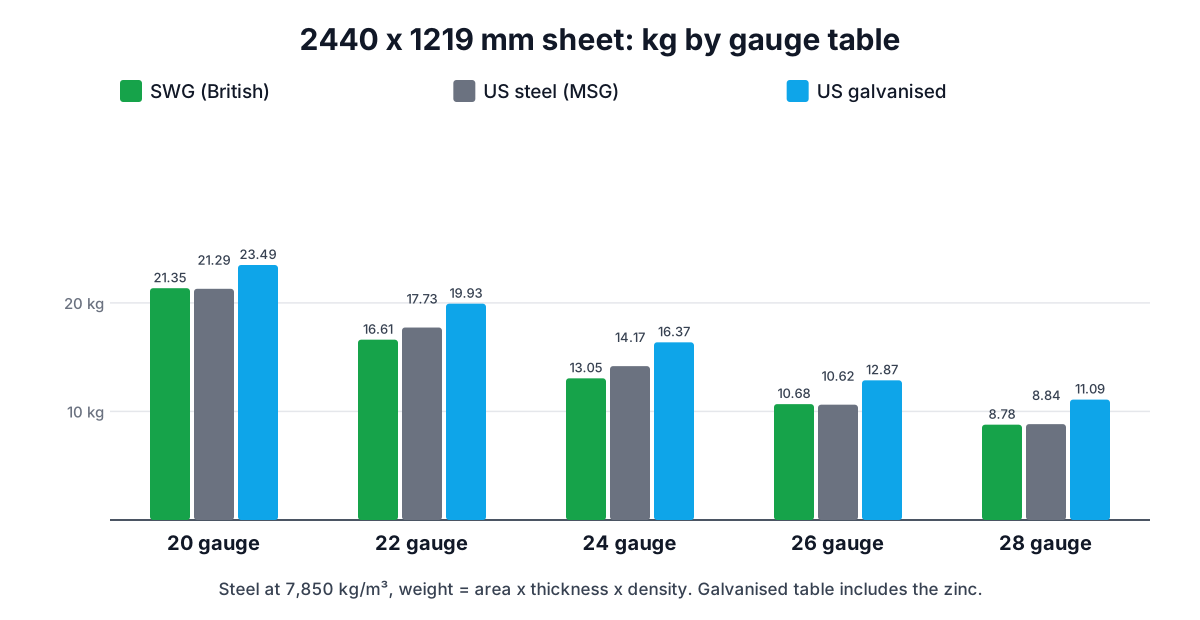
Thin sheet is still often sold by gauge. Many local charts use the British SWG, a list of fixed sizes in thousandths of an inch set in 1883 (see the Standard Wire Gauge table). Imported sheet and online charts may use the US tables instead, and the US galvanised table adds the zinc to the thickness. For a 2440 x 1219 mm sheet:
| Gauge | SWG | US steel | US galvanised |
|---|---|---|---|
| 20 | 21.35 kg | 21.29 kg | 23.49 kg |
| 22 | 16.61 kg | 17.73 kg | 19.93 kg |
| 24 | 13.05 kg | 14.17 kg | 16.37 kg |
| 26 | 10.68 kg | 10.62 kg | 12.87 kg |
| 28 | 8.78 kg | 8.84 kg | 11.09 kg |
On a lot of 100 sheets of "22 gauge", SWG gives 1,660.6 kg and the US steel table 1,773.2 kg, about 113 kg apart. The gauge chart guide for Pakistan goes through the tables in detail; the short version is to get the thickness in mm on the quotation.
Worked examples
A lot of GI roofing sheet
A contractor orders 100 galvanised sheets of 2440 x 1219 mm in 26 SWG (0.457 mm). In the calculator, set the size, choose "Gauge number" with SWG and 26, and a quantity of 100:
area           = 2.44 x 1.219 = 2.9744 m²
kg/m²          = 0.4572 x 7.85 = 3.589
steel each     = 10.68 kg
100 sheets     = 1,067.5 kg
Then add the zinc. ISL lists commercial galvanised coatings from Z60 to Z275 grams per square metre. At 275 g/m² in total, each sheet carries 2.9744 x 0.275 = 0.82 kg of zinc, or 81.8 kg across the lot, so the delivered weight is about 1,149 kg. Confirm on the mill certificate whether the coating figure is for both sides together.
Structural plate under PS 4798
PS 4798:2017, Pakistan's standard for carbon structural steel, is based on ASTM A36/A36M-14 and covers shapes, plates, sections and bars for bridges, buildings and general structural use. Plate is ordered in millimetres:
| Plate, 1500 x 6000 mm | kg/m² | Each plate | Plates per 25,000 kg |
|---|---|---|---|
| 6 mm | 47.1 | 423.9 kg | 58 |
| 10 mm | 78.5 | 706.5 kg | 35 |
The last column is a plain division (25,000 kg divided by the plate weight, rounded down) for checking a load against a vehicle's permitted payload. Use your transporter's actual figure; the formula gives the steel, not the packing, dunnage or the truck's own limits.
Base plates with bolt holes
Forty base plates, 400 x 400 x 12 mm, each with four 22 mm holes:
gross area   = 0.16 m²
holes        = 4 x π/4 x 0.022² = 0.00152 m²
net area     = 0.15848 m²
kg/m²        = 12 x 7.85 = 94.2
each         = 14.93 kg (15.07 kg before drilling)
forty        = 597.2 kg
Each hole removes about 36 g. For costing, the steel you buy is the full square; for the erection crew and the transport note, the drilled weight is the right one.
Standards worth naming on an order
PSQCA's list of compulsory items includes PS 4798 for structural steel, PS-ISO 3573 for hot-rolled carbon steel sheet and PS-ISO 3574 for cold reduced carbon steel sheet, both of commercial and drawing qualities, and PS ISO 16143 for general-purpose stainless steel. PS 4798 sends its general delivery requirements, and its product analysis tolerances, to ASTM A6/A6M. None of these standards change the weight formula, but naming the standard and the thickness in mm on an order fixes the two inputs that matter.
Why the weighbridge rarely matches
- Thickness tolerance. Steel is rolled to a band around the nominal thickness, and weight follows thickness one for one. A lot rolled near the lower limit weighs less than the calculation.
- Theoretical or actual weight. Ask which the price per kg uses. Theoretical weight is what the calculator gives.
- Coating. Zinc on GI and paint on colour coated sheet add to the steel weight.
- Packing. Straps, wooden skids and wrappers add to the delivered weight but not to the steel you are paying for.
For bent parts, weigh the flat blank, which the bend allowance calculator gives, not a box around the finished shape. The press brake tonnage calculator and punch force calculator take the same thickness for forming and punching.
Frequently asked questions
How do I calculate MS plate weight in kg?
Multiply length in metres by width in metres by thickness in mm by 7.85. A 1500 x 6000 x 6 mm plate is 9 x 6 x 7.85 = 423.9 kg; at 10 mm it is 706.5 kg.
What is the weight of a 26 gauge GI sheet?
For a 2440 x 1219 mm sheet in 26 SWG (0.457 mm), 10.68 kg of steel, plus the zinc: about 0.82 kg at a coating of 275 g/m² for both sides. If the gauge is from the US galvanised table, the sheet is 0.551 mm and 12.87 kg.
How many 26 SWG sheets make one tonne?
At 10.68 kg of steel each, about 94 sheets of 2440 x 1219 mm make a tonne of steel (1,000 / 10.675 = 93.7). With 275 g/m² of zinc, each sheet is about 11.49 kg and a tonne is about 87 sheets.
Does PS 4798 give a density for steel?
No. PS 4798 sets chemical composition and tensile requirements for structural steel and points to ASTM A6/A6M for general delivery requirements. The 7,850 kg/m³ used here is the usual design value for carbon steel.
Should I weigh the plate before or after drilling?
Use the full plate for buying and the drilled weight for lifting and transport. On a 400 x 400 x 12 mm base plate with four 22 mm holes the difference is 0.14 kg a plate.
Sources and further reading
- PS 4798:2017 (Rev) Carbon Structural Steel, PSQCA. Scope, ASTM A36/A36M-14 basis, delivery to ASTM A6/A6M.
- List of compulsory items to meet Pakistan Standards, PSQCA. PS 4798, PS-ISO 3573, PS-ISO 3574, PS ISO 16143.
- Products, International Steels Limited. Galvanised sheet 0.18 to 2.50 mm, nominal widths 914, 1,000 and 1,219 mm, coatings Z60 to Z275.
- Standard wire gauge, Wikipedia. The SWG table in inches and mm.
- Sheet metal: gauge, Wikipedia. How the US gauge tables are defined.
Open the Sheet Metal Weight Calculator
More Sheet Metal & Welding
Every tool in the Sheet Metal & Welding section, free and in your browser.