
Brick Calculation for 9-Inch and 4.5-Inch Walls
Number of bricks, cement bags and sand for a 9-inch or 4.5-inch wall in traditional or IS 1077 modular bricks, per square metre, cubic metre and 100 sq ft.
By Redbison Dev · · 10 min read
India edition. Indian edition built on IS 1077 brick sizes (230 x 110 x 70 mm and 190 x 90 x 90 mm), IS 2212 joint, soaking and curing rules, 9-inch and 4.5-inch walls, 50 kg cement bags and cubic-metre estimating. US edition
A 9-inch wall of traditional 230 x 110 x 70 mm bricks with 10 mm joints takes about 104 bricks per square metre of wall face, which is about 453 per cubic metre of brickwork, before breakage. A 4.5-inch partition takes half that, about 52 per square metre. With IS 1077 modular bricks, 190 x 90 x 90 mm, the numbers are rounder: 50 per square metre per leaf, 100 for a 190 mm wall. Add about 5% for breakage and cutting, and work out the mortar separately, because it decides how many 50 kg cement bags you buy.
This edition works through Indian walls with the Brick Calculator for 9 Inch and 4.5 Inch Walls, including the two things that most often throw an estimate off on site: bricks that are not the size on paper, and joints thicker than 10 mm.
The brick sizes in IS 1077
The Bureau of Indian Standards' IS 1077:1992, the specification for common burnt clay building bricks, gives two sets of sizes:
| Type | Length x width x height |
|---|---|
| Modular | 190 x 90 x 90 mm, and 190 x 90 x 40 mm |
| Non-modular (traditional) | 230 x 110 x 70 mm, and 230 x 110 x 30 mm |
Bricks are classed by average compressive strength, and the standard checks dimensions on 20 bricks laid together rather than one at a time: for the 230 mm brick, 20 in a row should measure 4,600 mm plus or minus 80 mm. Bricks from a particular kiln can differ from the nominal size, which is why measuring your own load matters (see below).
How the count works
Each brick in a wall "owns" its face plus one bed joint and one cross joint:
bricks per m² of one leaf = 1 / ((length + joint) x (height + joint))
For a traditional brick: 1 / (0.24 x 0.08) = 52.08 per square metre. A 9-inch wall is two leaves with the middle joint filled, so 104.2 per square metre of wall face. A modular brick with its joint occupies 0.2 x 0.1 m, so 50 per leaf and 100 for a one-brick wall. The calculator does exactly this, then subtracts doors and windows and adds breakage.
IS 2212:1991, the code of practice for brickwork, explains why 10 mm is the joint to use. No bed joint should be thicker than 12 mm, and four courses with three joints should measure four times the brick thickness plus 3 cm for traditional bricks, or 39 cm for modular bricks. Both work out to 10 mm joints. It also gives the nominal and actual thickness of walls: a one-brick traditional wall is nominally 9 inches and actually 8½ to 8¾ inches; a one-brick modular wall is 20 cm nominal and 19 cm actual.
Worked example: a 9-inch wall, 10 m x 3 m
In the Brick Calculator, choose Indian traditional brick, two leaves with the middle joint filled, 10 m x 3 m, no openings, 5% breakage, 15% mortar wastage, 1:6 mortar and 50 kg bags:
- Wall face: 30 m². Bricks: 30 x 104.17 = 3,125 net, 3,282 to buy.
- Brickwork volume at 230 mm: 6.9 m³, so 3,125 / 6.9 = 453 bricks per cubic metre.
- Mortar: 1.37 m³ in the joints, 1.57 m³ with wastage, about 0.2 m³ per cubic metre of brickwork before wastage.
- Cement: 8.6 bags of 50 kg, so 9 bags; sand about 1.79 m³.
Per 100 square feet of 9-inch wall (9.29 m²), that is about 968 bricks and 2.3 bags of cement before breakage.
A 4.5-inch partition
A partition 4 m x 3 m with a door and a window totalling 3.36 m², one leaf of traditional brick, in 1:4 mortar:
- Net area 8.64 m², 450 bricks net, 473 to buy.
- Mortar 0.18 m³ with wastage; 1.35 bags of cement, so 2; sand about 0.19 m³.
This example uses 1:4, a richer mix than the 9-inch wall's 1:6; the specification for your building decides the mix. Lintels, sills and any RCC band are separate items and are not in this count.
What changes the count on site
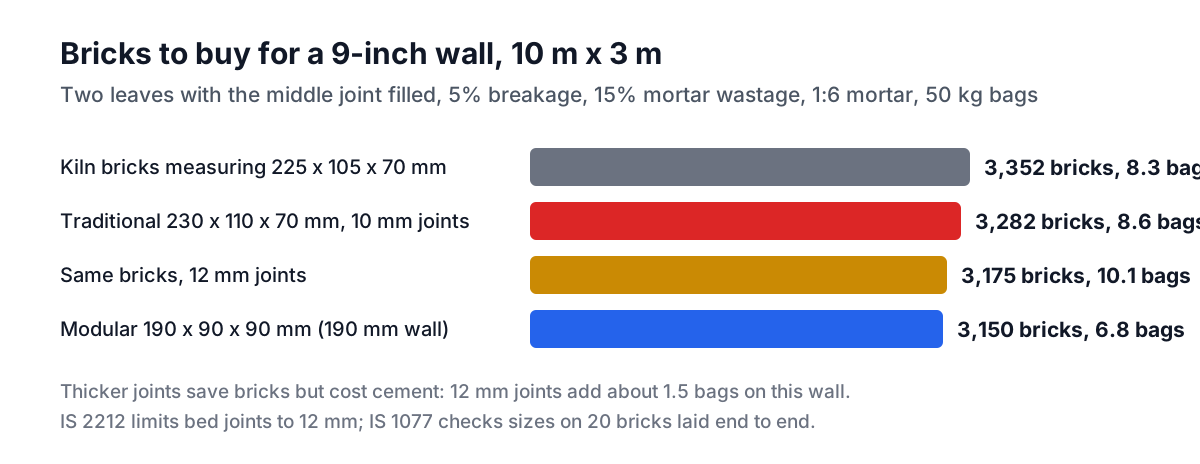
The same 10 m x 3 m 9-inch wall gives very different orders depending on the bricks and the mason:
| Case | Bricks to buy | Mortar with wastage | 50 kg bags at 1:6 |
|---|---|---|---|
| Traditional 230 x 110 x 70 mm, 10 mm joints | 3,282 | 1.57 m³ | 8.6 |
| Kiln bricks measuring 225 x 105 x 70 mm | 3,352 | 1.52 m³ | 8.3 |
| Traditional bricks, 12 mm joints | 3,175 | 1.85 m³ | 10.1 |
| Modular 190 x 90 x 90 mm, 190 mm wall | 3,150 | 1.25 m³ | 6.8 |
Measure the bricks you actually receive. Following IS 1077's method, lay 20 bricks in a row and divide by 20. If your bricks average 225 x 105 mm instead of 230 x 110 mm, enter the custom size: the order rises by 70 bricks on this wall, and the wall is thinner.
Watch the joints. At 12 mm, the limit in IS 2212, the wall needs about 107 fewer bricks but 1.5 more bags of cement. Thick joints are cheaper in bricks and dearer in cement.
Laying and curing
IS 2212 sets a few rules that affect quality more than quantity:
- Soak the bricks. Bricks should be soaked long enough for water to just penetrate the whole depth, so they do not suck water out of the mortar, then allowed to become skin-dry before laying. The code suggests a site test: soak bricks for different periods, break them and see how far the water has gone.
- Lay on a full bed. Bricks are laid on a full bed of mortar with cross joints flushed and packed, and no part of a wall should rise more than one metre above the general level during construction.
- Cure for seven days. In hot, dry weather keep the brickwork constantly wet for at least seven days, except for brickwork in mud mortar.
Wet cement mortar is strongly alkaline. The UK Health and Safety Executive's cement guidance warns that it can cause serious burns if trapped against the skin and dermatitis with repeated contact, so masons and helpers should wear waterproof gloves and wash it off quickly.
Tools for this job
- Brick Calculator for 9 Inch and 4.5 Inch Walls: bricks with breakage, wet mortar, 50 kg cement bags and sand.
- Concrete Calculator for India: the footing, plinth beam or lintel under and over the brickwork.
- Concrete Mix Ratio Calculator for India: cement, sand and aggregate for nominal concrete mixes.
- Related reading: concrete mix ratios and dry volume, and the US brick and mortar guide for US modular brick and concrete block.
Frequently asked questions
How many bricks are there in 1 cubic metre of brickwork?
About 453 traditional 230 x 110 x 70 mm bricks per cubic metre of 9-inch wall with 10 mm joints, before breakage. With modular 190 x 90 x 90 mm bricks it is 500 per cubic metre on the 20 cm nominal thickness, or about 526 on the 19 cm actual thickness.
How many bricks are needed for 100 square feet of 9-inch wall?
About 968 traditional bricks before breakage, and 1,017 with 5% added. The mortar for it needs about 2.3 bags of 50 kg cement in a 1:6 mix before wastage.
How much cement do I need for 1,000 bricks?
For a 9-inch wall in 1:6 mortar with 15% wastage, about 2.75 bags of 50 kg per 1,000 bricks laid: the 10 m x 3 m example uses 8.6 bags for 3,125 bricks. Thicker joints or a richer mix raise it.
What is the standard brick size in India?
IS 1077 gives the modular size as 190 x 90 x 90 mm (and 190 x 90 x 40 mm), and the non-modular traditional size as 230 x 110 x 70 mm (and 230 x 110 x 30 mm). Bricks from a given kiln can differ from these, so measure 20 from your load.
Sources and further reading
- IS 1077:1992 Common burnt clay building bricks: specification, Bureau of Indian Standards (copy at Public.Resource.Org). Modular and non-modular sizes, strength classes and the 20-brick dimension test.
- IS 2212:1991 Code of practice for brickwork, Bureau of Indian Standards (copy at Public.Resource.Org). Joint thickness, wall thicknesses, soaking, laying and curing.
- Handout on Indian Standards on building materials, Bureau of Indian Standards. The list of brick standards, including IS 1077, IS 2180 and IS 2222.
- Technical Note 10: Dimensioning and estimating brick masonry, Brick Industry Association. The module method for units and mortar per area.
- Construction hazardous substances: cement, Health and Safety Executive (UK). Burns and dermatitis from wet cement, and the gloves that prevent them.
Open the Brick and Block Calculator
More Civil & Structural
Every tool in the Civil & Structural section, free and in your browser.