
How Many Bricks per m², and How Much Mortar? (UK)
Bricks and blocks per m² for UK sizes, mortar and 25 kg cement bags for half-brick, one-brick and cavity walls, plus Approved Document A's wall tie rules.
By Redbison Dev · · 10 min read
United Kingdom edition. UK edition in millimetres and square metres, built on 215 x 102.5 x 65 mm bricks and 440 x 215 mm blocks with 10 mm joints, 25 kg cement bags, and the cavity wall, wall tie and mortar rules in Approved Document A. US edition
A UK brick is 215 x 102.5 x 65 mm and, with a 10 mm joint, takes up 225 x 75 mm of wall, so a half-brick leaf needs 59.26 bricks per square metre: the "60 a metre" rule. A one-brick wall, two leaves bonded together, needs about 118.5. A 440 x 215 mm concrete block takes about 9.9 per square metre. Add at least 5% for cuts and breakages, then work out mortar from the joints, and for a cavity wall count each leaf separately and add wall ties.
This edition works through UK walls with the Brick and Block Calculator for the UK, from a garden wall to an extension's cavity wall.
Where 59.26 bricks per square metre comes from
Each brick in running bond "owns" its face plus one bed joint and one head joint:
units per m² = 1 / ((length + joint) x (height + joint))
For a UK brick: 1 / (0.225 x 0.075) = 59.26. For a 440 x 215 mm block: 1 / (0.450 x 0.225) = 9.88. The block's thickness, 100 mm or 140 mm, does not change the count per square metre, only the mortar.
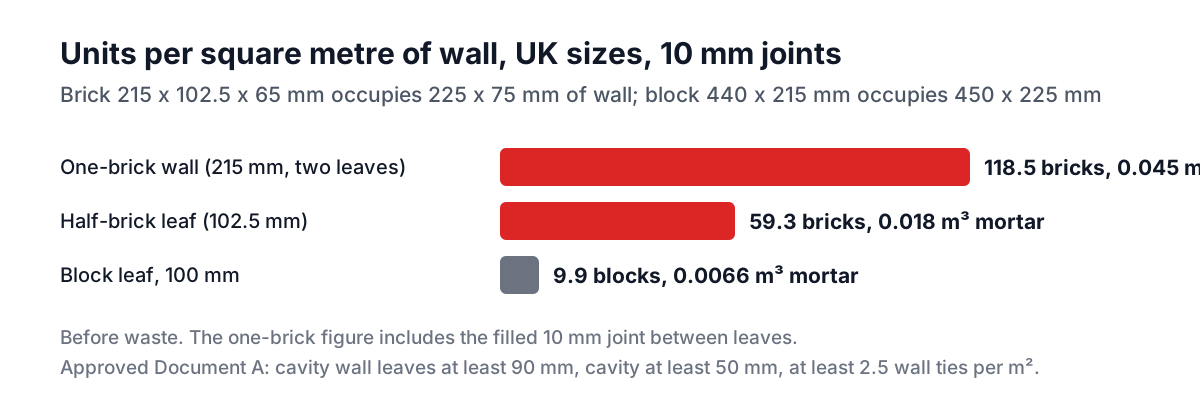
Mortar per brick follows the same geometry: the brick's share of wall, times the leaf thickness, minus the brick itself. For a UK brick that is (0.225 x 0.075 - 0.215 x 0.065) x 0.1025 = 0.000297 m³, about 0.3 litres, or 0.018 m³ per square metre of half-brick leaf before waste.
Worked example: the outer leaf of an extension
An extension wall 10 m long and 2.4 m high, with a 0.9 x 2.1 m door and a 1.2 x 1.05 m window. In the Brick and Block Calculator for the UK, choose UK brick, a half-brick leaf, 5% for cuts, 15% for mortar droppings and a 1:5 mix with 25 kg bags:
- Gross area 24 m², openings 3.15 m², net 20.85 m².
- Bricks: 20.85 x 59.26 = 1,236 before waste, 1,298 to order.
- Mortar: 0.367 m³ in the joints, 0.42 m³ with 15% for droppings.
- Cement: 5.4 bags of 25 kg, so 6 bags, and about 0.47 m³ of sand.
A 1:6 mix on the same wall needs 4.6 bags, so 5. The calculator turns wet mortar into dry cement and sand with a dry volume factor of 1.33; the result is an estimate to order from, not a mix design.
The inner leaf, and what a cavity wall adds
For a cavity wall, run the calculator once for each leaf over the same net area. The inner leaf of 440 x 215 x 100 mm block on 20.85 m² takes 206 blocks before waste and 217 with 5%, with 0.16 m³ of mortar and 2 bags of cement at 1:5. A 140 mm block keeps the count at 217 but needs 0.22 m³ of mortar.
Approved Document A, the 2013 edition for England, sets the masonry rules for small buildings that a builder will check against:
- Leaves and cavity (paragraph 2C8): cavity walls should have leaves at least 90 mm thick and a cavity at least 50 mm wide.
- Wall ties: at 900 mm horizontally and 450 mm vertically, or at least 2.5 ties per square metre, plus ties no more than 300 mm apart vertically within 225 mm of the edges of openings, movement joints and roof verges. On the 20.85 m² wall, 2.5 per m² is 52.1, so at least 53 general ties before the extra ones round the door and window.
- Thickness: the two leaves plus 10 mm should be at least as thick as the solid wall Table 3 requires for that height and length, 190 mm for a wall up to 3.5 m high and 12 m long. A 102.5 mm brick leaf plus a 100 mm block leaf plus 10 mm is 212.5 mm.
- Mortar (paragraph 2C22): designation (iii) to BS EN 1996-1-1 with its UK National Annex, strength class M4 to BS EN 998-2, or a 1:1:5 to 6 mix of CEM I cement, lime and fine aggregate by volume, or something equivalent or stronger.
The calculator's cement and sand mix is a cement-sand ratio; if your mortar is a 1:1:6 cement-lime-sand mix, or a ready-made designation (iii) mortar, use the wet volume it reports and order to that specification. Your building control body or engineer has the final say on walls that carry loads, retain earth or sit below ground.
A one-brick garden wall
A freestanding wall 8 m long and 1.2 m high, built one brick thick (215 mm) with the joint between the leaves filled, in a 1:4 mix:
- Bricks: 1,138 before waste, 1,195 to order, about 119 per square metre of wall face.
- Mortar: 0.43 m³ in the joints, 0.50 m³ with waste, including the 10 mm collar joint between the leaves.
- Cement: 7.7 bags of 25 kg, so 8, and about 0.53 m³ of sand.
The count does not include a coping or a brick-on-edge course on top, piers, or the footing; add those separately. Use the Concrete Calculator for the UK for the strip footing.
Mortar for 1,000 bricks
A useful figure for ordering is mortar per 1,000 bricks. For 1,000 UK bricks in a half-brick leaf, the joints hold 0.297 m³ of wet mortar, 0.34 m³ with 15% for droppings. In a 1:4 mix that is about 5.2 bags of 25 kg cement, so 6, and 0.36 m³ of sand. In 1:6 the cement drops to about 3.7 bags.
Safety: wet mortar burns
The Health and Safety Executive's guidance on cement explains why gloves matter. Wet cement is strongly alkaline: a serious burn or ulcer can develop quickly if it is trapped against the skin, and it can cause chemical burns to the eyes. It also contains hexavalent chromium, which can sensitise skin and lead to allergic dermatitis. HSE advises waterproof gloves suitable for alkalis, long or tight at the wrist so cement cannot get inside, and washing it off the skin as soon as possible.
Tools for this job
- Brick and Block Calculator for the UK: bricks or blocks per wall with openings, mortar, 25 kg cement bags and sand.
- Concrete Calculator for the UK: the strip footing under a wall or extension.
- Concrete Mix Ratio Calculator for the UK: cement, sand and aggregate for site-mixed concrete.
- Related reading: concrete mix ratios and dry volume, and the US brick and mortar guide for US modular brick and CMU block.
Frequently asked questions
How many bricks do I need per square metre?
About 60 for a half-brick wall: 59.26 for a 215 x 65 mm brick with 10 mm joints. A one-brick (215 mm) wall needs about 118.5 per square metre. Add 5% for cuts and breakages.
How many blocks are in a square metre?
About 10: 9.88 for a 440 x 215 mm block with 10 mm joints. The thickness of the block does not change the number per square metre, only the mortar, which rises from about 0.0066 m³ per square metre for a 100 mm block to about 0.0092 for 140 mm.
How many wall ties do I need for a cavity wall?
Approved Document A asks for ties at 900 mm horizontally and 450 mm vertically, or at least 2.5 per square metre, plus ties at no more than 300 mm vertical spacing within 225 mm of openings, movement joints and roof verges. A 20.85 m² wall needs at least 53 general ties.
What mortar mix should I use for brickwork?
For walls covered by Approved Document A's rules for small buildings, designation (iii) mortar, strength class M4, or a 1:1:5 to 6 cement, lime and fine aggregate mix by volume, or something of equal or greater strength and durability. Follow your engineer's or building control's specification where it differs.
Sources and further reading
- Approved Document A: Structure, GOV.UK. 2013 edition; paragraph 2C8 on cavity walls and wall ties, Table 3 on wall thickness and paragraph 2C22 on mortar.
- Approved Document A, 2013 edition (PDF), GOV.UK. The full document, including Section 2C on masonry walls in small buildings.
- Construction hazardous substances: cement, Health and Safety Executive. Burns and dermatitis from wet cement, gloves and washing.
- Brick calculator, Brick Development Association. The UK clay brick industry body's own estimating tool, for single and double skin walls.
- Technical Note 10: Dimensioning and estimating brick masonry, Brick Industry Association. The module method behind units per area and mortar per unit.
Open the Brick and Block Calculator
More Civil & Structural
Every tool in the Civil & Structural section, free and in your browser.