
M20 Concrete: Cement Bags, Sand and IS 456 Limits
Cement bags, sand and 20 mm aggregate for an M20 roof slab, the IS 456 exposure rule that can rule out a nominal mix, and how to correct for wet sand.
By Redbison Dev · · 10 min read

India edition. Works in 50 kg bags, cubic metres and cft, and checks site nominal mixes against IS 456:2000 Tables 5, 9 and 10 (exposure, nominal proportions and surface water) and the IS 2386 bulking test. US edition
For a typical M20 roof slab mixed on site at 1:1.5:3, you need about 8.06 bags of 50 kg cement per cubic metre of concrete, plus about 0.42 m³ of sand and 0.84 m³ of 20 mm aggregate. That much most site engineers know. What gets missed is the other half of IS 456: the exposure table that decides whether a nominal mix is allowed at all, the water cap that is tighter than the one in Table 9, and the correction for wet sand. This guide works through all three with the concrete mix calculator for India.
The quantities: one roof slab, worked through
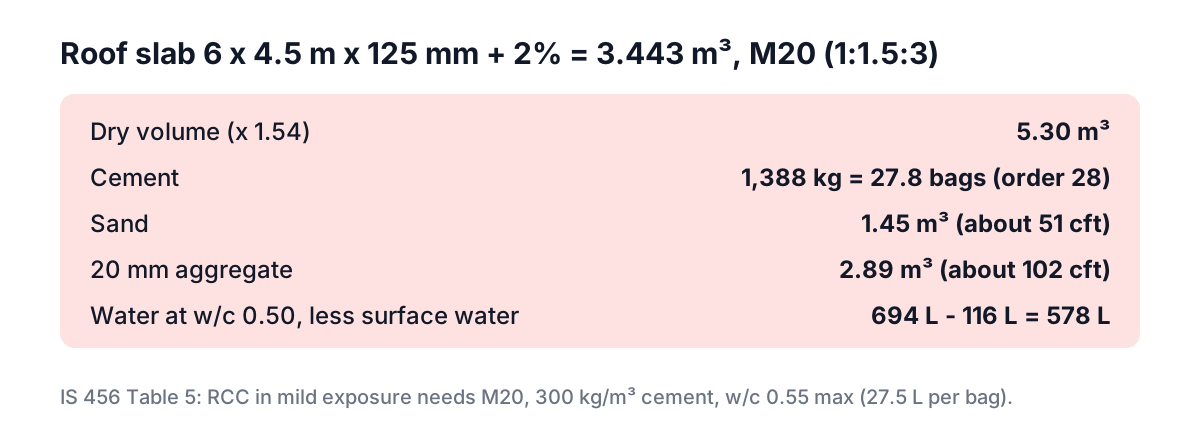
A slab 6 m x 4.5 m, 125 mm thick, with 2% extra for wastage, is 3.443 m³ of concrete. The calculator multiplies by the 1.54 dry volume factor (loose cement, sand and aggregate shrink when mixed and compacted) and splits by the ratio:
| Item | M20 (1:1.5:3) | M15 (1:2:4) |
|---|---|---|
| Dry volume | 5.30 m³ | 5.30 m³ |
| Cement | 1,388 kg, 27.8 bags (order 28) | 1,091 kg, 21.8 bags (order 22) |
| Sand | 1.45 m³ (about 51 cft) | 1.51 m³ (about 53 cft) |
| 20 mm aggregate | 2.89 m³ (about 102 cft) | 3.03 m³ (about 107 cft) |
| Cement content | 403 kg/m³ | 317 kg/m³ |
| Water at w/c 0.50 | 694 L | 545 L |
Sand and aggregate suppliers in many towns quote in cft; one cubic metre is 35.31 cft. The kilogram figures the calculator also shows use 1,600 kg/m³ for sand and 1,500 kg/m³ for aggregate, which you can change to your supplier's figure.
Step one: is a nominal mix allowed for this member?
IS 456:2000 clause 9.3 allows nominal mix concrete only for M20 or lower. That is well known. Less well known is Table 5, which sets a minimum grade, a minimum cement content and a maximum water-cement ratio for each exposure condition (20 mm aggregate):
| Exposure | Reinforced concrete: min cement | Max free w/c | Min grade | Plain concrete: min cement | Max free w/c | Min grade |
|---|---|---|---|---|---|---|
| Mild | 300 kg/m³ | 0.55 | M20 | 220 kg/m³ | 0.60 | (none) |
| Moderate | 300 kg/m³ | 0.50 | M25 | 240 kg/m³ | 0.60 | M15 |
| Severe | 320 kg/m³ | 0.45 | M30 | 250 kg/m³ | 0.50 | M20 |
| Very severe | 340 kg/m³ | 0.45 | M35 | 260 kg/m³ | 0.45 | M20 |
| Extreme | 360 kg/m³ | 0.40 | M40 | 280 kg/m³ | 0.40 | M25 |
Table 3 of the code describes the exposures. Mild is a surface protected against weather or aggressive conditions, except in coastal areas. Moderate includes surfaces sheltered from severe rain, concrete exposed to condensation and rain, and concrete buried in non-aggressive soil. Severe includes surfaces exposed to severe rain or alternate wetting and drying, and concrete in a coastal environment.
Put the two rules together. For reinforced concrete, mild exposure needs at least M20, which a nominal mix can just provide. Moderate exposure needs at least M25, which a nominal mix cannot: that member needs a design mix proportioned to IS 10262 and tested. Which exposure applies to your footing, column or slab is your structural engineer's call, but if the drawing says moderate or worse, a 1:1.5:3 site mix is not compliant whatever the cement bags say.
Step two: check the mix against Table 9, by mass
IS 456 Table 9 does not give volume ratios. It gives the total mass of dry fine and coarse aggregate per 50 kg of cement, and the maximum water per 50 kg bag. Converting the site ratios with the calculator's densities:
| Grade | Site ratio | Aggregate per bag (calculated) | Table 9 maximum | Water cap in Table 9 |
|---|---|---|---|---|
| M20 | 1:1.5:3 | 240 kg | 250 kg | 30 L per bag |
| M15 | 1:2:4 | 319 kg | 330 kg | 32 L per bag |
| M10 | 1:3:6 | 479 kg | 480 kg | 34 L per bag |
| M7.5 | 1:4:8 | 639 kg | 625 kg | 45 L per bag |
The first three sit just inside the table at these densities; 1:4:8 comes out slightly leaner than Table 9 allows. Heavier, wetter aggregate shifts these numbers, which is why the code prefers weighing.
Now the water. Table 9 allows 30 litres per bag for M20, a water-cement ratio of 0.60. But Table 5 caps reinforced concrete in mild exposure at 0.55, which is 27.5 litres per bag. The tighter of the two governs, so for an RCC slab the real limit is 27.5 litres, and 25 litres (w/c 0.50) leaves a margin. Clause 9.3.1 adds that if more water is needed for placing and compaction, the cement must be increased in proportion so the ratio is not exceeded.
Step three: correct for wet sand
IS 456 clause 10.2 says cement and aggregate should be batched by mass, and that ready-mixed concrete should be preferred, with large and medium sites using ready-mix or batching plants. Volume batching is allowed only where weigh-batching is not practical, and then with an allowance for bulking of sand made to IS 2386 (Part 3).
The IS 2386 field test is simple. Fill a container about two-thirds with the damp sand and measure its depth (h). Then flood the sand with water, rod it down, and measure again (h'). Percentage bulking is (h / h' - 1) x 100. If 20 cm of damp sand settles to 16 cm, bulking is 25%, and every box of sand must be 25% bigger to put in the intended amount. For the slab above, the 1.45 m³ of sand becomes about 1.81 m³ of damp, loose sand.
Wet aggregate also brings water. IS 456 Table 10 gives approximate surface water for nominal mixes when you have no better data:
| Aggregate | Surface water | Litres per m³ |
|---|---|---|
| Very wet sand | 7.5% | 120 |
| Moderately wet sand | 5.0% | 80 |
| Moist sand | 2.5% | 40 |
| Moist gravel or crushed rock | 1.25 to 2.5% | 20 to 40 |
With moist sand (40 L/m³) and moist aggregate at the low end (20 L/m³), the slab's 1.45 m³ of sand and 2.89 m³ of aggregate already carry about 58 + 58 = 116 litres. At w/c 0.50 the 694 litres of total water becomes about 578 litres to add from the drum.
Small pours: PCC under footings
Eight isolated footings with 1.2 x 1.2 m PCC beds, 100 mm thick, plus 5%, come to 1.21 m³. At M10 (1:3:6) that is 268 kg of cement, 5.4 bags (order 6), 0.56 m³ of sand and 1.12 m³ of coarse aggregate. Its cement content, 222 kg/m³, just clears the 220 kg/m³ that Table 5 asks of plain concrete in mild exposure.
Materials and curing
- Cement bags. The BIS handout on building materials notes that the cement standards require bags to be marked with type, batch, net quantity and a best-before date of 3 months. Check the date on site; old cement loses strength.
- Sand. IS 383:2016 covers natural sand, crushed sand and manufactured sand (M-sand) as fine aggregate, so M-sand from a compliant source is a legitimate choice.
- Design mixes. IS 10262:2019 sets the method for concrete mix proportioning, from ordinary grades to self-compacting concrete.
- Curing. IS 456 clause 13.5.1 asks for exposed surfaces to be kept continuously wet for at least 7 days with ordinary Portland cement and at least 10 days with blended cements such as PPC, and not less than 10 days in hot, dry weather.
Tools for this job
- Concrete mix calculator for India: bags, sand, aggregate and water for M20, M15, M10 and custom ratios.
- Concrete calculator for India: the volume of slabs, beams, columns and footings.
- Rebar calculator for India for the steel in the same slab, and the brick calculator for India for the walls.
- The Indian guide to estimating concrete and flooring covers volumes, tiles and ordering.
Frequently asked questions
Can I use a nominal mix for an RCC slab?
Only if the member's exposure is mild. IS 456 Table 5 requires at least M20 for reinforced concrete in mild exposure, which a 1:1.5:3 nominal mix can provide, but at least M25 in moderate exposure, and nominal mixes are allowed only up to M20 (clause 9.3). Ask your structural engineer which exposure the drawings assume.
What is the maximum water for one bag of cement in M20?
Table 9 allows 30 litres per 50 kg bag for nominal M20, but Table 5 limits reinforced concrete in mild exposure to a water-cement ratio of 0.55, or 27.5 litres per bag. Use the tighter figure, and count the water already in wet sand and aggregate.
How do I calculate bulking of sand on site?
Measure the depth of loose damp sand in a container (h), flood it with water, rod it and measure again (h'). Bulking is (h / h' - 1) x 100, the IS 2386 (Part 3) field method. Increase every volume of sand by that percentage.
How many cement bags for a 6 x 4.5 m slab, 125 mm thick?
About 28 bags of 50 kg for M20 (1:1.5:3) with 2% wastage, or 22 bags for M15 (1:2:4), using the 1.54 dry volume factor and cement at 1,440 kg/m³.
Sources and further reading
- IS 456:2000 Plain and Reinforced Concrete: Code of Practice, Bureau of Indian Standards (copy at Public.Resource.Org). Clauses 9.3, 10.2 and 13.5.1; Tables 3, 5, 9 and 10.
- IS 2386 (Part 3):1963 Methods of test for aggregates for concrete: specific gravity, density, voids, absorption and bulking, Bureau of Indian Standards (copy at Public.Resource.Org). The field method for bulking of sand.
- Handout on Indian Standards on Building Materials, Bureau of Indian Standards. Cement bag marking, IS 383:2016 and IS 10262:2019.
- IS 10262:2009 Concrete Mix Proportioning: Guidelines, Bureau of Indian Standards (copy at Public.Resource.Org). The earlier edition of the design mix method; the 2019 revision is current.
- IS 383:1970 Coarse and fine aggregates from natural sources for concrete, Bureau of Indian Standards (copy at Public.Resource.Org). The earlier edition; the BIS handout describes the 2016 revision, which covers manufactured sand.
Open the Concrete Mix Ratio Calculator
More Civil & Structural
Every tool in the Civil & Structural section, free and in your browser.