
XIRR vs CAGR in Mutual Funds: Your Return vs the Scheme's
Why your mutual fund XIRR differs from the scheme's CAGR: SEBI's point-to-point returns, CAS figures, SIP XIRR vs absolute return, worked in rupees.
By Redbison Dev · · 6 min read
India edition. Worked in rupees with lakh grouping, using the SEBI rules for how schemes report CAGR against their benchmark and what the consolidated account statement shows, with SIP and lump sum examples. US edition
Two investors put ₹7 lakh each into the same equity scheme between March 2022 and June 2024. On 6 November 2026 the scheme's NAV has gone from ₹40 to ₹62, a CAGR of 9.88% for anyone who held it from the first date. One investor's XIRR is 8.90%; the other's is 6.28%. Neither the scheme's figure nor the investors' figures is wrong. The scheme reports a point-to-point CAGR, which is a time-weighted return, and each investor's XIRR is a money-weighted return that depends on when their rupees went in. This edition explains both measures for Indian mutual fund investors, with every number from the XIRR and portfolio return calculator. It describes past returns only and is not a recommendation to buy, hold or switch any scheme.
What the scheme reports: CAGR on NAV
SEBI's Master Circular for Mutual Funds (as on 20 March 2026) tells AMCs to disclose the performance of all schemes on the AMFI website as scheme returns against the benchmark (Total Return Index), in CAGR terms for 1, 3, 5 and 10 years and since inception. Performance advertisements must show CAGR for at least the past 1, 3 and 5 years and since inception, plus point-to-point returns on a standard investment of ₹10,000, and must say whether the figures are for the regular or direct plan, because the plans have different expense structures.
All of these are calculated from the NAV at two dates, so they do not depend on anyone's purchases or redemptions. That is exactly what a time-weighted return (TWR) is. For a single scheme, TWR is simply the change in NAV, because each sub-period between cash flows is measured by NAV and the sub-periods multiply back to the end-to-end change. For the scheme in the example:
₹40 → ₹58 → ₹62:  (58 ÷ 40) × (62 ÷ 58) − 1 = 1.45 × 1.069 − 1 = 55.0%
CAGR over 4.65 years = 1.55^(1 ÷ 4.65) − 1 = 9.88% a year
Point-to-point on ₹10,000: 10,000 × 62 ÷ 40 = ₹15,500
The global GIPS standards take the same view for managers: firms must present time-weighted returns unless they control the external cash flows and the fund has certain characteristics, such as being closed-end or fixed-life.
What your money did: XIRR
XIRR is the single annual rate at which all your dated purchases, redemptions and today's value balance to zero. It is the same function as the spreadsheet's XIRR, which, as Microsoft's documentation explains, discounts every payment on a 365-day year. A rupee invested earlier has more time to earn, so XIRR weights each instalment by how long it was invested.
The two investors
| Investor A | Investor B | |
|---|---|---|
| 15 March 2022, NAV ₹40 | ₹5,00,000 (12,500 units) | ₹2,00,000 (5,000 units) |
| 10 June 2024, NAV ₹58 | ₹2,00,000 (3,448.28 units) | ₹5,00,000 (8,620.69 units) |
| Value on 6 November 2026, NAV ₹62 | ₹9,88,793 | ₹8,44,483 |
| Absolute return on ₹7,00,000 | 41.26% | 20.64% |
| Scheme CAGR (time-weighted) | 9.88% | 9.88% |
| XIRR | 8.90% | 6.28% |
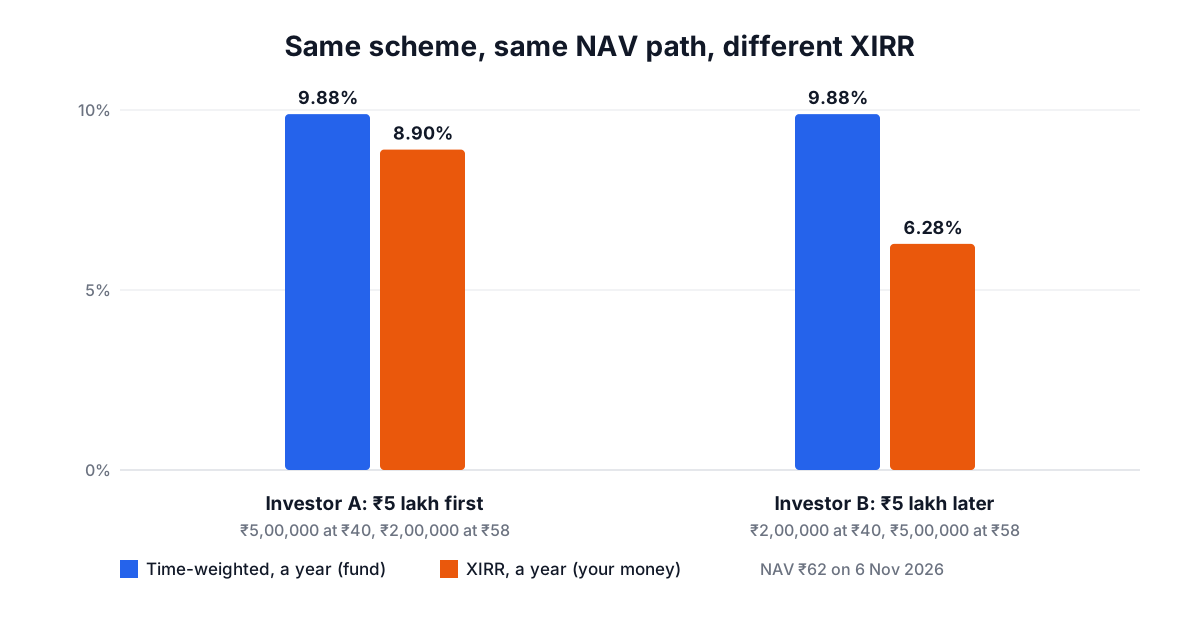
Most of the scheme's gain came in the first period (₹40 to ₹58, +45%), and only 6.9% in the second. Investor A had most of the money in for the strong period; Investor B put most of it in just before the weaker one. Both are below the scheme's 9.88% because some of their money missed the first leg entirely.
SIPs: why absolute return and XIRR disagree
Absolute return, the gain divided by the total invested, has no time in it. Take a SIP of ₹10,000 on the 5th of every month from November 2023 to October 2026, 36 instalments of ₹3,60,000 in all:
| Value on 6 November 2026 | Gain | Absolute return | XIRR |
|---|---|---|---|
| ₹4,30,000 | ₹70,000 | 19.44% | 11.84% |
| ₹3,90,000 | ₹30,000 | 8.33% | 5.25% |
Over three years the absolute figure is larger than the XIRR, but not because XIRR is pessimistic. The average SIP instalment has been invested for only about 18 months, not three years, so a 19.44% gain on that money is close to 12% a year. In the first few months of a SIP the opposite happens: a small gain annualised over a few weeks can produce a startling XIRR. The SIP vs lump sum guide for India shows how instalments average the purchase NAV, and the SIP calculator projects a plan forward.
Reading your CAS
SEBI requires each consolidated account statement (CAS) to show the total purchase value, or cost of investment, in each scheme, and the indicative half-yearly format has columns for the number of units, NAV, cumulative amount invested and market value, along with the scheme's average total expense ratio and the gross commission paid to distributors for regular plans. From those columns you can work out the absolute return, but not the time each rupee was invested. For XIRR you need the transaction dates, which are in the statement's transaction detail or your fund house account.
To check a figure:
- Enter each SIP instalment, lump sum and top-up as a buy with its date and amount.
- Enter redemptions, switches out and SWP withdrawals as sells on their dates.
- Enter today's market value and note the date; XIRR changes with it.
- Add units to every transaction if you want the time-weighted return as well. It should match the change in NAV for that scheme over your dates.
Your transactions are saved only in this browser.
Common mistakes
- Comparing your XIRR with a 1-year or 3-year CAGR over different dates. Use the scheme's NAV on your own first and last dates.
- Comparing regular and direct plans. They have different expense ratios, so their CAGRs differ even in the same scheme.
- Counting IDCW reinvestment as new money. Reinvested units come from the scheme, not from your bank; leave them out of buys or the XIRR will be understated. IDCW paid out to your bank is money you received; enter it as a sell.
- Judging a fund by your XIRR. XIRR mixes the scheme's performance with your timing. Judge the scheme by its CAGR against its benchmark TRI, which is what SEBI's disclosures provide.
What to take away
The scheme's CAGR tells you how the scheme performed over a period; your XIRR tells you how your money did with your timing. A gap between them is information about timing, not an error. Past performance may or may not be sustained in future. For a decision about your own portfolio, a SEBI-registered investment adviser can look at your goals and taxes, which this calculation does not.
Frequently asked questions
What is the difference between XIRR and CAGR?
CAGR is the annual growth rate between two values on two dates, so it fits a single lump sum or a scheme's NAV. XIRR handles many purchases and redemptions on different dates. For one lump sum with no other flows, the two are the same.
Why is my SIP XIRR lower than the absolute return?
Absolute return is a total over the whole period, while XIRR is a rate per year weighted by how long each instalment was invested. A 36-month SIP of ₹10,000 worth ₹4,30,000 has an absolute return of 19.44% and an XIRR of 11.84%.
Why does my XIRR differ from the scheme's return?
The scheme reports CAGR on NAV, which ignores investors' purchases and redemptions. Your XIRR depends on when you invested. In the example, the same scheme showed 9.88% CAGR while two investors had XIRRs of 8.90% and 6.28%.
Does the CAS show XIRR?
SEBI's indicative CAS format shows units, NAV, cumulative amount invested and market value, with total expense ratio and distributor commission in the half-yearly statement. If a statement or app shows an XIRR, you can check it by entering the dated transactions and current value in the calculator.
What is the point-to-point return on ₹10,000?
It is what a single ₹10,000 investment at the start date would be worth at the end date, based only on the NAV. SEBI requires it in performance advertisements alongside CAGR.
Sources and further reading
- Master Circular for Mutual Funds (20 March 2026), Securities and Exchange Board of India. Paragraph 6.9.1 (scheme performance against TRI in CAGR), 14.2 (advertisements, point-to-point return on ₹10,000) and 15.7.4 (consolidated account statement).
- Master Circular for Mutual Funds, full text (PDF), Securities and Exchange Board of India. Format 4F, indicative half-yearly CAS.
- Investor corner, Association of Mutual Funds in India. Scheme reports and investor education.
- 2020 GIPS Standards for Firms, CFA Institute. Provision 1.A.35 on time-weighted and money-weighted returns.
- XIRR function, Microsoft Support. The 365-day convention.
- Time-weighted vs money-weighted return (US edition).
Open the Time-Weighted Return Calculator
More Calculators
Every tool in the Calculators section, free and in your browser.
- Investment Calculator
- Compound Interest Calculator
- Simple Interest Calculator
- Interest Calculator
- EMI Calculator
- Retirement Calculator
- Time-Weighted Return Calculator
- Savings Goal Calculator
- Inflation Calculator
- CAGR Calculator
- ROI Calculator
- Present and Future Value Calculator
- NPV and IRR Calculator
- 401(k) Calculator
- Roth IRA Calculator
- APY and CD Calculator
- SIP Calculator
- Annuity Calculator
- Bond Price and Yield Calculator
- Currency Converter
- Dividend Calculator
- Stock Average Calculator
- RMD Calculator