
Time-Weighted vs Money-Weighted Return on an ISA or SIPP
Why your ISA's personal return differs from the fund's: TWR and XIRR worked in pounds, the April allowance effect, flexible ISA withdrawals and SIPP tax relief.
By Redbison Dev · · 6 min read
United Kingdom edition. Worked in pounds on a stocks and shares ISA and a SIPP, with the 2026 to 2027 ISA allowance, flexible ISA withdrawals and relief at source treated as dated cash flows. US edition
Two savers hold the same fund in a stocks and shares ISA. Both pay in £20,000 in April 2024 at £2.00 a unit and another £20,000 later, and on 6 November 2026 the unit price is £2.20. The fund has returned 10% over that time for both of them, about 3.8% a year. Yet one saver's money has earned −0.5% a year and the other's 5.7% a year. Nothing is wrong with either figure: the first is the fund's time-weighted return, the second is each saver's money-weighted return, and the gap is the timing of the second £20,000. This edition explains the two measures for UK savers, using the UK investment return calculator for every number. It describes past results only and is not advice on what to buy or when.
Two questions, two measures
How did the fund do? Time-weighted return (TWR) ignores your deposits and withdrawals. It splits the holding period at every cash flow, measures each piece by the change in unit price, and multiplies the pieces together. Everyone who held the fund over the same dates gets the same answer, which is why fund managers report it. The GIPS standards, the global code for presenting investment performance, require firms to present time-weighted returns unless the firm controls the external cash flows and the fund is, for example, closed-end or fixed-life.
How did my money do? Money-weighted return asks for the one annual rate at which everything you paid in, everything you took out and today's value balance out. Spreadsheets call it XIRR. Microsoft's documentation says XIRR discounts every payment on a 365-day year, and gives a reference case: −10,000 followed by four inflows returns 37.34%. The calculator uses the same convention.
The two ISA savers
The fund's unit price went from £2.00 in April 2024 to £2.50 in April 2025, fell back to £2.00 by January 2026 and was £2.20 on 6 November 2026.
| Saver A | Saver B | |
|---|---|---|
| 8 April 2024 | £20,000 at £2.00, 10,000 units | £20,000 at £2.00, 10,000 units |
| Second payment | 7 April 2025: £20,000 at £2.50, 8,000 units | 5 January 2026: £20,000 at £2.00, 10,000 units |
| Value on 6 November 2026 | 18,000 units × £2.20 = £39,600 | 20,000 units × £2.20 = £44,000 |
| Gain on £40,000 paid in | −£400 (−1.0%) | £4,000 (+10.0%) |
| Time-weighted return | +10.0% (3.76% a year) | +10.0% (3.76% a year) |
| XIRR | −0.48% a year | 5.67% a year |
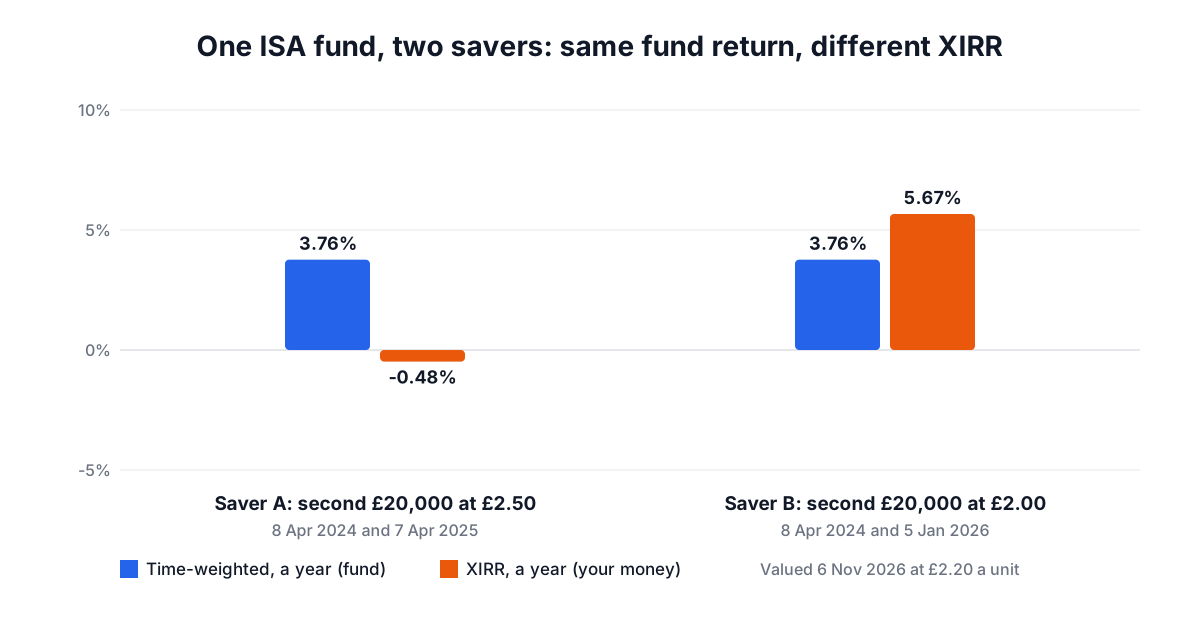
Saver A's TWR is the chain of two price moves: £2.00 to £2.50 is +25%, £2.50 to £2.20 is −12%, and 1.25 × 0.88 = 1.10. Saver B's chain is £2.00 to £2.00, then £2.00 to £2.20, also 1.10. The fund is identical. What differs is that Saver A's second payment went in at a high point and Saver B's at a dip.
There is a UK twist in Saver A's pattern. The ISA allowance resets each tax year (GOV.UK gives £20,000 for the 2026 to 2027 tax year). If you pay the whole allowance in the first days of April, a large share of your money-weighted return depends on what the market does from early April. It is neither good nor bad on average; it just means your personal figure can differ a lot from the fund's.
Annualise before you compare
TWR comes out as a cumulative figure over the whole period, while XIRR is already a yearly rate. The savers' 10% took 2.58 years, so the annual TWR is 1.10^(1 ÷ 2.58) − 1 = 3.76%. Comparing the raw 10% with Saver B's 5.67% XIRR would mislead you into thinking the fund beat the saver.
Withdrawals from a flexible ISA
GOV.UK says you can take money out of an ISA at any time without losing the tax benefits, and that with a flexible ISA you can put cash back in during the same tax year without it reducing that year's allowance. In its example, someone who has paid £10,000 of a £20,000 allowance and then takes out £3,000 can pay in £13,000 more that year if the ISA is flexible, but only £10,000 if it is not.
For return measurement, a withdrawal and a replacement are just two more dated cash flows. Enter the withdrawal as a sell on its date and the replacement as a buy on its date. Leave either out and the XIRR is wrong: a missing withdrawal makes the current value look too low, so the return looks worse than it was.
SIPP contributions and tax relief
With relief at source, GOV.UK explains, your pension provider claims tax relief from the government at the basic 20% rate and adds it to your pot; in Scotland, a 19% starter-rate taxpayer still gets 20%. Higher and additional rate taxpayers claim the extra relief through Self Assessment rather than through the provider.
So a £500 gross contribution costs you £400 and the provider claims £100. Suppose you pay £400 net on the 15th of each month from November 2024 to October 2026, 24 payments, the relief is treated as arriving with each payment, and the pot is worth £13,000 on 6 November 2026:
| What you count as paid in | Total | XIRR |
|---|---|---|
| Gross contributions, £500 a month | £12,000 | 8.07% a year |
| Only your £400 a month | £9,600 | 32.90% a year |
The second figure is not an investment return: it treats the £100 of relief on each payment as if the investments had earned it. To judge the investments, count the gross £500 as the contribution. To see what your own £400 has turned into, the second figure is a fair answer to that narrower question, as long as you label it.
Using the calculator
- Clear the sample data. Add each payment in pounds as a buy with its date, and the units it bought if your statement shows them.
- Add withdrawals and transfers out as sells.
- Enter today's value from your platform, and note the date: XIRR moves with the valuation date.
- Read the TWR (needs units on every transaction) and the XIRR. If your platform shows a personal return next to the fund's performance, check which method it uses before comparing.
Transactions stay in your browser's storage on this device.
Common mistakes
- Comparing a cumulative TWR with an annual XIRR. Annualise first.
- Mishandling dividends. In accumulation units, income is already in the price, so do not add it as a buy. In income units paid to cash, the income is a return you have taken out; enter it as a sell or the XIRR understates.
- Counting SIPP tax relief as growth. Enter gross contributions.
- Reading a short-period XIRR literally. A few months of gains, annualised, can look extreme.
- Mixing accounts. Unit prices of one fund cannot value a portfolio of several funds; TWR for a whole ISA needs its total value on every cash-flow date.
What to take away
Use the fund's time-weighted return to judge the fund against its benchmark and its peers, and your XIRR to judge how your own pattern of paying in has worked out. If you pay in monthly rather than in April, the UK edition of the SIP vs lump sum guide shows how regular contributions change the picture, and the ETF fees guide explains what platform and fund charges take from both figures. Past returns do not predict future returns. These measures describe what happened; for a decision about your own pension or ISA, such as consolidating accounts or changing funds, talk to a regulated financial adviser.
Frequently asked questions
Why is my ISA return different from the fund's performance?
The fund's figure is time-weighted and ignores when you paid in. Your personal figure is money-weighted, so it rises if you added money before rises and falls if you added it before falls. Platform charges taken from your account, rather than from the fund, also lower your figure.
Should I include pension tax relief as a contribution?
Yes, if you want the return on the investments. With relief at source the provider adds 20% basic-rate relief to your pot, so a £400 payment becomes a £500 contribution. Counting only the £400 made the example's XIRR 32.90% instead of 8.07%.
How do I record a flexible ISA withdrawal?
As a sell on the day the money left, and any replacement as a buy on the day it went back in. GOV.UK says a flexible ISA lets you replace cash in the same tax year without using up more of that year's allowance; the return calculation only needs the dates and amounts.
Is XIRR the same as annualised return?
For a single payment held to today, yes. With several payments and withdrawals, XIRR is the one annual rate that makes them all balance against today's value.
Does time-weighted return include my ISA allowance timing?
No. That is the point of it: everyone in the fund over the same dates gets the same TWR. The timing of your payments shows up only in the XIRR.
Sources and further reading
- Individual Savings Accounts (ISAs), GOV.UK. £20,000 maximum in ISAs in the 2026 to 2027 tax year.
- ISAs: withdrawing your money, GOV.UK. Withdrawals and flexible ISAs, with the £13,000 / £10,000 example.
- Tax on your private pension: pension tax relief, GOV.UK. Relief at source at 20%, Scottish rates and Self Assessment claims.
- 2020 GIPS Standards for Firms, CFA Institute. Provision 1.A.35 on when money-weighted returns may be presented instead of time-weighted.
- XIRR function, Microsoft Support. The 365-day convention and the 37.34% reference example.
- Time-weighted vs money-weighted return (US edition), with a three-investor example in dollars.
Open the Time-Weighted Return Calculator
More Calculators
Every tool in the Calculators section, free and in your browser.
- Investment Calculator
- Compound Interest Calculator
- Simple Interest Calculator
- Interest Calculator
- EMI Calculator
- Retirement Calculator
- Time-Weighted Return Calculator
- Savings Goal Calculator
- Inflation Calculator
- CAGR Calculator
- ROI Calculator
- Present and Future Value Calculator
- NPV and IRR Calculator
- 401(k) Calculator
- Roth IRA Calculator
- APY and CD Calculator
- SIP Calculator
- Annuity Calculator
- Bond Price and Yield Calculator
- Currency Converter
- Dividend Calculator
- Stock Average Calculator
- RMD Calculator