
Time-Weighted vs Money-Weighted Return in a TFSA or RRSP
Why your TFSA or RRSP rate of return differs from the fund's: TWR and XIRR worked in Canadian dollars, with a withdrawal, January re-contribution and annual limits.
By Redbison Dev · · 6 min read
Canada edition. Worked in Canadian dollars on a TFSA with the CRA's annual dollar limits and its rule that withdrawals return as room on January 1 of the next year, plus how to treat RRSP refunds. US edition
Two people hold the same ETF in their TFSAs and each has put a net $21,000 in since January 2024. On November 6, 2026 the ETF is up 30% from where they started, about 9.8% a year, and that is the same for both of them. Their personal rates of return are not: one has earned 10.37% a year and the other 9.36%. The fund's figure is a time-weighted return; each person's figure is a money-weighted return, and the difference comes from one withdrawal and one January re-contribution. This edition explains the two measures for Canadian investors, with every figure from the Canadian rate of return calculator. It describes past results and is not advice on what to buy or when.
Two different questions
How did the investment do? A time-weighted return (TWR) breaks the holding period at each deposit or withdrawal, measures each piece by the change in the unit price, and multiplies the pieces together. The size and timing of your cash flows drop out, so everyone in the fund over the same dates gets the same answer. The GIPS standards, the global code for investment managers' performance, require firms to present time-weighted returns, allowing money-weighted ones only where the firm controls the cash flows and the fund is, for example, closed-end or fixed-life.
How did my money do? A money-weighted return is the one annual rate at which all your contributions, withdrawals and today's value balance out. In a spreadsheet it is XIRR, which, as Microsoft's documentation describes, discounts each payment on a 365-day year. The calculator uses the same convention.
Canadian dealers' annual performance reports show a money-weighted return, so compare it with your XIRR, not with the fund's time-weighted figure. Section 14.19 of National Instrument 31-103 requires the report to give the account's annualized total percentage return, net of charges, using a money-weighted method.
Two TFSA holders, one ETF
The ETF's unit price was $40 on January 15, 2024, $46 on January 15, 2025, $50 on September 2, 2025, $47 on January 15, 2026 and $52 on November 6, 2026.
The CRA's table of limits shows a TFSA dollar limit of $7,000 for each of 2024, 2025 and 2026. Both holders contribute it each January. Holder A also withdraws $4,000 in September 2025. The CRA says a withdrawal does not create new contribution room right away; the amount is added back on January 1 of the next calendar year. So in January 2026 Holder A can contribute the new $7,000 plus the $4,000 withdrawn, $11,000 in total.
| Holder A | Holder B | |
|---|---|---|
| January 15, 2024 | Buy $7,000 at $40 | Buy $7,000 at $40 |
| January 15, 2025 | Buy $7,000 at $46 | Buy $7,000 at $46 |
| September 2, 2025 | Sell $4,000 at $50 | None |
| January 15, 2026 | Buy $11,000 at $47 | Buy $7,000 at $47 |
| Net contributed | $21,000 | $21,000 |
| Value, November 6, 2026 at $52 | $25,023 | $24,758 |
| Time-weighted return | 30.0% (9.78% a year) | 30.0% (9.78% a year) |
| XIRR | 10.37% a year | 9.36% a year |
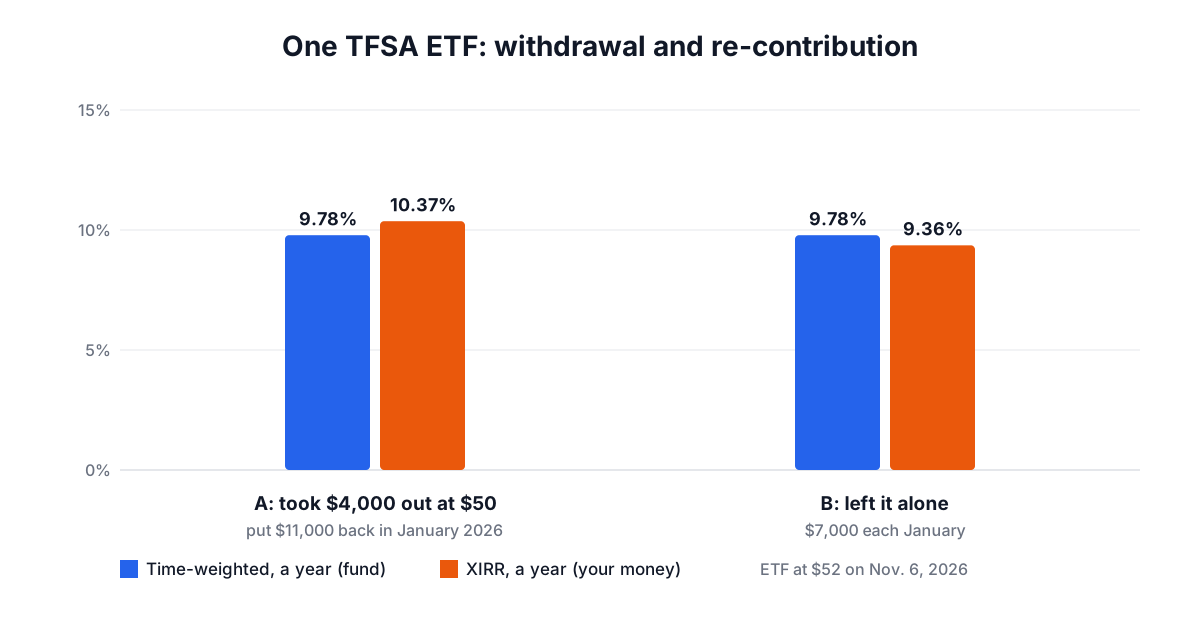
Holder A's TWR chains four price moves: $40 to $46 (+15%), $46 to $50 (+8.7%), $50 to $47 (−6%) and $47 to $52 (+10.6%). The product is 1.30, exactly the $40 to $52 change that Holder B also sees. The XIRR differs because Holder A took $4,000 out near a high and put it back after a dip. That worked here; it could as easily have gone the other way, and the time-weighted figure, which judges the ETF, is unaffected either way.
Annualize before comparing
The 30% TWR covers 2.81 years, so its annual rate is 1.30^(1 ÷ 2.81) − 1 = 9.78%. XIRR is already annual. Set the cumulative 30% beside Holder A's annual 10.37% and the ETF seems to have won by almost 20 points; on the same annual basis, Holder A in fact did slightly better than the ETF.
Recording withdrawals and the January rule
For the calculation, a withdrawal is a sell on its date and a re-contribution is a buy on its date. The TFSA rule only affects when you can put money back without exceeding your room: before January 1 of the following year, replacing a withdrawal can be an over-contribution, which the CRA covers on its own page. The return calculation does not care about room; it only needs every dated cash flow.
RRSPs and the refund
An RRSP contribution can produce a tax refund, but the refund is paid to you, not earned by the investments. Do not count it as return. If you reinvest it in the RRSP, enter it as a new contribution on the day it goes in. For reference, the CRA's table gives RRSP dollar limits of $32,490 for 2025 and $33,810 for 2026.
Monthly contributions behave as you would expect. $400 on the 5th of each month from November 2024 to October 2026, worth $10,650 on November 6, 2026, is a gain of $1,050 on $9,600 (10.94%), and an XIRR of 10.26%: the average dollar has been invested for about a year, so the annual and total figures are close.
Using the calculator
- Clear the sample data and add each contribution in dollars as a buy with its date, and the units it bought if your statement shows them.
- Add withdrawals as sells on their dates.
- Enter the current market value and note the date; XIRR changes with it.
- Read the TWR (needs units on every transaction) and the XIRR side by side.
Your transactions stay in this browser's storage on this device.
Common mistakes
- Leaving out a withdrawal. The current value then looks too small and the XIRR far too low.
- Comparing a cumulative TWR with an annual XIRR. Annualize first.
- Counting the RRSP refund as growth. Enter it as a contribution if you reinvest it.
- Treating distributions inconsistently. Reinvested distributions buy units with the fund's money, not yours, so leave them out of buys. Distributions paid out to cash are money you received; enter them as sells.
- Reading a few months of XIRR literally. Short periods produce extreme annual rates.
What to take away
Use the fund's time-weighted return to judge the fund or manager against a benchmark, and your XIRR to see how your own contributions and withdrawals worked out. A gap between the two is the effect of timing, not an error. The Canadian ETF fees guide covers what fees take from both, and the compound interest guide for Canada shows why January contributions get more time to grow. Past returns do not predict future returns; for a decision about your own accounts, talk to a registered adviser.
Frequently asked questions
Why is my TFSA return different from the fund's posted return?
The fund's return is time-weighted and ignores when you invested. Your personal return is money-weighted, so it reflects the timing of your contributions and withdrawals. Account-level fees outside the fund also lower it.
When do I get TFSA room back after a withdrawal?
The CRA says the amount withdrawn is added back as contribution room on January 1 of the next calendar year, not in the year you withdraw.
Should I include my RRSP tax refund in the return?
No. The refund is a tax effect, not investment growth. If you put it back into the RRSP, enter it as a contribution on that date.
Is XIRR the same as CAGR?
Only for a single deposit with no withdrawals. XIRR handles many dated cash flows in both directions.
What were the TFSA dollar limits for 2024 to 2026?
The CRA's table shows $7,000 for each of 2024, 2025 and 2026.
Sources and further reading
- MP, DB, RRSP, DPSP, ALDA, TFSA limits, YMPE and the YAMPE, Canada Revenue Agency. TFSA dollar limits for 2024 to 2026; RRSP dollar limits for 2025 and 2026.
- Withdrawing from a TFSA, Canada Revenue Agency. Withdrawals added back as room on January 1 of the next calendar year.
- Tax-free savings account, Canada Revenue Agency.
- 2020 GIPS Standards for Firms, CFA Institute. Provision 1.A.35 on time-weighted and money-weighted returns.
- National Instrument 31-103, consolidated to January 1, 2026, Canadian Securities Administrators (published by the Alberta Securities Commission). Section 14.19(1)(i) on the money-weighted return in the annual investment performance report.
- XIRR function, Microsoft Support. The 365-day convention.
- Time-weighted vs money-weighted return (US edition).
Open the Time-Weighted Return Calculator
More Calculators
Every tool in the Calculators section, free and in your browser.
- Investment Calculator
- Compound Interest Calculator
- Simple Interest Calculator
- Interest Calculator
- EMI Calculator
- Retirement Calculator
- Time-Weighted Return Calculator
- Savings Goal Calculator
- Inflation Calculator
- CAGR Calculator
- ROI Calculator
- Present and Future Value Calculator
- NPV and IRR Calculator
- 401(k) Calculator
- Roth IRA Calculator
- APY and CD Calculator
- SIP Calculator
- Annuity Calculator
- Bond Price and Yield Calculator
- Currency Converter
- Dividend Calculator
- Stock Average Calculator
- RMD Calculator