
TWR vs XIRR in Singapore: Did Your CPFIS Fund Beat CPF?
Why a unit trust's published return and your own XIRR differ, how to test a CPFIS or SRS investment against the CPF interest rate, and REIT payouts done right.
By Redbison Dev · · 6 min read
Singapore edition. Uses S$ examples, the CPF Ordinary Account rate of 2.5% and the 4% floor for the Special, MediSave and Retirement Accounts (October to December 2026) as hurdles for CPFIS money, and IRAS rules on dividends and REIT payouts. US edition
A unit trust's factsheet and your own statement can describe the same fund over the same years and still disagree by whole percentage points a year. The factsheet shows a time-weighted return (TWR): how the fund did, whatever investors put in or took out. Your own result is a money-weighted return (MWR, computed as XIRR): how your dollars did, given when you added them. For Singapore investors the second number has a natural yardstick: the interest your CPF savings would have earned if you had left them alone. This edition shows how to measure both and how to use the CPF rate as the test, with every figure reproducible in the investment returns calculator for Singapore. It describes past results with hypothetical prices; it is not advice on what to buy.
Two questions, two numbers
TWR splits the holding period at every cash flow, measures each piece on its own and chains them:
TWR = (1 + r1) × (1 + r2) × ... × (1 + rn) − 1
For a single fund the unit price (NAV) does that for you, because the price per unit does not depend on how many units you own. A NAV that goes from S$1.00 to S$1.10 is a 10% TWR for everyone who held over those dates.
XIRR finds the one annual rate at which all your dated cash flows, plus today's value, net to zero:
0 = Σ CF ÷ (1 + rate) ^ (days ÷ 365)
It gives more weight to periods when more of your money was in. That is exactly right for judging your own decisions, and exactly wrong for judging a fund manager who cannot control when you top up.
Always annualise a TWR before comparing it with XIRR, which is already a yearly rate.
The CPF hurdle
Under the CPF Investment Scheme (CPFIS), you can invest Ordinary Account (OA) and Special Account (SA) savings, after keeping the first S$20,000 in the OA and S$40,000 in the SA. CPF Board's own advice is to "only invest your CPF savings if you're confident of earning more than the CPF interest."
For 1 October to 31 December 2026, CPF lists these rates:
| Account | Interest rate | Basis |
|---|---|---|
| Ordinary Account | 2.5% a year | 3-month average of major local banks' rates, legislated minimum 2.5% |
| Special, MediSave and Retirement Accounts | 4% a year | 12-month average yield of 10-year SGS plus 1%, floor of 4% (extended to 31 December 2027) |
The Government also pays extra interest on the first S$60,000 of combined balances (with OA money counted up to S$20,000), so the real hurdle for money near those limits is higher still. The rates are reviewed quarterly, so check the current ones before comparing.
The right comparison is your XIRR, not the fund's TWR, because the CPF alternative would have earned interest on exactly the money you moved, from exactly the dates you moved it.
Worked example: one fund, three CPFIS investors
A unit trust has these NAVs: S$1.00 on 1 March 2023, S$0.92 on 1 March 2024, S$1.18 on 3 March 2025 and S$1.10 on 6 November 2026. Three members invest OA money in it:
| Investor | What they did | Value on 6 Nov 2026 | TWR | TWR a year | XIRR |
|---|---|---|---|---|---|
| A | S$30,000 at S$1.00; S$20,000 more at S$1.18 | S$51,644 | 10.00% | 2.62% | 1.13% |
| B | S$30,000 at S$1.00 only | S$33,000 | 10.00% | 2.62% | 2.62% |
| C | S$10,000 at S$1.00; S$20,000 more at S$0.92 | S$34,913 | 10.00% | 2.62% | 5.14% |
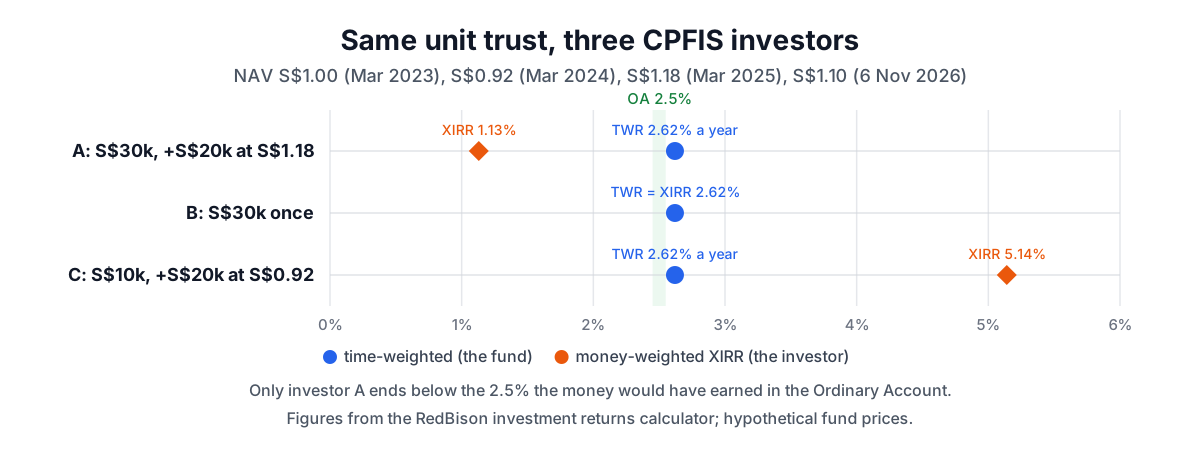
The fund's TWR is the same for all three: 10% over about 3.69 years, or 2.62% a year, just above the OA's 2.5%. The investors' results are not:
- A added S$20,000 at S$1.18, near the peak, before the NAV slipped about 7% to S$1.10. The XIRR of 1.13% is well below 2.5%: the OA would have done better.
- B invested once, so XIRR equals the annualised TWR. For comparison, S$30,000 at 2.5% compounded once a year for 3.69 years grows to about S$32,860, against the fund's S$33,000. That margin is before counting any extra interest the OA balance would have attracted.
- C added most of the money at the low and earned 5.14%, beating even the 4% SA rate.
To repeat investor A in the calculator: add a buy dated 1 March 2023 for S$30,000 with 30,000 units, a buy dated 3 March 2025 for S$20,000 with 16,949.15 units, and a current value of S$51,644.07.
REITs: price return is not your return
Singapore REITs pay out income as distributions, and IRAS says REIT distributions are generally not taxable for individuals (except where derived through a partnership in Singapore or from carrying on a trade, business or profession). So the cash you receive is the return you keep, and it has to be in the calculation.
Suppose you bought 10,000 units of a REIT at S$1.50 on 2 January 2024 (S$15,000). It paid S$285 every six months, five payments from August 2024 to August 2026 (S$1,425 in all), and the units trade at S$1.42 on 6 November 2026 (S$14,200).
| Measure | Result |
|---|---|
| Price change, S$1.50 to S$1.42 | −5.33% |
| XIRR without the distributions | −1.91% a year |
| XIRR with each distribution entered as cash received | +1.50% a year |
Leaving the payouts out turns a small gain into a loss. In the calculator, enter each distribution as a sale of that amount on the date it reached your bank or CDP account. If you reinvested distributions into more units, do not enter them separately: they are already in the current value.
A TWR built from the unit price alone is a price return. A total return figure that assumes distributions were reinvested will be higher than the price change.
Monthly investment plans
Monthly plans are where XIRR earns its keep, because no two instalments have been invested for the same time. Suppose you put S$500 a month into an ETF on the 5th, from November 2024 to October 2026 (24 instalments, S$12,000), and the holding is worth S$13,000 on 6 November 2026.
The simple gain is S$1,000, or 8.33%. The XIRR is 7.85% a year, because the average dollar was invested for only about a year. If the holding were worth S$13,600, XIRR would be 12.46%. Over a period this short, small changes in the end value swing XIRR a lot; treat it as a description of the past, not a rate you can expect to keep.
Include brokerage and platform fees in each purchase amount so the result is after costs.
Dividends and gains in Singapore
IRAS treats one-tier dividends from Singapore resident companies as generally not taxable, lists unit trusts in Singapore among non-taxable dividends, and says foreign dividends received in Singapore by resident individuals are generally not taxable (dividends received through a partnership in Singapore are the exception). IRAS also says gains from selling shares and financial instruments are generally not taxable for individuals, as they are generally viewed as personal investments. For most individual investors, then, XIRR on the cash you actually received is close to an after-tax return. These exemptions do not give back tax that another country withholds at source, for example on some overseas-listed funds, so enter dividends net of any withholding.
Tools for this job
- Investment returns calculator for Singapore: TWR and XIRR from dated buys, sales and distributions in S$.
- Compound interest calculator: what the CPF rate, or any fixed rate, would have grown the same money to.
- Dividend calculator: yield and payouts on REITs and dividend shares.
Related reading: the dividend yield and DRIP guide for Singapore, the ETF fees and dividends guide and regular investing versus a lump sum. If CPF or SRS money is a large part of your retirement plan, a licensed financial adviser can look at the whole picture.
Frequently asked questions
Which return should I compare with CPF interest?
Your XIRR. It measures the money you actually moved out of CPF from the dates you moved it, which is what the CPF interest would have been paid on. The fund's TWR tells you whether the manager did well, not whether your switch paid off.
Why is my return lower than the fund's factsheet?
Usually because you added money before a fall or took money out before a rise. Fees charged outside the fund, such as platform or wrap fees, also lower your result. The factsheet's TWR ignores both.
How do I enter REIT distributions?
As a sale of the distribution amount on the date you received it. For a reinvested distribution, make no separate entry, because the extra units are already in the current value.
Can XIRR be used for SRS investments?
Yes. Enter each contribution you invested as a buy, any withdrawal as a sale, and today's value. Comparing it with what the money would have earned as cash in the SRS account shows whether investing was worth it; the tax on SRS withdrawals is a separate question.
Sources and further reading
- Earning attractive interest, CPF Board. OA, SA, MA and RA rates for October to December 2026, the 2.5% minimum, the 4% floor to 31 December 2027 and extra interest on the first S$60,000.
- Investing your CPF savings, CPF Board. What CPFIS allows, the S$20,000 OA and S$40,000 SA set aside, and the advice to invest only if confident of beating CPF interest.
- Dividends, IRAS. One-tier dividends, unit trusts, REIT distributions and foreign dividends received by individuals.
- Gains from sale of property, shares and financial instruments, IRAS. When share gains are and are not taxable.
- 2020 GIPS Standards for Firms (PDF), CFA Institute. Provision 1.A.35: firms must present time-weighted returns unless they control the external cash flows and the composite or fund is closed-end, fixed-life or fixed-commitment, or holds illiquid investments as a significant part of its strategy.
- XIRR function, Microsoft Support. The actual-days ÷ 365 convention the calculator follows.
Open the Time-Weighted Return Calculator
More Calculators
Every tool in the Calculators section, free and in your browser.
- Investment Calculator
- Compound Interest Calculator
- Simple Interest Calculator
- Interest Calculator
- EMI Calculator
- Retirement Calculator
- Time-Weighted Return Calculator
- Savings Goal Calculator
- Inflation Calculator
- CAGR Calculator
- ROI Calculator
- Present and Future Value Calculator
- NPV and IRR Calculator
- 401(k) Calculator
- Roth IRA Calculator
- APY and CD Calculator
- SIP Calculator
- Annuity Calculator
- Bond Price and Yield Calculator
- Currency Converter
- Dividend Calculator
- Stock Average Calculator
- RMD Calculator