
CPVC Pipe Size for Overhead Tank Supply: ½, ¾ or 1 Inch
Choosing ½, ¾ or 1 inch CPVC or GI pipe for an overhead tank supply: real bores to IS 15778 and IS 1239, and friction loss in metres of head.
By Redbison Dev · · 10 min read
India edition. Uses two pipe types common in Indian homes, CPVC to IS 15778 (SDR 11 and 13.5) and GI medium tube to IS 1239, and measures friction against the few metres of head an overhead or terrace tank gives. US edition
In many Indian homes the water at a tap does not come straight from a pressurised main. It comes from an overhead or terrace tank, and the only push it has is the height of the water in that tank above the outlet. On the top floor that can be just a couple of metres, and a pipe that is one size too small can use it all up in friction. At 0.2 litres per second, a reasonable shower flow, 12 m of ½" CPVC loses about 3.1 m of head, while ¾" CPVC loses 0.5 m. That difference is why top-floor showers trickle. The Water Pipe Size Calculator (India) picks from CPVC and GI sizes and reports the loss in metres of head.
This is a design check. The National Building Code of India and your local bye-laws govern plumbing in buildings, and a licensed plumber should confirm the layout.
Head is your pressure
Water pressure from a tank is simply the height of water above the outlet:
1 m of water ≈ 9.8 kPa ≈ 0.1 kg/cm²
pressure at the outlet = (height of the tank's water level above the outlet) − (friction in the pipe and fittings)
So a tank whose lowest working water level is 3 m above a shower rose gives about 0.3 kg/cm² with no flow. As soon as water moves, friction takes its share. Measure from the lowest level the tank normally drains to, not the brim, because the pressure falls as the tank empties.
A pressure pump or booster changes the picture entirely: then the head available is what the pump delivers at that flow, and pipe friction becomes a smaller share.
What ½, ¾ and 1 inch actually mean
Indian pipe is sold by nominal size, and the bore depends on the material and the wall.
CPVC to IS 15778. The standard covers chlorinated PVC pipe for hot and cold water distribution, made in three standard dimension ratios (SDR) for water up to 82 °C. The calculator uses SDR 11. Finolex's dimension table for IS 15778 gives:
| Size | Mean OD | SDR 11 wall (min to max) | SDR 11 bore at minimum wall | SDR 13.5 wall (min) |
|---|---|---|---|---|
| ½" (15 mm) | 15.8 to 16.0 mm | 1.7 to 2.2 mm | 12.5 mm | 1.4 mm |
| ¾" (20 mm) | 22.1 to 22.3 mm | 2.0 to 2.5 mm | 18.2 mm | 1.7 mm |
| 1" (25 mm) | 28.5 to 28.7 mm | 2.6 to 3.1 mm | 23.4 mm | 2.1 mm |
Notice that a ½" CPVC pipe is only about 16 mm outside, so its bore is around 12.5 mm or less. The same table lists working pressures of 28.14 kg/cm² at 27 °C and 6.93 kg/cm² at 82 °C for SDR 11, far more than any tank supply needs, yet that thick wall is what you pay for in bore.
GI tube to IS 1239 (Part 1), medium. Galvanised iron is found in many older buildings and is still widely used in water supply schemes. The Meghalaya PHED summary of IS 1239 medium tube gives:
| Nominal bore | OD range | Wall | Bore at mean OD |
|---|---|---|---|
| 15 NB | 21.0 to 21.8 mm | 2.6 mm | 16.2 mm |
| 20 NB | 26.5 to 27.3 mm | 2.6 mm | 21.7 mm |
| 25 NB | 33.3 to 34.2 mm | 3.2 mm | 27.35 mm |
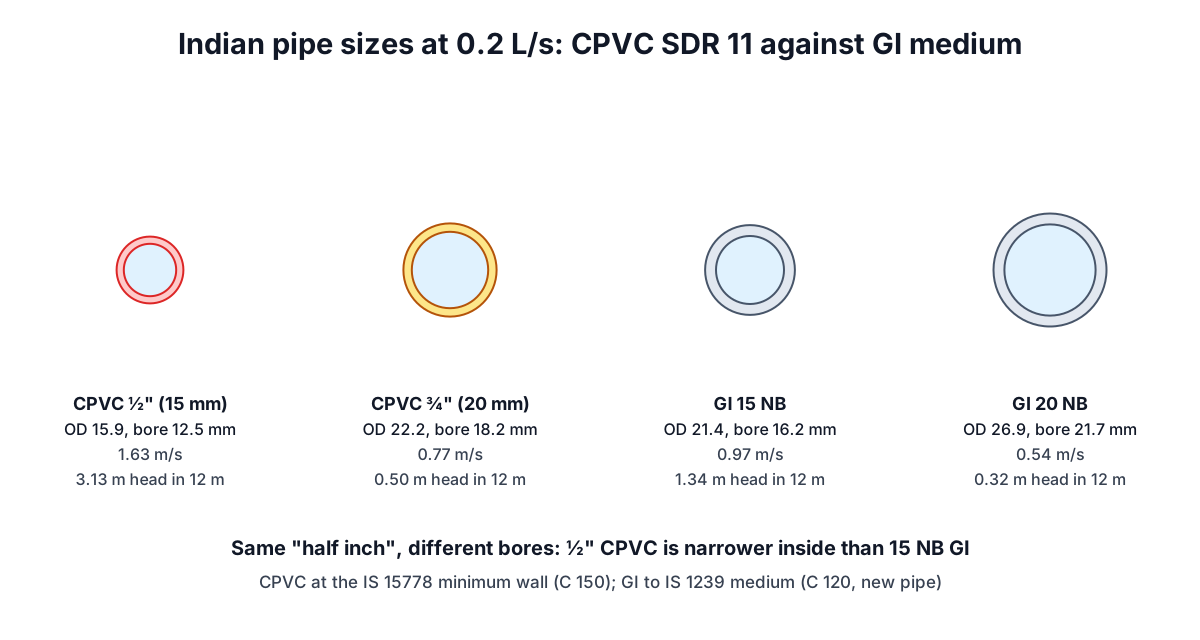
So "half inch" GI has a noticeably bigger bore than "half inch" CPVC. Swapping a GI line for CPVC of the same nominal size makes the bore smaller, even though the new pipe is smoother.
The two calculations
Velocity. Flow equals bore area times speed, so a speed limit sets a minimum bore:
d_min (mm) = 35.68 × √(Q in L/s ÷ v in m/s)
At 0.2 L/s and 1.5 m/s, that is 13.0 mm, which rules out ½" CPVC (12.5 mm) and allows 15 NB GI (16.2 mm) or ¾" CPVC. A modest speed keeps pipes quiet; on a tank supply, friction usually decides first anyway.
Friction. The calculator uses the Hazen-Williams formula, which suits cold water at ordinary temperatures:
head loss per metre = 10.67 × Q^1.852 ÷ (C^1.852 × d^4.8704) Q in m³/s, d in m
C reflects smoothness. The calculator uses 150 for CPVC, the design value for PVC-type plastics, and 120 for galvanised iron. Metal pipe loses smoothness with age: the same design table drops cast iron from 130 when new to between 89 and 100 after 20 years. Old GI that has scaled inside is also narrower than new, so it loses more than the calculator shows.
Worked examples
Set the India calculator to SI units and the India tube standard, then enter these.
A top-floor shower from a terrace tank. Flow 0.2 L/s, 12 m of CPVC from the tank outlet, velocity limit 1.5 m/s. The calculator picks ¾" (18.2 mm bore): 0.77 m/s and 0.50 m of head lost. In ½" the water would run at 1.63 m/s and lose 3.13 m. If the tank's lowest level is 3 m above the shower, the ½" line leaves almost nothing; the ¾" line leaves about 2.5 m, roughly 0.25 kg/cm².
The same shower on an old GI line. 0.2 L/s through 12 m of 15 NB GI medium: 0.97 m/s and 1.34 m lost at C = 120. If the pipe has scaled and you drop C to 100, the loss rises to 1.88 m, before counting the narrowing that scale causes.
A bathroom down-take in a flat. 0.5 L/s over 15 m. In CPVC the calculator picks 1" (23.4 mm bore): 1.16 m/s and 1.01 m lost. ¾" would run at 1.92 m/s and lose 3.43 m. In GI, 20 NB gives 1.35 m/s and 2.20 m lost.
When the wall is thicker than the minimum. The calculator uses the minimum wall from IS 15778, which gives the largest bore. A ½" pipe at the 2.2 mm maximum wall has an 11.5 mm bore; at 0.2 L/s over 12 m it loses 4.70 m, half as much again as the 3.13 m at the minimum wall. A ¾" SDR 11 pipe at maximum wall (17.2 mm bore) loses 0.66 m, while ¾" SDR 13.5 at its minimum wall (18.8 mm bore) loses 0.43 m. If the tank head is tight, measure the actual pipe or ask the maker for the bore.
Fittings, tanks and other checks
- Fittings add loss. Elbows, tees, valves and the mixer all add to the straight length. For comparison, Canada's plumbing code allows for fittings by multiplying the developed length by 1.5 in its average pressure loss method, and asks for more where insert fittings narrow the bore.
- Count the outlets that run together. A down-take feeding two bathrooms needs more than one shower's flow, but rarely the sum of every tap.
- Hot water lines. CPVC is rated to 82 °C. Hazen-Williams does not account for temperature, so for a long hot line from a geyser, treat the result as a guide.
- Codes. The National Building Code of India, which BIS now lists as SP 7, sets out practice for building services including plumbing. Your municipal bye-laws decide what applies to your building.
For related checks, the Flow Rate Calculator converts between flow, velocity and pipe area, and the Pump Power Calculator estimates the motor size for lifting water to the tank or boosting pressure.
Frequently asked questions
Is ½ inch or ¾ inch CPVC better for a shower line?
From an overhead tank, ¾ inch for anything but a very short run. At 0.2 L/s, 12 m of ½ inch CPVC loses about 3.1 m of head against 0.5 m for ¾ inch, and a terrace tank may give only a few metres above a top-floor shower.
What is the inside diameter of ¾ inch CPVC pipe?
For IS 15778 SDR 11, the mean outside diameter is about 22.2 mm and the wall is 2.0 to 2.5 mm, so the bore is between about 17.2 and 18.2 mm. SDR 13.5 pipe, with a 1.7 mm minimum wall, is about 18.8 mm inside.
How much pressure does an overhead tank give?
About 0.1 kg/cm² (9.8 kPa) for every metre between the tank's water level and the outlet. A tank 3 m above a tap gives about 0.3 kg/cm² before friction, which is why small pipes struggle on upper floors.
Should I replace GI with the same size of CPVC?
Check the bore first. 15 NB GI medium has a bore of about 16.2 mm, while ½" CPVC SDR 11 is 12.5 mm at most. Like-for-like replacement can lower the flow even though CPVC is smoother, so going up one size is often the better choice.
What is the difference between SDR 11 and SDR 13.5 CPVC?
SDR is the ratio of outside diameter to wall thickness, so SDR 13.5 has thinner walls and a larger bore than SDR 11 of the same size, with lower pressure ratings: Finolex lists 6.93 kg/cm² for SDR 11 and 5.60 kg/cm² for SDR 13.5 at 82 °C.
Sources and further reading
- Galvanized Iron Pipes (GI): dimensions of medium steel tubes as per IS 1239, Public Health Engineering Department, Government of Meghalaya. Outside diameters, wall and mass for 15 to 150 NB medium tube.
- IS 15778: CPVC pipes for potable hot and cold water distribution supplies, Bureau of Indian Standards (public copy). Scope: three SDRs, water up to 82 °C.
- IS 1239 (Part 1): steel tubes, tubulars and other wrought steel fittings, Bureau of Indian Standards (public copy). Light, medium and heavy tube for water, gas, air and steam.
- CPVC pipes: dimensions and pressure ratings to IS 15778, Finolex Industries. Mean outside diameters, SDR 11 and 13.5 walls and working pressures.
- National Building Code, Bureau of Indian Standards. Access to the code, listed as SP 7, through the BIS standards portal.
- Hazen-Williams equation, Wikipedia. The SI formula and design C values, including 120 for galvanised iron.
Open the Water Pipe Size Calculator
More HVAC & Plumbing
Every tool in the HVAC & Plumbing section, free and in your browser.