
Copper Water Pipe Sizes in Australia: DN15, DN18 or DN20?
Sizing AS 1432 copper by DN from a flow in L/s: Type B bores, the NCC 3 m/s velocity cap and minimum diameter, the 50 kPa outlet pressure and friction loss.
By Redbison Dev · · 10 min read
Australia edition. Built on NCC 2025 Volume Three (the Plumbing Code of Australia: B1P2 velocity, B1V1 minimum diameter, B1P5 fixture flow and B1P6 pressures) and AS 1432 Type B copper sizes by DN, in L/s and kPa. US edition
In Australia, the Plumbing Code of Australia sets two limits that decide most copper water pipe sizes: water in cold water service pipework must not exceed 3 metres per second for at least 99% of the time it is used in the peak hour, and outlets need a working pressure of at least 50 kPa. Between them sits the friction loss in the pipe. The catch is that copper tube is ordered by DN, and the DN is a label rather than the bore: DN20 Type B copper is only about 17 mm inside. This guide shows how to size DN15, DN18, DN20 and DN25 copper against those rules, with the Water Pipe Size Calculator (Australia) doing the sums.
States and territories administer plumbing and add their own variations to the NCC. This guide explains the design checks; it does not replace AS/NZS 3500.1 or your licensed plumber's calculation.
The NCC rules for cold water services
NCC 2025 Volume Three, Part B1 (cold water services), sets these performance requirements:
| Clause | Requirement |
|---|---|
| B1P2 | Velocity in cold water service pipework must not exceed 3 m/s for no less than 99% of the time water is required during the peak hour |
| B1P5 | Taps and outlets for showers, basins, kitchen sinks and laundry troughs limited to a flow rate of not more than 9 L/min (one of two compliance routes for water efficiency) |
| B1P6 | Points of discharge must have a working pressure of not less than 50 kPa and a static pressure within the building of not more than 500 kPa |
The deemed-to-satisfy route, B1D3, is that the cold water service is in accordance with AS/NZS 3500.1. Some states vary B1D3 itself (Tasmania, for example, exempts existing low-pressure gravity-only supplies), so check the version adopted where you work.
The minimum diameter in B1V1
The verification method B1V1 turns the velocity rule into a size check for Class 2 and Class 3 buildings. The pipe complies when its diameter is at least:
D_min = √(4 × Q99 × 10³ ÷ (π × v))      D_min in mm, Q99 in L/s, v in m/s
at v = 3 m/s:  D_min ≈ √(425 × Q99)
Q99 is the design flow: the greater of the probable simultaneous flow (worked out in B1V1 from the fixtures downstream and their probability of use) and the flow of the single largest fixture downstream. The calculator uses the same continuity equation with whatever velocity limit you set.
DN is a label: AS 1432 sizes
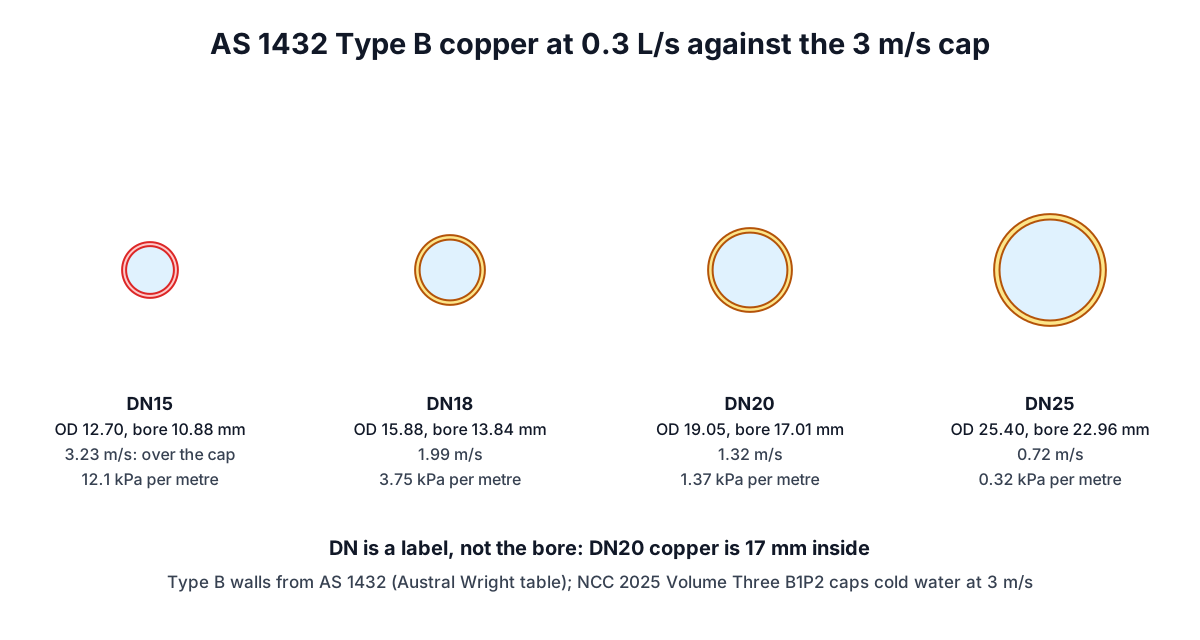
Australian copper sizes come from the old imperial outside diameters. Austral Wright's AS 1432 table lists four wall thicknesses (Types A to D, with green, blue, red and black colour caps). For Type B, the blue-capped tube the calculator uses:
| DN | Outside diameter | Type B wall | Bore |
|---|---|---|---|
| DN15 | 12.70 mm | 0.91 mm | 10.88 mm |
| DN18 | 15.88 mm | 1.02 mm | 13.84 mm |
| DN20 | 19.05 mm | 1.02 mm | 17.01 mm |
| DN25 | 25.40 mm | 1.22 mm | 22.96 mm |
| DN32 | 31.75 mm | 1.22 mm | 29.31 mm |
Type A has thicker walls (1.02 mm on DN15, 1.42 mm on DN20), so its bore is smaller still. If you size from a metric bore that matches the label, a 15 mm bore for DN15, say, you will oversize every pipe on paper.
Friction: how much pressure the run uses
A pipe can pass the 3 m/s cap and still leave too little at the outlet. The calculator works out friction with the Hazen-Williams formula, C = 140 for copper:
head loss per metre = 10.67 × Q^1.852 ÷ (C^1.852 × d^4.8704)      Q in m³/s, d in m
1 m of head ≈ 9.8 kPa
Start from the pressure at the meter, subtract friction, the rise to the outlet (about 9.8 kPa per metre) and losses in valves and devices, and check that at least 50 kPa is left at the tap or shower, or whatever higher figure the fixture maker states.
Worked examples
Set the Australian calculator to SI units and the AS 1432 copper standard.
A branch to a shower and basin, 0.3 L/s over 20 m. The minimum bore at 3 m/s is √(425 × 0.3) = 11.3 mm. DN15 Type B (10.88 mm) would run at 3.23 m/s and breaks B1P2, so the calculator picks DN18: 1.99 m/s and 74.9 kPa lost over the 20 m. That passes the cap but uses a large share of the supply pressure. A DN20 branch runs at 1.32 m/s and loses 27.4 kPa.
One shower at the B1P5 limit. A 9 L/min shower rose draws 0.15 L/s. In DN15 Type B that is 1.61 m/s, comfortably under the cap, and 10 m of DN15 loses 33.5 kPa. A dedicated DN15 run to a single water-efficient shower is usually fine; it is the combined flows of several outlets that push the size up.
The main from the meter, 0.6 L/s over 25 m. At a 3 m/s limit the calculator picks DN20: 2.64 m/s and 123.9 kPa lost before the water reaches the first tap. If the meter sees 350 kPa, that leaves about 226 kPa at the house, before any rise or fittings. Setting a 2.2 m/s design target instead gives DN25: 1.45 m/s and 28.7 kPa lost, keeping most of the pressure for the fixtures.
A larger home or two dwellings, 1.0 L/s over 30 m. The minimum bore at 3 m/s is 20.6 mm, so DN25 Type B is the smallest that complies: 2.42 m/s and 88.8 kPa lost. DN32 would run at 1.48 m/s and lose 27.0 kPa, which may be worth the cost on a low-pressure street.
Checks the calculator leaves to you
- Design flow. The calculator sizes a pipe for the flow you give it; it does not add up fixtures. Use the design flow from your AS/NZS 3500.1 design or the B1V1 probable simultaneous flow.
- Fittings. Elbows, tees and valves add loss. Add an allowance to the straight length before you compare the result with the pressure you have.
- Too much pressure. B1P6 caps static pressure in the building at 500 kPa, so a high-pressure supply needs its pressure brought down, typically with a pressure limiting valve, and that valve's loss counts in the budget.
- Hot water. B1P2 is a cold water requirement. Hazen-Williams does not account for water temperature, so treat hot-side results as an estimate and keep to the pipe maker's recommended velocities.
- Other materials. PE-X and polybutylene systems use their own sizes and insert fittings. Size them from the maker's bore data.
For pumps on tank or bore supplies, the Pump Power Calculator turns flow and head into motor power, and our Australian guide to the equal friction method for ducts applies the same friction budget to air.
Frequently asked questions
What is the maximum water velocity allowed in Australian plumbing?
NCC 2025 Volume Three, B1P2, says water velocity in cold water service pipework must not exceed 3 m/s for no less than 99% of the time water is required during the peak hour. Valves and devices must also allow fixtures to work properly.
What is the inside diameter of DN20 copper pipe?
In AS 1432 Type B, DN20 is 19.05 mm outside with a 1.02 mm wall, so the bore is 17.01 mm. Type A has a 1.42 mm wall and a smaller bore. DN20 is the old ¾ inch outside diameter, not a 20 mm bore.
What water pressure must a tap or shower get?
B1P6 requires a working pressure of not less than 50 kPa at points of discharge, and a static pressure within the building of not more than 500 kPa. Fixtures that need more or less must get a pressure suitable for them.
Is DN15 copper big enough for a shower?
For one shower at the 9 L/min limit, usually yes: 0.15 L/s runs at 1.61 m/s in DN15 Type B. Once a branch carries a shower and basin together, around 0.3 L/s, DN15 exceeds 3 m/s and DN18 or DN20 is needed.
How do I work out the minimum pipe diameter for a flow?
At the 3 m/s cap, B1V1 gives D_min ≈ √(425 × Q99), with D_min in mm and Q99 in L/s. For 0.6 L/s that is about 16 mm, so DN18 Type B (13.84 mm) is too small and DN20 (17.01 mm) is the smallest that complies.
Sources and further reading
- NCC 2025 Volume Three, Part B1 Cold water services, Australian Building Codes Board. B1P2, B1P5, B1P6, B1D3 and the B1V1 minimum diameter.
- Copper tubing to AS 1432, Austral Wright Metals. Outside diameters, Type A to D wall thicknesses and colour caps.
- Hazen-Williams equation, Wikipedia. The SI formula, C values for copper and its limits.
- Darcy-Weisbach equation, Wikipedia. The general friction method for hot water and other fluids.
- National Plumbing Code of Canada 2025, National Research Council Canada. For comparison: a code that sets velocity by manufacturer recommendation and checks pressure per metre instead of a fixed cap.
Open the Water Pipe Size Calculator
More HVAC & Plumbing
Every tool in the HVAC & Plumbing section, free and in your browser.