
Water Line Size for a House: Sizing Pipe to the NPC in L/s
How the National Plumbing Code of Canada sizes water pipe: the NPS ¾ minimum service, the house table, the 2.6 kPa per metre test and copper and PEX examples.
By Redbison Dev · · 10 min read
Canada edition. Follows the National Plumbing Code of Canada 2025 (Subsection 2.6.3 and its appendix sizing methods) in L/s, m/s and kPa, with copper and PEX tube in NPS sizes. US edition
Canadian water piping lives in two systems at once. The National Plumbing Code of Canada is written in SI, with flows in litres per second, velocities in metres per second and pressures in kilopascals, while the pipe itself is still bought as NPS ½, ¾ and 1. The code's answer to "what size water line does a house need?" starts with a floor: a water service may not be smaller than NPS ¾. Whether ¾ is enough depends on the peak demand, the length and the pressure at the street. This guide walks through the NPC 2025 rules and the appendix method, with the Water Pipe Size Calculator (Canada) doing the friction sums.
The NPC is a model code. Provinces and territories adopt it, sometimes with changes, and enforce their own edition, so check with the authority where you build. This guide does not replace a licensed plumber or a designer's calculation.
What NPC 2025 requires
Subsection 2.6.3 of Division B sets the rules for sizing water systems:
| Rule | What it says |
|---|---|
| 2.6.3.3.(1) | Where static pressure at any fixture may exceed 550 kPa, install a pressure-reducing valve to limit it to 550 kPa |
| 2.6.3.4.(1) | Water service pipes are sized for peak demand flow, but not less than NPS ¾ |
| 2.6.3.4.(5) | Table 2.6.3.4 may be used for buildings with one or two dwelling units, or row houses with separate services, where entry pressure is at least 200 kPa and the water system is no longer than 90 m |
| 2.6.3.5.(1) | Maximum velocities are those recommended by the pipe and fitting manufacturer |
Peak demand comes from fixture units, the hydraulic loads in Table 2.6.3.2.-A and the related tables, not from adding up every tap's full flow.
The house shortcut
Table 2.6.3.4 gives the number of fixture units each size from NPS ½ to 1¼ can serve, in three columns for design velocities of 3.0, 2.4 and 1.5 m/s. NPS ½ serves 8, 7 or 4 fixture units, and NPS 1¼ serves 83, 57 or 30, depending on the column; the lower the velocity you design for, the fewer fixtures each size can carry. The table's note says it is not intended to limit velocities otherwise permitted by 2.6.3.5. If your entry pressure is below 200 kPa or the system is longer than 90 m, the shortcut is off the table and you size by a calculation.
The appendix method: pressure per metre
The code's explanatory notes (A-2.6.3.1.(2)) describe an average pressure loss method that is easy to follow at home. Its order of operations:
- Start from the minimum static pressure at the property line (or the private water system), using the lowest pressure of the day if it varies.
- Subtract the losses in the water service to get the adjusted pressure at the building entry.
- Subtract losses in the meter, pressure-reducing valve, backflow preventer and any treatment equipment, the loss due to height to the most remote outlet, and the minimum pressure that outlet needs to work.
- Divide what is left by the total equivalent length: the developed length from the entry to the most remote outlet, multiplied by 1.5 to allow for fittings, with more for insert fittings according to the fitting maker.
If the result is less than 2.6 kPa per metre, the method does not apply and a detailed engineering design is required. The code's own illustration starts at 565 kPa, loses 25 kPa in the service to leave 540 kPa, deducts 160 kPa for devices, height and the fixture's minimum pressure to leave 380 kPa, and divides by 114 m of equivalent length for 3.3 kPa per metre.
Its sizing table, Table A-2.6.3.1.(2)-F, then lists the flow each size carries at 3.0, 2.4, 1.5 and 1.2 m/s. For NPS ¾ that is 0.95, 0.77, 0.48 and 0.38 L/s; for NPS 1, 1.62, 1.26, 0.81 and 0.65 L/s.
How the calculator checks a size
The calculator does the same two things with the actual bore of the tube you choose:
minimum bore:  d_min (mm) = 35.68 × √(Q in L/s ÷ v in m/s)
friction:      head loss per metre = 10.67 × Q^1.852 ÷ (C^1.852 × d^4.8704)   Q in m³/s, d in m
               1 m of head ≈ 9.8 kPa;  C = 140 copper, 150 PEX
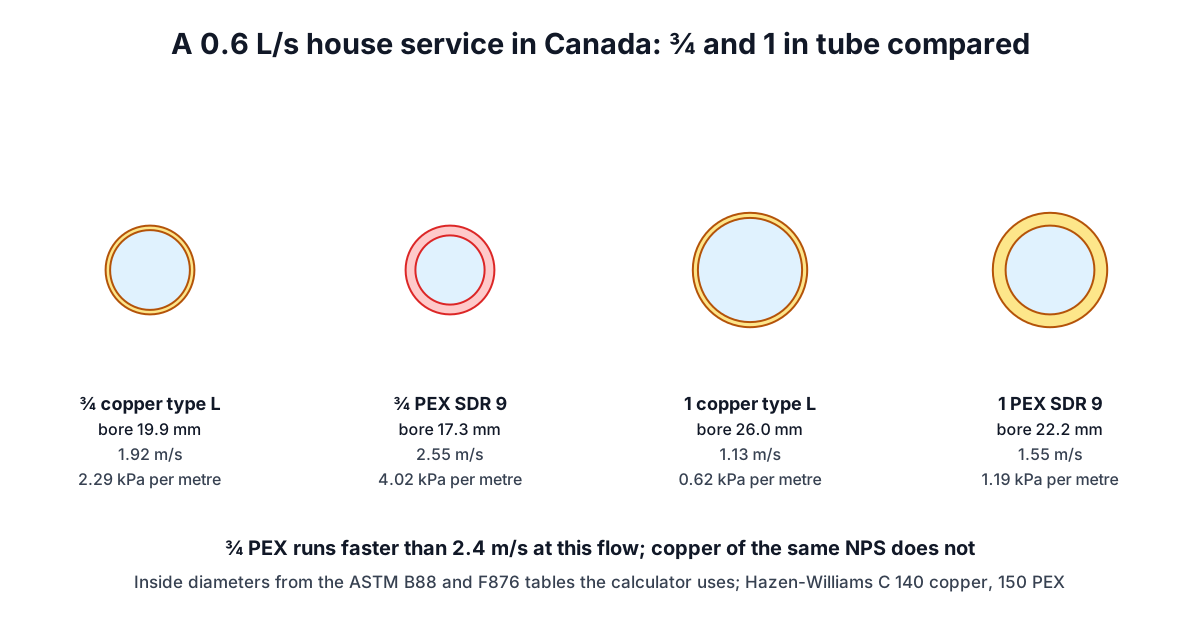
It stores the published bores of ASTM copper types L and M and of PEX (SDR 9, at the minimum wall), because NPS is not the bore. NPS ¾ type L copper is 19.9 mm inside, ¾ PEX only 17.3 mm.
Worked examples
Set the Canadian calculator to SI units and the US / Canada tube standard.
A detached house service, 0.6 L/s over 30 m of type L copper. With a 2.4 m/s limit the calculator accepts NPS ¾: 1.92 m/s and 68.6 kPa lost over the 30 m. With a 1.5 m/s limit it moves to NPS 1: 1.13 m/s and 18.7 kPa. Both satisfy the NPS ¾ minimum. On a lot where the street gives only 200 kPa, though, the ¾ service would use a third of it before the first fixture, which is a strong argument for 1 in on a long service.
The same service in PEX. ¾ PEX has a 17.3 mm bore, so at 0.6 L/s it would run at 2.55 m/s, over a 2.4 m/s limit. The calculator picks 1 in PEX instead: 1.55 m/s and 35.6 kPa over 30 m. PEX goes up a size where type L copper did not.
Checking the 2.6 kPa per metre test. Say the municipality tells you the minimum static pressure at the property line is 450 kPa. A 20 m service in 1 in type L at 0.6 L/s loses 12.5 kPa, leaving 437.5 kPa at the entry. Allow 35 kPa for the meter and backflow preventer, 58.8 kPa for a 6 m rise to the top-floor shower (6 × 9.8 kPa), and 100 kPa as the minimum the shower valve needs; use your own fixture maker's figure. That leaves 243.7 kPa. With 25 m of developed length to that shower, the equivalent length is 37.5 m, so 6.5 kPa per metre is available, comfortably above 2.6. A ¾ type L branch carrying the full 0.6 L/s loses 2.29 kPa per metre, well inside the budget.
A hot water branch, 0.3 L/s over 15 m at 1.5 m/s. In type M copper the calculator picks NPS ¾ (20.6 mm bore): 0.90 m/s and 8.1 kPa (type M is not listed in ⅝, so the calculator steps to ¾). Type L would allow ⅝ at 1.33 m/s and 21.1 kPa; in PEX it is ¾ at 1.28 m/s and 16.7 kPa.
Practical checks
- Gallons. A 0.6 L/s demand is about 9.5 US gallons per minute but only 7.9 imperial gallons per minute. When a fixture's flow is given in gpm, check which gallon it means.
- Height costs pressure. Every metre of rise takes about 9.8 kPa, close to 30 kPa for a 3 m storey, before any friction.
- Hot water. NPC 2.6.1.12 requires thermostats on electric storage water heaters to be set at 60 °C. Hazen-Williams does not account for water temperature, so treat hot-side results as an estimate and keep within the pipe maker's velocity for hot water.
- Too much pressure. Above 550 kPa static at a fixture, a pressure-reducing valve is required, and its own loss goes into step 3 above.
For the rest of the job, the Pump Power Calculator sizes a booster from flow and head, and our Canadian guide to sizing ducts by the equal friction method applies the same friction-per-metre budget to air.
Frequently asked questions
What is the minimum water service size for a house in Canada?
NPC 2025 Sentence 2.6.3.4.(1) says water service pipes are sized for peak demand but may not be smaller than NPS ¾. Your province's adopted code may differ, so check the edition in force.
What water velocity does the National Plumbing Code allow?
Sentence 2.6.3.5.(1) sets the maximum velocities as those recommended by the pipe and fitting manufacturer. The house table and the appendix table are laid out in columns for 3.0, 2.4 and 1.5 m/s, and the appendix table adds 1.2 m/s.
When can I use the NPC sizing table for a house?
For buildings with one or two dwelling units, or row houses with separate water services, where the pressure at the building entry is at least 200 kPa and the water system is no longer than 90 m. Otherwise the size comes from a calculation.
What does 2.6 kPa per metre mean in the plumbing code?
It is the threshold in the appendix's average pressure loss method. Divide the pressure left for friction by the equivalent length (developed length times 1.5); if the answer is under 2.6 kPa per metre, that method cannot be used and the system needs a detailed engineering design.
Is ¾ inch PEX enough for a house water service?
Often not at typical house demands. ¾ PEX is about 17.3 mm inside, so at 0.6 L/s it runs at 2.55 m/s, above a 2.4 m/s limit. The calculator picks 1 in PEX for that flow, and copper can stay at ¾.
Sources and further reading
- National Plumbing Code of Canada 2025 (PDF), National Research Council Canada. Subsection 2.6.3, Table 2.6.3.4 and Note A-2.6.3.1.(2) with its average pressure loss method.
- National Plumbing Code of Canada 2025: catalogue record, Government of Canada Publications. Twelfth edition, developed by the Canadian Board for Harmonized Construction Codes.
- National Plumbing Code of Canada 2025: NRC Publications Archive record, National Research Council Canada. Free access to the code.
- Hazen-Williams equation, Wikipedia. The SI form, C values and the formula's limits.
- Darcy-Weisbach equation, Wikipedia. The general method for hot water and other fluids.
Open the Water Pipe Size Calculator
More HVAC & Plumbing
Every tool in the HVAC & Plumbing section, free and in your browser.