
How Many GIB Sheets Do I Need? Board, Stopping and Tape
Work out GIB plasterboard sheets for a room in metres, then the screws, paper tape and stopping compound from the GIB Site Guide coverage rates.
By Redbison Dev · · 9 min read

New Zealand edition. New Zealand edition for GIB plasterboard: rooms in metres, 1200 mm sheets from 2400 to 4800 mm long, screws at about 800 per 100 m², 75 m tape rolls, GIB compound coverage per lineal metre of joint and the Level 4 finish under AS/NZS 2589. US edition
A 4.2 by 3.6 metre lounge with a 2.4 metre stud, one door and one window has 48.80 m² of walls and ceiling to line. With 10% added for offcuts, that is 19 sheets of 1200 x 2400 GIB, 13 sheets of 1200 x 3600 or 10 sheets of 1200 x 4800. Stopping it takes about 59 metres of paper tape (one 75 m roll), roughly 460 screws, and either one bag of setting compound plus a pail of finishing compound, or two 15 litre pails of an all-purpose air-drying compound.
This edition works through those numbers with the GIB and Plasterboard Calculator, using the sheet sizes, coverage rates and fixing rules in Winstone Wallboards' GIB Site Guide.
Measure the room in metres
Walls are the perimeter times the stud height; the ceiling is length times width. Take off doors and windows:
walls    = 2 x (4.2 + 3.6) x 2.4      = 37.44 m²
ceiling  = 4.2 x 3.6                  = 15.12 m²
openings = 0.81 x 1.98 + 1.8 x 1.2    = 3.76 m²
net      = 37.44 + 15.12 - 3.76       = 48.80 m²
Stud heights vary between houses, so measure yours rather than assuming 2.4 m.
Choose the sheet length before you count
The GIB Site Guide's coverage table gives every standard size, all 1200 mm wide: 2400 (2.88 m²), 2700 (3.24 m²), 3000 (3.60 m²), 3600 (4.32 m²), 4800 (5.76 m²) and longer. Its fixing guidance is to set sheets out to minimise joints, which usually means fixing wall sheets horizontally, and using the largest practical sheets.
| Sheet | Sheets for 48.80 m² + 10% | Board bought | Weight per sheet (10 mm, up to) |
|---|---|---|---|
| 1200 x 2400 | 19 | 54.72 m² | about 20 kg |
| 1200 x 3600 | 13 | 56.16 m² | about 30 kg |
| 1200 x 4800 | 10 | 57.60 m² | about 40 kg |
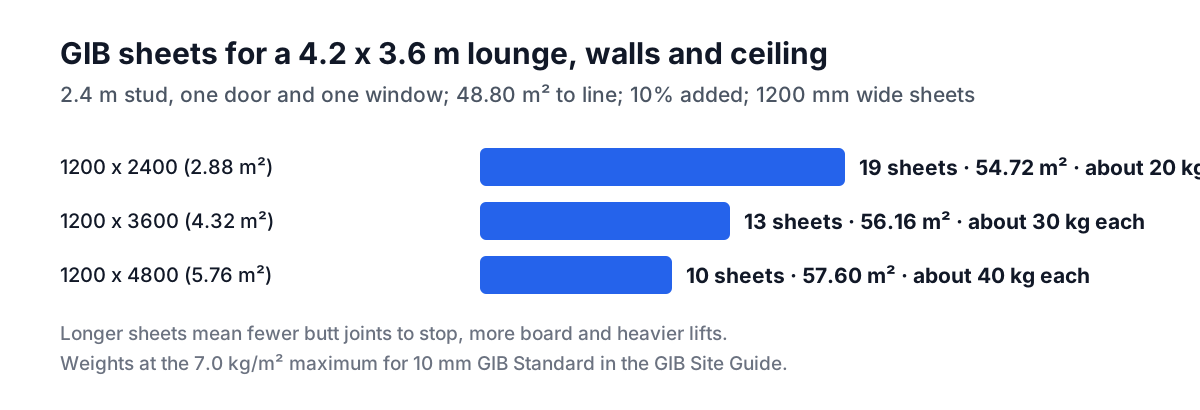
The longer sheets cost more board, about 3 m² extra here, but a 4.8 m sheet runs the full 4.2 m wall in one piece, so there are no butt joints in the middle of it. Butt joints are the hard ones to stop flat: the guide asks for them to land on framing or be back-blocked. Weights are from the guide's maximum of 7.0 kg per m² for 10 mm GIB Standard (9.0 kg for 13 mm), so two people are needed for anything over 3.6 m, and a ceiling of 4.8 m sheets needs a lifter.
For a 2.7 m stud, the 1350 mm wide GIB Wideline covers the wall height in two horizontal sheets. The calculator lists 1200 mm sheets, so for Wideline divide the net wall area by the sheet area (1350 x 4800 is 6.48 m²): the same lounge's walls at 2.7 m, 38.36 m² net, take 7 Wideline sheets of 4.8 m with 10% added.
Screws and fixing
The Site Guide's rule of thumb is approximately 800 screws per 100 m² of plasterboard, so set the calculator's screw rate to 8 per m²: about 461 screws for the 57.60 m² of 4.8 m sheets. The fixing details behind that figure:
- 10 mm board takes at least 25 mm x 6g GIB Grabber high thread screws, 13 mm board 32 mm;
- fasteners at 300 mm maximum centres around the sheet perimeter, no closer than 12 mm to a paper-bound edge or 18 mm to a cut edge;
- GIB-Fix adhesive daubs at 300 mm maximum centres on intermediate studs, not at sheet edges or within 200 mm of a fastener;
- stud centres no more than 600 mm where horizontally fixed sheets leave edge joints unsupported.
Bracing walls are the exception to every rule above. Linings that form a GIB EzyBrace bracing element, designed to NZS 3604, use the fastener pattern in the EzyBrace specification, much closer around the perimeter. If you are relining a wall in an older house, check the plans before you treat it as an ordinary lining: removing or refixing a bracing element is structural work.
Tape and stopping compound
New Zealand stoppers estimate compound by the lineal metre of joint, and the Site Guide gives approximate coverage for each product. The calculator's tape figure, 121 m per 100 m² of board, is a fair proxy for joint length on a room like this: about 59 m for the lounge, so one 75 m roll of GIB Paper Joint Tape.
| Compound | Coats it covers | Coverage | For 59 m of joint |
|---|---|---|---|
| GIB LiteSet (setting) | taping and second coat | 200 m per 18 kg bag | 1 bag |
| GIB Tradeset (setting) | taping and second coat | 200 m per 20 kg bag | 1 bag |
| GIB Trade Finish Lite (air drying) | top coat only | 75 m per 15 L pail | 1 pail |
| GIB Trade Finish Multi (air drying) | taping plus two coats | 50 m per 15 L pail | 2 pails |
So the two routes for the lounge are a bag of setting compound for the first two coats and a pail of finishing compound for the top coat, or two pails of an all-purpose compound for all three. The calculator's ready-mix estimate of 38 L per 100 m² gives 18.5 L, which agrees with the two-pail route. GIB notes these are rough guides that vary with site conditions and should not be used for quoting.
The Site Guide also explains why stoppers mix the two types. In cool weather air-drying compound dries slowly when applied thick, so most stoppers use a setting compound for the first and second coats and a thin air-drying top coat. Where a room is cold, its suggestion is one 2 kW fan heater per 50 m² of floor area to help drying.
The finish you are paying for
GIB uses the three Levels of Finish defined in AS/NZS 2589:2017:
| Level | What it means | Where |
|---|---|---|
| 3 | Tape bedded and one coat over joints and fasteners | Areas not decorated, such as above ceilings |
| 4 | Tape bedded and at least two further coats, finished free of tool marks | The default for homes; flat or low-sheen paint |
| 5 | Level 4 plus a paint or plaster material sprayed, rolled or trowelled over the whole area | Gloss or semi-gloss paint, or critical lighting |
Level 4 is what the coverage table above assumes. Level 5 adds a coat over the whole surface, not just the joints. If that is a 1 mm skim, the guide gives about 10 m² per kg, so the lounge's 48.8 m² would need roughly 5 kg more. If you plan a semi-gloss paint or have long windows washing light across the walls, agree Level 5 before stopping starts.
Wet areas and other boards
Bathrooms, laundries and kitchens use water-resistant boards. GIB's Aqualine wet areas manual sets out where GIB Aqualine is needed and how it meets Building Code clause E3 (internal moisture). Fire-rated walls (GIB Fyreline) and noise-control walls follow their own system specifications, so count those sheets separately from standard board.
Before the board goes up
- Framing moisture. The Site Guide asks for timber moisture content of 18% or less at the time of fixing.
- Storage. Keep the board flat, off the ground, dry and under cover until it is fixed.
- Control joints. Long walls and ceilings need control joints at a maximum of 12 m centres in either direction.
Tools for this job
- GIB and Plasterboard Calculator: sheets, board area, screws, tape and compound for a room in metres.
- Paint Calculator: sealer and topcoats for the new linings, in litres.
- Square Footage Calculator: areas of rooms with odd shapes, in square metres.
- The US drywall, mud and tape guide covers 4 x 8 ft sheets and US compound buckets.
Frequently asked questions
How many GIB sheets do I need for a room?
Add the wall area (perimeter x stud height) and the ceiling area, take off doors and windows, add 10% and divide by the sheet area. A 4.2 x 3.6 m lounge with a 2.4 m stud needs 19 sheets of 2400, 13 of 3600 or 10 of 4800 for walls and ceiling.
What sizes does GIB plasterboard come in?
GIB Standard is 1200 mm wide in lengths from 2400 mm up, including 2700, 3000, 3600 and 4800 mm, in 10 mm and 13 mm thicknesses. GIB Wideline is 1350 mm wide for horizontal fixing on walls taller than 2.4 m.
How many screws do I need per GIB sheet?
The GIB Site Guide gives approximately 800 screws per 100 m² of board, about 23 for a 1200 x 2400 sheet and 46 for a 1200 x 4800 sheet. Bracing elements use a closer fastener pattern from the GIB EzyBrace specification.
How much stopping compound do I need?
Estimate by joint length. A 75 m roll of tape covers a room of about 60 m² of board. For 59 m of joint, one 18 kg bag of GIB LiteSet covers the first two coats and one 15 L pail of GIB Trade Finish the top coat; with an all-purpose compound, allow two 15 L pails.
What level of finish should I ask for?
Level 4 is the default under AS/NZS 2589:2017 and suits flat or low-sheen paint. Ask for Level 5 if you plan a gloss or semi-gloss finish or the walls catch strong side light.
Sources and further reading
- GIB Site Guide, Winstone Wallboards. Sheet sizes and coverage, maximum weights, fixing and adhesive centres, screws per 100 m², compound coverage per lineal metre, Levels of Finish, moisture content and control joints.
- GIB Aqualine wet areas manual, Winstone Wallboards. Water-resistant linings and Building Code clause E3.
- GIB products, Winstone Wallboards. The board, compound and tape range.
- AS/NZS 2589:2017 Gypsum linings: application and finishing, Standards New Zealand. The standard behind Levels of Finish 3 to 5.
- Drywall, Wikipedia. Background on gypsum board and jointing.
More Carpentry & Woodworking
Every tool in the Carpentry & Woodworking section, free and in your browser.