
Solar Panel Payback in the Philippines: Peso Figures
How many years rooftop solar takes to pay back on a Meralco bill: October 2026 rates, net metering credits at generation cost, and yields for Manila, Cebu and Davao.
By Redbison Dev · · 11 min read

Philippines edition. Written for Philippine homeowners: peso figures on Meralco's October 2026 rates and generation charge, net metering under RA 9513 and the 2025 amended rules, and PVGIS yields for Manila, Cebu and Davao. US edition
A 5 kW rooftop system costing ₱300,000 on a Meralco home, using 60% of its output in the house and exporting the rest under net metering, saves ₱85,261.15 in its first year at October 2026 rates and pays for itself in about 3.5 years. That is fast, because Philippine electricity is expensive and the sun is strong all year. The figure depends on three things specific to the Philippine setup: exports are credited at the generation charge rather than the full rate, a bigger household saves more per kWh than the average rate suggests, and the price you pay per watt varies a lot between installers. This edition works through each with the Philippine solar payback calculator, which opens on the Meralco figures below.
What a kWh of solar is worth on a Meralco bill
Meralco's October 2026 rate tables give the typical residential bills below (non-lifeline customers):
| Monthly use | Total bill | Overall rate per kWh |
|---|---|---|
| 200 kWh | ₱3,012.30 | ₱15.0615 |
| 300 kWh | ₱4,611.23 | ₱15.3708 |
| 400 kWh | ₱6,272.08 | ₱15.6803 |
| 500 kWh | ₱8,121.20 | ₱16.2425 |
The same schedule puts the generation charge at ₱10.2005 per kWh, and fixed charges of ₱16.38 a month (supply customer charge) and ₱5.00 a month (metering customer charge) that solar does not reduce.
Solar earns money two ways:
- Power you use while the sun is up is power you do not buy, so it saves close to your full rate.
- Power you export is credited under net metering at the applicable monthly blended generation cost, not the retail rate, according to Meralco's net metering guide. The examples use the October generation charge, ₱10.2005, about two thirds of the 200 kWh overall rate.
Net metering itself comes from Section 10 of the Renewable Energy Act of 2008 (Republic Act No. 9513, approved December 16, 2008), which requires distribution utilities to enter into net-metering agreements with qualified end-users and left the interconnection standards and pricing methodology to the Energy Regulatory Commission.
The base case, step by step
Enter 5 kW, a total cost of ₱300,000, 1,300 kWh a year per kW, 60% self-use, ₱15.0615 per kWh used at home, ₱10.2005 per kWh exported, a ₱60,000 inverter replacement in year 12 and 0.5% a year panel degradation:
year-one production   = 5 kW x 1,300           = 6,500 kWh
used at home (60%)    = 3,900 kWh x ₱15.0615   = ₱58,739.85
exported (40%)        = 2,600 kWh x ₱10.2005   = ₱26,521.30
year-one saving                                = ₱85,261.15
payback (flat rates)                           = 3.5 years
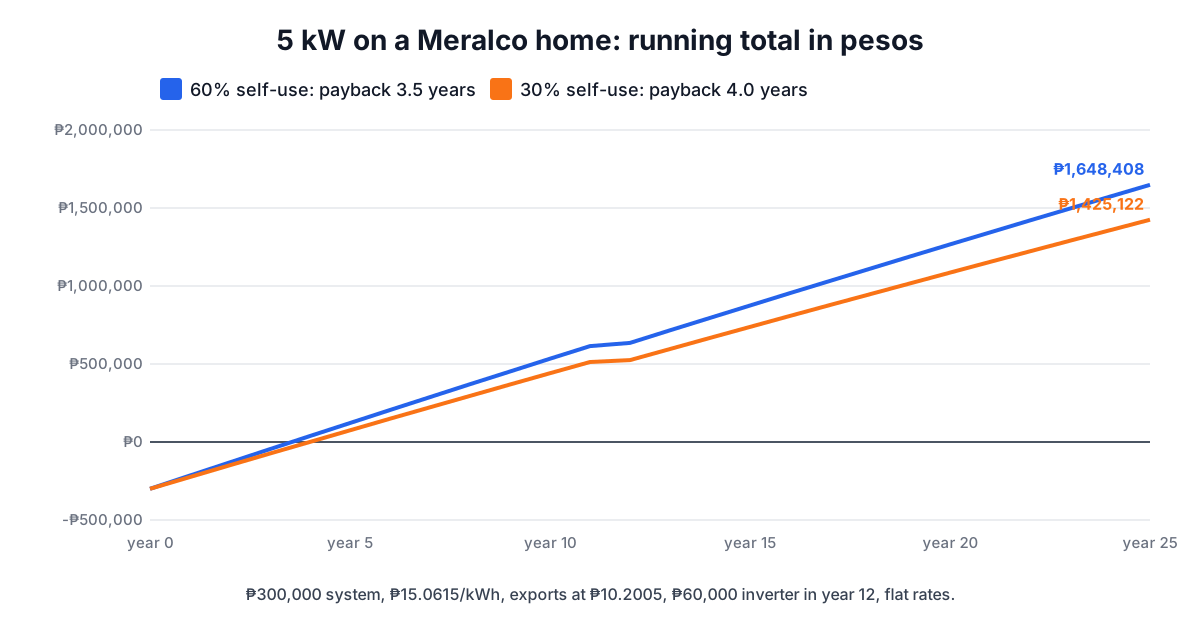
Over 25 years the system makes about 153,114 kWh, which works out at about ₱2.35 per kWh including the inverter replacement, against ₱15.06 from the grid. With flat rates it comes out ₱1,648,407.51 ahead.
How much sun: Manila, Cebu and Davao
The 1,300 kWh per kW in the example is a round starting figure. The European Commission's PVGIS tool gives these yearly outputs for 1 kW of panels facing south at the optimum tilt with 14% system losses. For the Philippines it uses the ERA5 weather reanalysis for 2005 to 2023 rather than satellite data, so treat the numbers as estimates:
| City | Tilt | kWh per kW a year | Lowest month | Highest month |
|---|---|---|---|---|
| Manila | 16° | 1,341 | July, 97.4 kWh | March, 135.6 kWh |
| Cebu | 10° | 1,420 | January, 107.0 kWh | March, 138.2 kWh |
| Davao | 7° | 1,383 | June, 102.6 kWh | March, 131.9 kWh |
Queried from the PVGIS 5.3 PVcalc service with the PVGIS-ERA5 database, 1 kW, 14% losses, azimuth 0° (south) and optimised tilt, at Manila 14.5995° N, 120.9842° E; Cebu City 10.3157° N, 123.8854° E; and Davao City 7.0731° N, 125.6128° E. Other points in the same city give slightly different figures.
At Cebu's 1,420 kWh per kW, the same system saves ₱93,131.41 in year one and pays back in 3.2 years. Even the weakest months produce about 70% to 80% of the best. Shading from neighboring buildings, water tanks and trees can matter more than the city, so use your installer's estimate for your own roof.
Bigger households save more per kWh
Meralco's rate per kWh rises with consumption, because some charges, notably the distribution charge, step up at higher usage levels. That means solar saves a large household more than its average rate.
Take a home using 500 kWh a month whose daytime solar use brings its imports down to 300 kWh. On the October 2026 tables, the bill falls from ₱8,121.20 to ₱4,611.23, a saving of ₱3,509.97 a month, or ₱17.55 per kWh of solar used. That is more than the ₱16.24 average rate at 500 kWh. Entered in the calculator as the price per kWh, it lifts the year-one saving to ₱94,966.30 and shortens the payback to 3.2 years.
The levers, in pesos
| Change from the base case | Year-one saving | Payback |
|---|---|---|
| Base case (60% self-use, 1,300 kWh/kW, flat rates) | ₱85,261.15 | 3.5 years |
| Only 30% used at home | ₱75,782.20 | 4.0 years |
| Cebu yield, 1,420 kWh/kW | ₱93,131.41 | 3.2 years |
| Large household saving ₱17.55 per kWh | ₱94,966.30 | 3.2 years |
| Rates rising 3% a year | ₱85,261.15 | 3.4 years |
| A 3 kW system at ₱200,000 | ₱51,156.69 | 3.9 years |
Self-use matters less here than in countries with very low export credits, because exports still earn about two thirds of the retail rate. Running the aircon, washing machine and water heater while the panels produce still pays.
Price per watt. The 3 kW system costs ₱66.67 per watt against ₱60 for the 5 kW one, which is why it pays back more slowly despite the same rates. Compare quotes per watt and check what each includes.
Rates. Meralco's rates change every month with generation costs. A 3% yearly rise is a scenario, not a forecast; use your own bill and test a flat case too.
Net metering in practice
Meralco's guide sets out the rules a payback estimate should respect:
- Size. The program is for systems of not more than 100 kW per qualified installation.
- Costs. There is no fee to apply, and the distribution impact study, testing and commissioning are not charged to the applicant. You still pay for LGU permits and inspection, the ERC Certificate of Compliance application fee any difference in meter cost and, in some cases, a Distribution Asset Study or network requirement.
- Credits. Unused export credits are banked and carried forward to later bills. They are bill credits, not cash, so a system much larger than your use earns credits you may never spend.
- REC meter. Under the 2025 amended rules, the meter that measures your total generation is voluntary. If you decline it, you sign an affidavit and waiver and Meralco estimates generation by an approved method.
- Start date. Credits begin only after the meters are installed, the system passes testing and commissioning, and a special meter reading starts net metering service.
If you are with an electric cooperative rather than Meralco, use the rate and generation charge on your own bill.
Frequently asked questions
How many years does solar take to pay back in the Philippines?
For a ₱300,000, 5 kW system on a Meralco home at October 2026 rates, with 60% self-use and exports at the ₱10.2005 generation charge, about 3.5 years with flat rates. At 30% self-use it is about 4.0 years.
How does Meralco credit exported solar power?
At the applicable monthly blended generation cost, not the full retail rate, so the credit changes every month. On the October 2026 schedule the generation charge was ₱10.2005 per kWh. Unused credits carry forward to later bills and are not paid in cash.
How much electricity does 1 kW of solar produce in the Philippines?
PVGIS estimates about 1,341 kWh a year in Manila, 1,420 in Cebu and 1,383 in Davao for south-facing panels at the best tilt with 14% losses. Shade and roof direction can lower this.
Is there a size limit for net metering?
Yes. Net metering covers systems of not more than 100 kW per qualified installation, and final approval depends on the system and local network conditions.
Does a bigger household get more value from solar?
Usually, yes. Meralco's per-kWh rate rises with consumption, so cutting a 500 kWh bill to 300 kWh saved ₱3,509.97 in October 2026, ₱17.55 per kWh, above the average rate at either level.
Sources and further reading
- Rates and charges (October 2026 tables), Manila Electric Company. Typical bills by consumption, the ₱10.2005 generation charge and fixed customer charges.
- Solar and net metering, Manila Electric Company. Export credits, the 100 kW ceiling, fees, REC meter rules.
- Republic Act No. 9513, Renewable Energy Act of 2008, Lawphil. Section 10 on net metering.
- Renewable energy programs, Department of Energy. Net metering guide and materials.
- Photovoltaic Geographical Information System (PVGIS), European Commission Joint Research Centre. Yields for Manila, Cebu and Davao.
Open the Solar Panel Payback Calculator
More Energy & Sustainability
Every tool in the Energy & Sustainability section, free and in your browser.