
Rooftop Solar Payback in India After PM Surya Ghar Subsidy
How many years a rooftop solar system takes to pay back in India: PM Surya Ghar subsidy, 5% GST, units per kW, your slab rate, net metering and inverter costs.
By Redbison Dev · · 11 min read
India edition. Written for Indian homes: the PM Surya Ghar central financial assistance of ₹30,000 per kW for the first 2 kW and ₹18,000 for the third (higher in special category states), GST on solar cut to 5% from 22 September 2025, units and your slab tariff in rupees. US edition
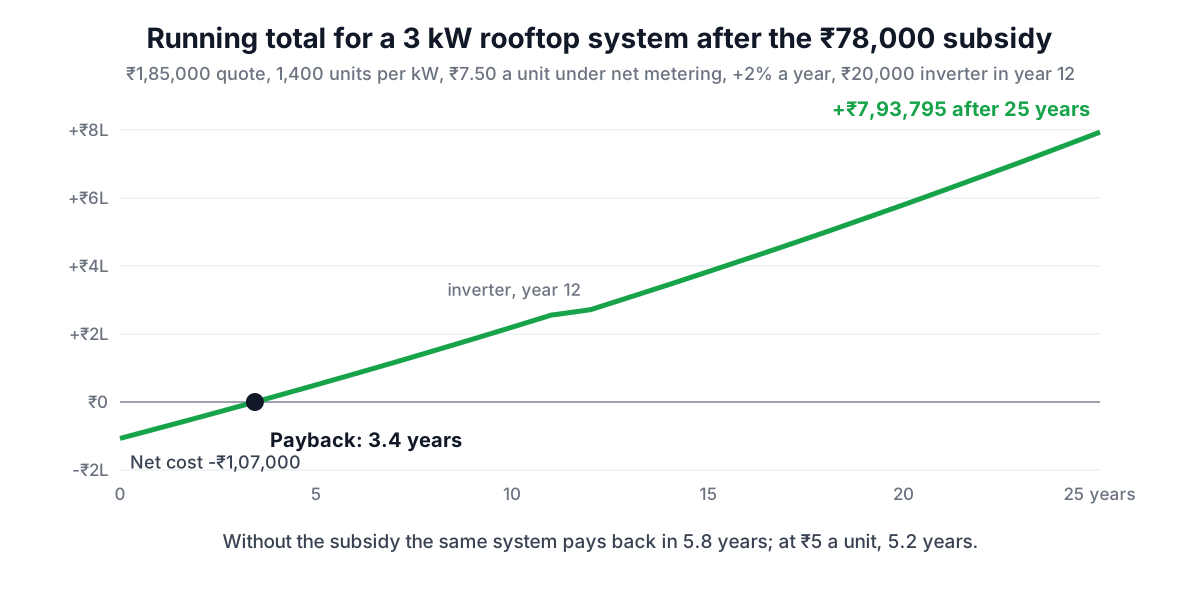
A 3 kW rooftop system quoted at ₹1,85,000 costs ₹1,07,000 after the ₹78,000 PM Surya Ghar subsidy, and if it makes 1,400 units per kW a year that you would otherwise buy at ₹7.50 a unit, it saves ₹31,500 in the first year and pays back in about 3.4 years. Without the subsidy it takes 5.8 years; on a ₹5 slab, 5.2 years. Those three numbers, the subsidy, your units per kW and your slab rate, decide almost all of an Indian solar payback. This edition works through each one with the Rooftop Solar Payback Calculator (India) and shows where payback estimates tend to be optimistic.
Step 1: the subsidy, and why it stops at 3 kW
Under PM Surya Ghar: Muft Bijli Yojana, any consumer with a residential connection from the local DISCOM can install rooftop solar on a roof, terrace, balcony or elevated structure and claim central financial assistance (CFA) at these rates (MNRE criteria, via PIB):
| Capacity | CFA (general) | CFA (special category states and UTs) |
|---|---|---|
| First 2 kWp | ₹30,000 per kWp | ₹33,000 per kWp |
| Third kWp | ₹18,000 per kWp | ₹19,800 per kWp |
| Beyond 3 kWp | No additional CFA | No additional CFA |
| Group housing societies and RWAs, common facilities including EV charging, up to 500 kWp at 3 kWp per house | ₹18,000 per kWp | ₹19,800 per kWp |
So a 3 kW home system gets 2 × ₹30,000 + ₹18,000 = ₹78,000, or ₹85,800 in a special category state, and a 5 kW system gets the same ₹78,000. Above 3 kW, every extra kW is at full price, which is why the payback on a bigger system is slower even when the roof can take it.
The calculator treats the CFA as a rebate taken off the cost. Ask your vendor when it will be credited; if you pay the full amount first, the subsidy is money you are waiting for, and a loan to bridge it has a cost.
Step 2: GST at 5%
The GST Council's 56th meeting cut GST on renewable energy devices and parts from 12% to 5%, including solar power generators and photovoltaic cells whether or not assembled into modules or panels, with goods rates changing from 22 September 2025 (GST Council, 56th meeting recommendations).
If a ₹1,85,000 quote includes GST at 5%, the same system at 12% would have cost about ₹1,97,333. After the subsidy that is ₹1,19,333 instead of ₹1,07,000, and payback would be 3.8 years instead of 3.4. If you have an older quote, ask for it to be reissued.
The cut is to the goods rate. A turnkey rooftop contract can split the price between the equipment and installation, and the installation part may be taxed differently, so ask the vendor how GST is applied on the invoice.
Step 3: units per kW on your roof
Production is system size × units (kWh) per kW a year. It depends on your city's sunshine, the roof's direction and tilt, dust, and shade from water tanks, neighbouring buildings and trees. The calculator starts at 1,400 units per kW a year as an assumption; replace it with the estimate from your vendor, or model your roof in a tool such as PVWatts, which estimates PV output for locations around the world (PVWatts).
The example system makes 3 × 1,400 = 4,200 units in the first year, about 350 a month. Panels then lose about 0.5% a year, so year 25 makes about 3,724 units. At 1,200 units per kW instead of 1,400, payback rises from 3.4 to 4.0 years.
Step 4: what each unit is worth
Every unit the panels make is worth the price of a unit you no longer buy, at the rate of the slab it comes off. Two things change that:
- Slab tariffs. Many residential tariffs are set in slabs that rise with consumption. Solar removes the most expensive units first, from the top slab, so use the rate of your highest slab, not your average bill divided by units. A household whose consumption sits mostly in a low slab saves less per unit.
- Surplus units. If your DISCOM sets exported units off against imported units, every unit is worth your tariff, and the calculator's 100% self-use setting fits. If it pays a lower rate for surplus units at the end of the settlement period, lower the self-use share and enter that rate as the export credit.
For the 3 kW example at ₹7.50 a unit, the first-year saving is 4,200 × ₹7.50 = ₹31,500. The example also allows ₹1,000 a year for cleaning and upkeep, and ₹20,000 for an inverter replacement in year 12.
Putting it together
With those inputs the Rooftop Solar Payback Calculator (India) gives:
| Case | Net cost | First-year saving | Payback | IRR |
|---|---|---|---|---|
| 3 kW, ₹78,000 CFA, ₹7.50 a unit | ₹1,07,000 | ₹31,500 | 3.4 years | 29.7% |
| Same, no subsidy | ₹1,85,000 | ₹31,500 | 5.8 years | 17.3% |
| Same, special category state (₹85,800 CFA) | ₹99,200 | ₹31,500 | 3.2 years | 32.0% |
| Same, ₹5 a unit | ₹1,07,000 | ₹21,000 | 5.2 years | 19.5% |
| Same, 1,200 units per kW | ₹1,07,000 | ₹27,000 | 4.0 years | 25.4% |
| 5 kW at ₹2,90,000, ₹78,000 CFA | ₹2,12,000 | ₹52,500 | 4.0 years | 25.5% |
| 5 kW, 70% offset at ₹7.50 and surplus paid ₹3 | ₹2,12,000 | ₹43,050 | 4.9 years | 20.9% |
The example's tariffs rise 2% a year, below the Reserve Bank's 4% CPI inflation target (RBI, monetary policy overview), so it does not lean on big tariff increases. Over 25 years the 3 kW system makes about 98,935 units at an all-in cost of about ₹1.54 a unit (net cost plus upkeep and inverter, divided by units), far below any residential slab.
Where Indian payback estimates go wrong
- Using the bill average instead of the top slab. If solar takes you from a high slab to a low one, the last units saved are worth the high rate but the next ones are worth less. Size the system to your consumption.
- Oversizing for the roof. Beyond 3 kW there is no extra CFA, and surplus units may earn less than your tariff. The 5 kW rows show how a lower offset share slows payback.
- Ignoring shade and dust. A water tank's shadow across one string, or months of dust before the monsoon, cuts output. Ask the vendor how the estimate allows for them, and plan regular cleaning.
- Forgetting the inverter. An inverter may need replacing during the panels' life. Budget for one replacement.
- Counting the subsidy before it arrives. Check when it is credited, and if you borrow to bridge it, add the interest.
How to check a vendor's quote
- Confirm the system size in kWp, the price including GST (and how the invoice splits goods at 5% from installation), and the CFA you are eligible for.
- Take the units per kW from the vendor's estimate for your roof, and sense-check it with PVWatts.
- Find your highest slab rate on your bill, and ask your DISCOM how surplus units are settled.
- Include upkeep and an inverter replacement.
- Run the Rooftop Solar Payback Calculator (India) with your figures, with and without tariff increases.
Tools for this job
- Rooftop Solar Payback Calculator (India): payback, IRR and cost per unit with the PM Surya Ghar subsidy as a rebate.
- Electricity Cost Calculator (India): what each appliance costs in units and rupees, to size the system to your use.
- Solar Panel Calculator: how many panels a given monthly consumption needs.
- NPV and IRR Calculator: compare solar with an FD or other uses of the money.
Related reading: the India guide to EV and petrol running costs for households thinking of charging an EV from the roof, and the US edition for how ROI, NPV and IRR are defined.
Frequently asked questions
How much subsidy do I get on a 3 kW rooftop system?
₹78,000 under PM Surya Ghar: ₹30,000 per kWp for the first 2 kWp and ₹18,000 for the third. In special category states and UTs it is ₹33,000 and ₹19,800, so ₹85,800. There is no additional CFA beyond 3 kWp.
What is the payback period of rooftop solar in India?
In the 3 kW example, 3.4 years with the subsidy and 5.8 years without, at ₹7.50 a unit and 1,400 units per kW a year. A lower slab rate or less sunny roof makes it longer: 5.2 years at ₹5 a unit.
How many units does a 1 kW solar system produce?
It depends on location, tilt, shade and dust. The calculator starts at 1,400 units per kW a year as an assumption, about 117 units a month. Use your vendor's estimate for your roof, or model it in PVWatts.
Is GST on solar panels 5% now?
Yes. The GST Council cut the rate on renewable energy devices, including solar power generators and photovoltaic modules, from 12% to 5%, with goods rates changing from 22 September 2025.
Is a bigger system better if my roof has space?
Not always. Above 3 kWp there is no extra CFA, and if surplus units are paid below your tariff, the extra panels earn less. A 5 kW system offsetting 70% of its output at ₹7.50, with the rest paid ₹3, pays back in 4.9 years against 3.4 for the 3 kW example.
Sources and further reading
- Criteria and details of incentives under PM Surya Ghar: Muft Bijli Yojana, Press Information Bureau and Ministry of New and Renewable Energy. CFA rates by capacity and for special category states.
- Recommendations of the 56th Meeting of the GST Council, GST Council and PIB, 3 September 2025. GST on renewable energy devices cut from 12% to 5%, goods rates from 22 September 2025.
- Monetary policy: overview, Reserve Bank of India. The 4% CPI inflation target.
- PVWatts Calculator, National Laboratory of the Rockies. PV output estimates for locations worldwide.
- Photovoltaic Degradation Rates: an Analytical Review, Progress in Photovoltaics. Jordan and Kurtz on field degradation rates.
Open the Solar Panel Payback Calculator
More Energy & Sustainability
Every tool in the Energy & Sustainability section, free and in your browser.