
Solar Panel Payback in the UK: SEG, Self-Use and VAT
Work out UK solar payback honestly: self-use at the price-cap rate, exports at your SEG rate, 0% VAT until March 2027, batteries and the inverter, in pounds.
By Redbison Dev · · 11 min read
United Kingdom edition. Written for UK homes: the Ofgem price cap unit rate for October to December 2026, Smart Export Guarantee rates set by each supplier, the 0% VAT on residential solar and batteries until 31 March 2027, and a 4.2 kW example in pounds. US edition
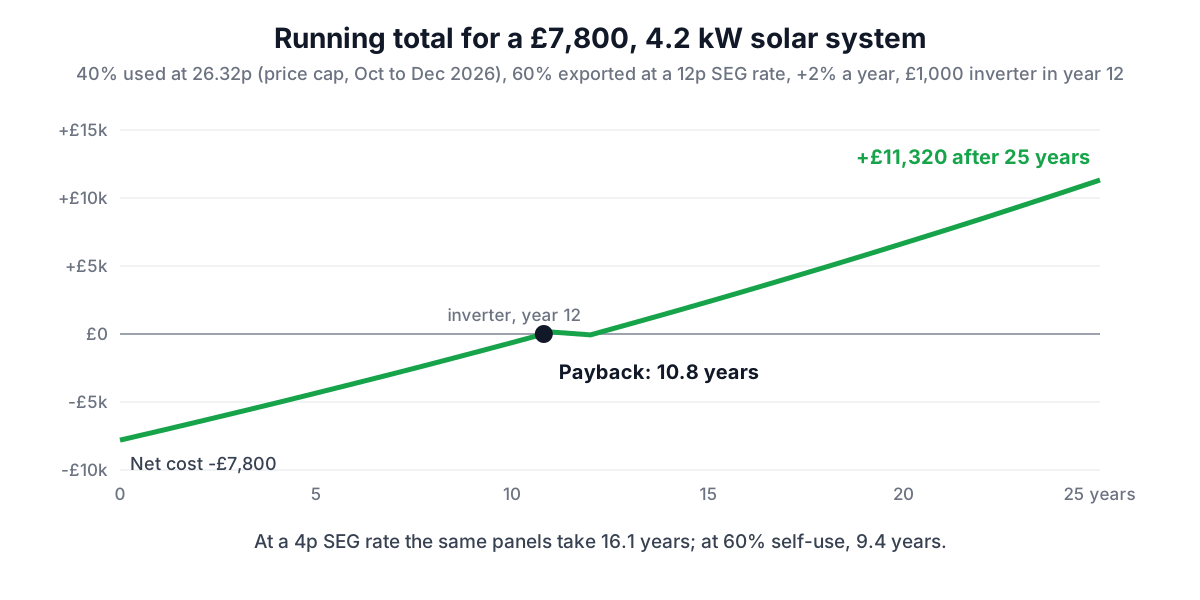
Take an assumed quote of £7,800 for a 4.2 kW solar system (an illustrative figure, not a market average; use your own installer's price): it pays for itself in about 10.8 years if you use 40% of the output at home at the October to December 2026 price-cap rate of 26.32p and export the rest at a 12p Smart Export Guarantee (SEG) rate. Drop the export rate to 4p and the same panels take 16.1 years; use 60% of the output yourself and it is 9.4 years. In the UK the answer turns on two numbers more than any other: how much you use yourself and what your supplier pays for exports. This edition works through both with the Solar Panel Payback Calculator (UK), adds the VAT deadline that matters for anyone deciding now, and shows when a battery helps.
Step 1: output per kW on a UK roof
Output is system size × yearly kWh per kW for your roof. UK roofs vary a lot with orientation, pitch, shading and latitude, so this number is the one to take from your installer's performance estimate rather than a national average. The calculator starts at 900 kWh per kW as a placeholder; the example uses it:
- 4.2 kW × 900 = 3,780 kWh in the first year.
- Panels lose about 0.5% a year, so year 25 makes about 3,352 kWh, and the 25 years together make about 89,041 kWh.
How much the yield moves the answer: at 800 kWh per kW the example's payback is 13.4 years; at 1,000 it is 9.8 years. That spread is bigger than most of the decisions you can make about equipment.
Step 2: self-use at the unit rate, exports at your SEG rate
A kWh you use in the house saves your full unit rate; a kWh you export earns only what your SEG tariff pays.
The unit rate. For 1 October to 31 December 2026, Ofgem's price cap sets an average Direct Debit electricity unit rate of 26.32p per kWh, with a daily standing charge of 54.83p, across England, Scotland and Wales (Ofgem, price cap rates by region). Solar reduces the units you buy, not the standing charge, so leave that out of the savings.
The export rate. The SEG, which started on 1 January 2020, requires some suppliers, the SEG licensees, to pay small-scale generators, including solar PV up to 5 MW in Great Britain, for electricity they export. Each licensee sets its own rate, contract length and terms, and the rate must always be above zero (Ofgem, Smart Export Guarantee). That freedom is why SEG offers range widely, and why you should compare them as you would compare import tariffs.
For the 4.2 kW example with 40% self-use and a 12p SEG rate:
- 1,512 kWh used at home × 26.32p = £397.96
- 2,268 kWh exported × 12p = £272.16
- First-year saving: £670.12
If every kWh were valued at the unit rate, the saving would be £994.90 and payback 7.8 years. That "simple" figure overstates this UK case by three years, so check which one a quote uses.
Step 3: VAT, the inverter and price changes
VAT. Installing solar panels in residential accommodation is zero-rated from 1 May 2023 to 31 March 2027, and from 1 April 2027 the rate reverts to 5%. Since 1 February 2024 the zero rate also covers batteries installed in homes, including a battery retrofitted to existing panels (GOV.UK, VAT Notice 708/6). For the example, 5% VAT would raise the cost to £8,190 and stretch payback from 10.8 to 12.6 years. If you are deciding between this winter and next summer, that date is worth checking with your installer.
The inverter. A string inverter may need replacing once during the panels' life. The example includes £1,000 in year 12.
Prices. The example raises both the unit rate and the SEG rate by 2% a year. That is an assumption, not a forecast; with prices flat, payback is 13.5 years instead of 10.8.
Putting it together
With the example inputs, the Solar Panel Payback Calculator (UK) gives:
| Measure | Result |
|---|---|
| First-year saving | £670.12 |
| Payback | 10.8 years |
| Gain after 25 years | £11,320 |
| IRR | 7.9% a year |
| NPV at 4% | £3,778 |
| Cost per kWh over 25 years | 9.9p |
The cost per kWh is the clearest comparison for a UK household: about 9.9p for each kWh the panels make over 25 years, against 26.32p for a kWh from the grid on the current cap.
What moves a UK payback most
Each row changes one input from the example:
| Change | Payback | 25-year gain | IRR |
|---|---|---|---|
| Example (40% self-use, 12p SEG) | 10.8 years | £11,320 | 7.9% |
| SEG rate 4p | 16.1 years | £5,873 | 4.5% |
| SEG rate 15p | 9.9 years | £13,363 | 9.0% |
| 60% self-use | 9.4 years | £14,571 | 9.7% |
| 800 kWh per kW | 13.4 years | £9,085 | 6.6% |
| 1,000 kWh per kW | 9.8 years | £13,556 | 9.1% |
| Prices flat (0% a year) | 13.5 years | £6,985 | 5.9% |
| Installed after March 2027 at 5% VAT | 12.6 years | £10,930 | 7.4% |
| With a £3,500 battery, 70% self-use | 13.5 years | £12,696 | 6.4% |
Three lessons stand out for UK homes. The export rate is worth shopping for: the gap between a 4p and a 15p SEG offer is six years of payback. Daytime use is worth more than any export rate, because a kWh used at home saves 26.32p. And on these figures a battery raises the 25-year gain slightly but lengthens payback, because it costs more than the extra self-use saves; it pays better if you also charge it overnight on a cheaper tariff, which this calculation does not include.
How to check a UK quote
- Confirm the system size in kW and the total price, and whether VAT is shown at 0%.
- Take the yearly output from the installer's performance estimate for your roof, not a brochure figure.
- Estimate honestly how much you will use at home in daylight: people out at work all day use less.
- Get two or three SEG offers before you sign, and check whether an offer requires you to buy your electricity from the same supplier.
- Run the calculator with prices flat and rising to see the range.
- Check whether planning permission is needed. Solar panels on houses may be permitted development, but there are limits and conditions, and the Planning Portal advises checking with your local authority (Planning Portal, solar panels).
Tools for this job
- Solar Panel Payback Calculator (UK): payback, IRR, NPV and cost per kWh with SEG exports and the price-cap rate.
- Electricity Cost Calculator (UK): what your appliances cost at your unit rate, to see what daytime use could save.
- NPV and IRR Calculator (UK): compare the panels with other uses of the money.
- Solar Panel Calculator: size a system from your yearly usage.
Related reading: the UK guide to heat pump and gas boiler running costs and the UK guide to EV and petrol running costs, both of which raise daytime electricity use and so self-use. The US edition explains US net metering and net billing.
Frequently asked questions
How long do solar panels take to pay back in the UK?
In this example, 10.8 years for a £7,800, 4.2 kW system using 40% of its output at the 26.32p price-cap rate and exporting the rest at 12p. With a 4p export rate it takes 16.1 years; with 60% self-use, 9.4 years. Your roof's output and your daytime use decide most of the difference.
What is a good Smart Export Guarantee rate?
Suppliers set their own SEG rates, which must be above zero, so offers vary widely. In the example, moving from 4p to 15p shortens payback from 16.1 to 9.9 years. Compare several offers, including any tied to an import tariff.
Is there VAT on solar panels?
Not until 31 March 2027: installing solar panels and batteries in homes is zero-rated from 1 May 2023 to 31 March 2027, and the rate returns to 5% from 1 April 2027. In the example, 5% VAT would add £390 and about 1.8 years to the payback.
Is a solar battery worth it in the UK?
On daytime solar alone, not in this example: a £3,500 battery that lifts self-use from 40% to 70% lengthens payback from 10.8 to 13.5 years, though the 25-year gain rises slightly. A battery charged on a cheap overnight tariff as well can do better than this calculation shows.
Do solar panels reduce my standing charge?
No. Solar reduces the units you buy from the grid; the daily standing charge, 54.83p on the October to December 2026 cap for Direct Debit electricity, stays the same.
Sources and further reading
- Get energy price cap standing charges and unit rates by region, Ofgem. 26.32p per kWh and 54.83p a day, 1 October to 31 December 2026.
- Smart Export Guarantee (SEG), Ofgem. Who pays, eligible systems, rates set by each licensee.
- VAT on energy-saving materials and heating equipment (VAT Notice 708/6), HM Revenue and Customs. Zero rate to 31 March 2027, batteries from 1 February 2024.
- Solar panels: planning permission, Planning Portal.
- Photovoltaic Degradation Rates: an Analytical Review, Progress in Photovoltaics. Jordan and Kurtz on field degradation rates.
Open the Solar Panel Payback Calculator
More Energy & Sustainability
Every tool in the Energy & Sustainability section, free and in your browser.