
Solar Payback in Australia: STCs, Feed-in Tariffs, Self-Use
Work out rooftop solar payback in Australia: the STC discount and its shrinking deeming period, self-use at your usage rate, exports at your feed-in tariff, in A$.
By Redbison Dev · · 11 min read
Australia edition. Written for Australian rooftops: small-scale technology certificates and the deeming period that falls from five years for 2026 installations to four for 2027, self-consumption valued at your usage rate, exports at your feed-in tariff, and a 6.6 kW example in A$. US edition
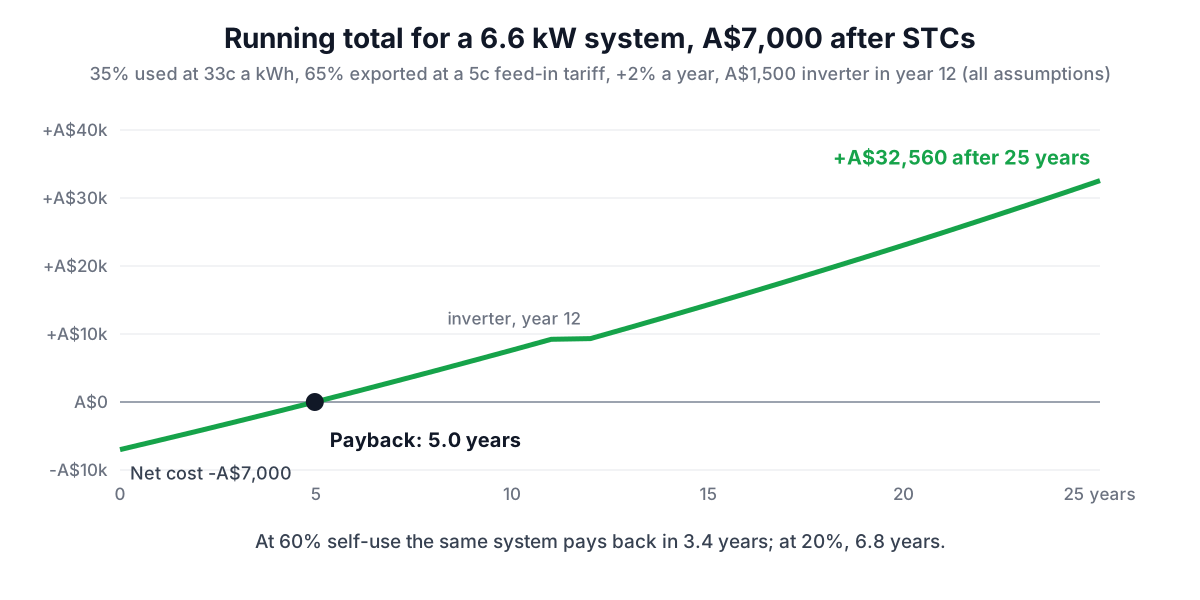
A 6.6 kW system quoted at A$8,710 before its small-scale technology certificate (STC) discount, and A$7,000 after it, pays back in about 5.0 years if you use 35% of its output at a usage rate of 33c a kWh and export the rest at a 5c feed-in tariff. Use 60% yourself and it is 3.4 years; use 20% and it is 6.8 years. On these figures the feed-in tariff is a small part of the answer: the share of output you use at home, and when you install, matter more. This edition works through both with the Solar Panel Payback Calculator (Australia), including the January date that cuts the STC discount every year until 2030.
The prices in the example (33c usage, 5c feed-in, A$8,710 quote, A$38 an STC) are assumptions to replace with the numbers on your own bill and quote. They differ by state, network and retailer.
Step 1: the STC discount, and why the installation year matters
Australian solar quotes can include a discount for STCs, the certificates created for a system under the Small-scale Renewable Energy Scheme. One STC represents 1 MWh of renewable electricity, and the number a system creates depends on its location, installation date, the electricity it is deemed to generate and the deeming period (Clean Energy Regulator, STCs).
The deeming period is the part that changes every year. For small-scale solar it is set by installation year (Clean Energy Regulator, deeming period decline):
| Installed in | Deeming period |
|---|---|
| 2025 | 6 years |
| 2026 | 5 years |
| 2027 | 4 years |
| 2028 | 3 years |
| 2029 | 2 years |
| 2030 | 1 year, then the scheme ends |
Because the certificates stand for the output deemed over that period, the same system installed in 2027 creates roughly four-fifths of the STCs it would have created in 2026. In the example, a 45-STC discount at an assumed A$38 is A$1,710; at four-fifths, about 36 STCs, it is A$1,368. The net price rises by A$342 and payback moves from 5.0 to 5.2 years. That is not a reason to rush a poor quote, but if you are ready, installing in December rather than January keeps the larger discount. The CER publishes the calculation details on its STC entitlement page; your installer's quote should show the STC count.
Batteries now create STCs too. The CER notes that the Department of Climate Change, Energy, the Environment and Water buys STCs equivalent to the battery STCs created, so that cost is not passed on to retailers or households. Enter a battery quote after that discount.
Step 2: output per kW
Production is system size × yearly kWh per kW. It varies with your city, the roof's direction and pitch, and shading. The calculator starts at 1,400 kWh per kW as an assumption; replace it with your installer's estimate, or model your roof in PVWatts, which estimates PV output worldwide (PVWatts).
The 6.6 kW example makes 6.6 × 1,400 = 9,240 kWh in its first year and about 217,657 kWh over 25 years, allowing for 0.5% a year degradation. At 1,200 kWh per kW payback is 5.8 years; at 1,600 it is 4.4.
Step 3: self-use against exports
Each kWh you use at home saves your full usage rate. Each kWh you export earns your feed-in tariff. With the example's 33c and 5c, a kWh used at home is worth more than six exported kWh. For 35% self-use:
- 3,234 kWh used at home × 33c = A$1,067.22
- 6,006 kWh exported × 5c = A$300.30
- First-year saving: A$1,367.52
Now compare two ways to improve that. Moving from 35% to 60% self-use, by running the dishwasher, pool pump, hot water or EV charging in the middle of the day, lifts the first-year saving to A$2,014.32. Losing the feed-in tariff entirely, at 0c, drops it to A$1,067.22. Both matter, but the first is under your control. Self-use is also where a household out at work all day loses most: at 20% self-use, payback is 6.8 years.
Putting it together
With the example inputs and A$1,500 for an inverter replacement in year 12, the Solar Panel Payback Calculator (Australia) gives:
| Measure | Result |
|---|---|
| Net price after STCs | A$7,000 |
| First-year saving | A$1,367.52 |
| Payback | 5.0 years |
| Gain after 25 years | A$32,560 |
| IRR | 20.3% a year |
| NPV at 5% | A$14,473 |
| Cost per kWh over 25 years | 3.9c |
The cost per kWh, net price plus the inverter divided by lifetime output, is the clearest comparison: about 3.9c for each kWh the panels make, against the 33c usage rate assumed for the grid.
What moves an Australian payback most
Each row changes one input from the example:
| Change | Payback | 25-year gain | IRR |
|---|---|---|---|
| Example (35% self-use, 33c, 5c FiT) | 5.0 years | A$32,560 | 20.3% |
| 60% self-use | 3.4 years | A$51,980 | 29.9% |
| 20% self-use | 6.8 years | A$20,908 | 14.2% |
| Feed-in tariff 2c | 5.7 years | A$27,150 | 17.5% |
| Feed-in tariff 0c | 6.3 years | A$23,544 | 15.6% |
| Usage rate 28c | 5.6 years | A$27,705 | 17.8% |
| 1,200 kWh per kW | 5.8 years | A$26,694 | 17.3% |
| 1,600 kWh per kW | 4.4 years | A$38,426 | 23.3% |
| Installed in 2027 (about 36 STCs) | 5.2 years | A$32,218 | 19.4% |
| Prices flat (0% a year) | 5.2 years | A$23,713 | 18.2% |
The pattern is clear: self-use and your usage rate dominate. A bigger system with more exports adds less than its size suggests; a 10 kW system at A$12,500 with an assumed A$2,584 STC discount and only 25% self-use pays back in 5.7 years, slower than the 6.6 kW example.
How to check an Australian quote
- Confirm the system size, the price before and after STCs, and the number of STCs and the price per STC used.
- Check the installation date against the deeming period: a quote for December may not hold in January.
- Take the yearly output from the installer's estimate for your roof, and sense-check it with PVWatts.
- Find your usage rate and feed-in tariff on your bill, including any time-of-use rates in the daytime.
- Estimate your daytime use honestly, and what you could move into the middle of the day.
- Run the calculator with prices flat and rising.
Tools for this job
- Solar Panel Payback Calculator (Australia): payback, IRR and cost per kWh with the STC discount and feed-in tariff.
- Electricity Cost Calculator (Australia): what appliances cost at your usage rate, to see what daytime use could save.
- NPV and IRR Calculator (Australia): compare solar with an offset account or other uses of the money.
- Solar Panel Calculator: size a system from your yearly usage.
Related reading: the Australian guide to heat pump and gas running costs and the Australian guide to EV and petrol running costs, both of which raise daytime electricity use. The US edition explains ROI, NPV and IRR in more detail.
Frequently asked questions
How long does solar take to pay back in Australia?
In this example, about 5.0 years for a 6.6 kW system costing A$7,000 after STCs, using 35% of its output at 33c and exporting the rest at 5c. At 60% self-use it is 3.4 years; at 20%, 6.8 years. Use your own quote, usage rate and feed-in tariff.
Is the STC rebate going down?
Yes, each January. The deeming period for small-scale solar is 5 years for 2026 installations, 4 for 2027, 3 for 2028, 2 for 2029 and 1 for 2030, when the scheme ends, so the same system creates fewer STCs each year.
Is a high feed-in tariff more important than self-use?
Usually not. With a 33c usage rate and a 5c feed-in tariff, a kWh used at home is worth more than six exported kWh. In the example, losing the feed-in tariff entirely stretches payback from 5.0 to 6.3 years, while raising self-use to 60% shortens it to 3.4.
Do batteries get STCs?
Yes. The Clean Energy Regulator says solar batteries create STCs, and the Department of Climate Change, Energy, the Environment and Water buys STCs equivalent to the battery STCs created. Enter a battery quote after that discount and raise the self-use share to model it.
What output should I expect per kW?
It depends on your location, roof direction and shading. The calculator's 1,400 kWh per kW a year is a starting assumption; take your installer's estimate or model the roof in PVWatts.
Sources and further reading
- Deeming period decline, Clean Energy Regulator. Deeming period by installation year, 2025 to 2030.
- Small-scale technology certificates, Clean Energy Regulator. What sets the number of STCs, 1 STC per MWh, and battery STCs.
- Calculate small-scale technology certificate entitlements, Clean Energy Regulator.
- PVWatts Calculator, National Laboratory of the Rockies. PV output estimates for locations worldwide.
- Photovoltaic Degradation Rates: an Analytical Review, Progress in Photovoltaics. Jordan and Kurtz on field degradation rates.
Open the Solar Panel Payback Calculator
More Energy & Sustainability
Every tool in the Energy & Sustainability section, free and in your browser.