
Solar Payback in South Africa: Rand Figures Explained
How long rooftop solar takes to pay back in South Africa: Cape Town's Home User tariff and feed-in credit, Eskom's Homeflex rule and tariff hikes, in rand.
By Redbison Dev · · 11 min read
South Africa edition. Written for South African homeowners: rand figures on the City of Cape Town 2026/27 Home User and feed-in tariffs, Eskom's 2026/27 increases and Homeflex rule for grid-tied systems, PVGIS yields for three cities, and the end of the SARS rebate. US edition
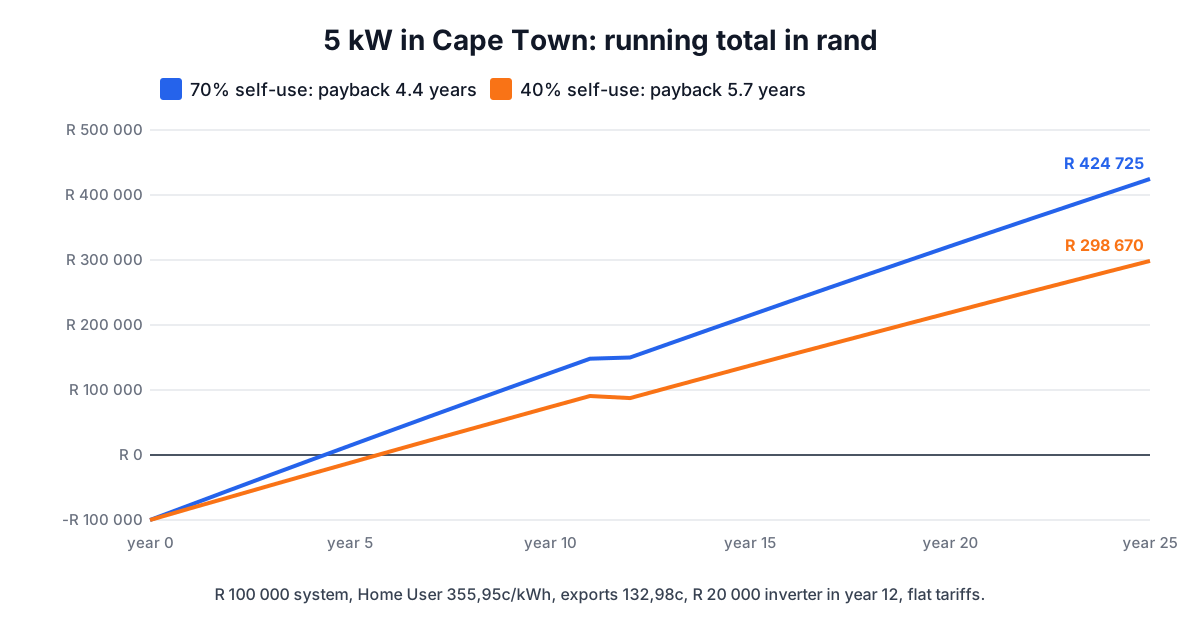
A 5 kW grid-tied system costing R 100 000 in Cape Town, using 70% of its output at home on the City's Home User tariff and exporting the rest for the feed-in credit, saves R 23 124,72 in its first year and pays for itself in about 4.4 years with tariffs held flat. That is a short payback by international standards, because South African electricity is expensive per kWh and the sun is strong. But the answer moves a lot with three local details: which tariff you are on, how much of your solar you use yourself rather than export, and whether your municipality pays for exports at all. This edition works through them in rand with the South African solar payback calculator, which opens on the Cape Town figures below.
What one kWh of solar is worth in Cape Town
Every kWh you use from your own panels is a kWh you do not buy. Every kWh you export earns a much smaller credit. The City of Cape Town's 2026/27 electricity tariff book sets the numbers:
| Cape Town 2026/27 | Excl. VAT | Incl. 15% VAT |
|---|---|---|
| Home User energy, first 600 kWh a month | 309,52c/kWh | 355,95c/kWh |
| Home User energy, above 600 kWh | 407,88c/kWh | 469,06c/kWh |
| Home User service and wires charge | R 368,96 a month | R 424,30 a month |
| Residential SSEG feed-in tariff | 107,98c/kWh | 124,18c/kWh |
| SSEG feed-in incentive | 25,00c/kWh | 28,75c/kWh |
| Domestic energy, first 600 kWh (for comparison) | 359,82c/kWh | 413,79c/kWh |
| Domestic service and wires charge (credit meter) | R 65,02 a month | R 74,77 a month |
Three rules in the tariff book shape every payback calculation:
- The residential feed-in tariff is only available with Home User. It applies to approved residential small-scale embedded generation (SSEG) connections in conjunction with the Home User tariff only.
- The service and wires charge does not shrink with solar. R 424,30 a month is paid whatever you import, so it never belongs in the price per kWh you enter.
- Feed-in adds an AMI administration fee. The tariff book says an additional AMI administration fee applies to the residential feed-in tariff but does not print the amount there, so ask the City for it and add the yearly total to the upkeep field.
The examples use 355,95c for self-used power and 132,98c for exports (the 107,98c feed-in tariff plus the 25c incentive, before VAT). If you are not VAT-registered, check on your account which rate the credit is actually applied at.
The base case, step by step
Enter 5 kW, a total cost of R 100 000 and 1 600 kWh a year per kW, 70% self-use, R 3,5595 per kWh used at home, R 1,3298 per kWh exported, an R 20 000 inverter replacement in year 12 and 0.5% a year panel degradation. The calculator works it out like this:
year-one production   = 5 kW x 1 600         = 8 000 kWh
used at home (70%)    = 5 600 kWh x R 3,5595 = R 19 933,20
exported (30%)        = 2 400 kWh x R 1,3298 = R 3 191,52
year-one saving                              = R 23 124,72
payback (flat tariffs)                       = 4.4 years
The exported 30% earns only about 37% of the value of self-used power (132,98c against 355,95c). That is the single biggest lever you control.
How much sun: yields for three cities
The 1 600 kWh per kW in the tool's example is a cautious starting figure. The European Commission's PVGIS tool, using its SARAH3 satellite data for 2005 to 2023, gives these yearly outputs for 1 kW of panels facing north at the optimum tilt with 14% system losses:
| City | Tilt | kWh per kW a year | Lowest month | Highest month |
|---|---|---|---|---|
| Cape Town | 30° | 1 728 | June, 90.5 kWh | January, 182.9 kWh |
| Johannesburg | 30° | 1 720 | February, 124.2 kWh | August, 161.2 kWh |
| Durban | 32° | 1 473 | November, 113.2 kWh | March, 133.4 kWh |
With PVGIS's Cape Town yield of 1 728 kWh per kW, the same system makes 8 640 kWh, saves R 24 974,70 in year one and pays back in 4.0 years. Cape Town's winter is the catch: June output is half of January's, so a system sized on the yearly average will import more from May to August. Highveld winters are dry and sunny, which is why Johannesburg's lowest month is in summer, not winter. Your installer's design for your own roof, direction and shading should replace all of these.
The four levers, in rand
| Change from the base case | Year-one saving | Payback |
|---|---|---|
| Base case (70% self-use, 1 600 kWh/kW, flat tariffs) | R 23 124,72 | 4.4 years |
| Self-use falls to 40% | R 17 773,44 | 5.7 years |
| Self-used power valued at the above-600 kWh block, 469,06c | R 29 458,88 | 3.4 years |
| Tariffs rise 9.01% a year | R 23 124,72 | 3.8 years |
| Switching from Domestic to Home User adds R 4 194,36 a year in fixed charges | R 23 124,72 before the charge | 5.4 years |
Self-use. Running the geyser, pool pump, dishwasher and washing machine in sunny hours moves kWh from export (132,98c) to self-use (355,95c). Going from 40% to 70% self-use takes 1.3 years off the payback.
Which block you save. A household that regularly uses more than 600 kWh a month saves the higher block price first, so its solar is worth more per kWh.
Tariff increases. Eskom's 2026/27 increase was 8.76% for its direct customers, including residential, from 1 April 2026, and 9.01% on its municipal tariffs from 1 July 2026, following NERSA's MYPD6 decisions. Municipalities then set their own retail tariffs. Carrying 9.01% forward every year is a scenario, not a forecast; it shortens the payback because each year's saving is larger.
The tariff switch. If you are on the Domestic tariff today and want the feed-in credit, you have to move to Home User. Its service and wires charge is R 349,53 a month more (R 424,30 against R 74,77), which is R 4 194,36 a year. Treating that whole difference as a cost of going solar stretches the payback to 5.4 years. It overstates the cost slightly, because Home User's first-block energy price is 57,84c lower than Domestic's on the kWh you still import.
If you are an Eskom direct customer
Eskom's 2026/2027 tariff booklet describes Homepower as a tariff for supplies without grid-tied generation, and says a time-of-use tariff is mandatory for grid-tied generation. For homes, that means Homeflex, with the Gen-offset arrangement for exported energy. Under time-of-use the value of a self-used kWh depends on when you use it, so a flat price per kWh is an approximation. Enter a weighted average of the Homeflex energy rates for the hours your panels actually produce, from the booklet's time-of-use periods.
What no longer applies
The SARS rooftop solar incentive was a rebate of 25% of the cost of the panels, up to R 15 000 per taxpayer, for panels bought and first used between 1 March 2023 and 29 February 2024, according to SARS. It does not apply to a system installed now, so the rebate field stays at zero.
Batteries and load-shedding
The figures above are for a grid-tied system without a battery. Hybrid systems add a battery for back-up during outages. A battery's value is partly in avoided disruption rather than in rand saved on the bill, so add its cost to the quote and see how far the payback moves, then decide whether the back-up is worth the difference to you. Battery cycling can also raise self-use if it stores midday surplus for the evening.
In Cape Town, installers must apply to the City to authorise a system for grid connection before it is installed, the inverter must be on the City's approved list, and the City installs a bi-directional meter at your expense, according to its SSEG application page, which adds that meter changes and an AMI access fee may apply, quoted during authorisation. If your whole municipal account is regularly offset by feed-in credit, you can apply to the Cash for Power programme: applications are assessed once a year, successful applicants sign a contract with the City, and residential customers are paid once a year when the remaining credit exceeds R 1 000.
Frequently asked questions
How long does solar take to pay back in Cape Town?
For a R 100 000, 5 kW grid-tied system on the Home User tariff, with 70% self-use and exports at 132,98c, about 4.4 years with flat tariffs. At 40% self-use it is about 5.7 years. Your own quote, roof and usage pattern will move these figures.
Does Cape Town pay for solar exports on the Domestic tariff?
No. The 2026/27 tariff book makes the residential feed-in tariff available only for approved SSEG connections on the Home User tariff. Home User carries a higher service and wires charge, R 424,30 a month including VAT against R 74,77 on Domestic, but a lower energy price.
How much do solar panels produce in South Africa?
PVGIS gives about 1 728 kWh a year per kW for north-facing panels in Cape Town, 1 720 in Johannesburg and 1 473 in Durban, at the optimum tilt with 14% losses. Shading, direction and dust reduce this.
Can I still claim the solar tax rebate?
Not for new installations. The SARS incentive covered panels bought and first used from 1 March 2023 to 29 February 2024, at 25% of the panel cost up to R 15 000.
Do tariff increases make solar pay back faster?
Yes. Eskom's 2026/27 increases were 8.76% for direct customers and 9.01% for municipal tariffs. If increases of 9.01% continued every year, the base case would pay back in 3.8 years instead of 4.4. Treat that as a scenario.
Sources and further reading
- Electricity consumptive tariffs 2026/27, City of Cape Town. Home User and Domestic tariffs, SSEG feed-in tariff and incentive.
- 2026-2027 tariff increase, Eskom. 8.76% for direct customers from 1 April 2026; 9.01% for municipal tariffs from 1 July 2026.
- Tariffs and Charges Booklet 2026/2027, Eskom. Homepower, Homeflex and Gen-offset.
- What is the SARS solar tax benefit?, South African Revenue Service.
- Photovoltaic Geographical Information System (PVGIS), European Commission Joint Research Centre. Yields for Cape Town, Johannesburg and Durban.
- Apply to sell surplus SSEG electricity to the City, City of Cape Town.
Open the Solar Panel Payback Calculator
More Energy & Sustainability
Every tool in the Energy & Sustainability section, free and in your browser.