
SWG vs US Gauge: Sheet Thickness Chart in mm
Why 26 gauge GI is 0.457 mm in SWG but 0.551 mm in the US galvanised table, how to read a gauge on a quotation, and how to order sheet by mm in Pakistan.
By Redbison Dev · · 9 min read
Pakistan edition. Written for buyers and fabricators in Pakistan: British SWG beside the US tables in mm, the PS-ISO sheet standards on PSQCA's compulsory list, and a local mill's thickness ranges. US edition
A gauge number on a quotation in Pakistan can point to at least five different thicknesses. "26 gauge" GI sheet is 0.457 mm if the dealer means the British Standard Wire Gauge (SWG), 0.455 mm in the US steel table and 0.551 mm in the US galvanised table. On a 2440 x 1219 mm sheet that is the difference between 10.68 kg and 12.87 kg of steel. The fix is simple: read the gauge as a hint and buy on the thickness in millimetres. This edition shows where each table comes from, how far apart they are at the thin gauges used for roofing, ducting and panels, and how to write a purchase order that cannot be misread. Every thickness below comes from the sheet gauge to mm converter, which holds SWG and the US tables side by side.
Which gauge tables turn up in Pakistan
Two families of gauge meet in the Pakistani market.
British SWG. The Imperial Standard Wire Gauge was fixed by Order in Council on 23 August 1883 and became the legal standard on 1 March 1884, according to the history of the Standard Wire Gauge. It was later published as BS 3737:1964, which has since been withdrawn; the current British Standard for wire and sheet sizes, BS 6722:1986, is metric only. Each SWG number is a round figure in thousandths of an inch: 22 SWG is 0.028 in (0.711 mm), 26 SWG is 0.018 in (0.457 mm). It is the table older workshop habit, wire and many local sheet charts follow.
The US tables. Imported sheet, American catalogues and many websites use the US tables, which come in four versions:
- the Manufacturers' Standard Gauge for plain carbon steel, built from a weight of 41.82 lb per square foot per inch of thickness, as the sheet metal reference notes;
- the galvanised gauge, which is the steel gauge plus a near-constant allowance for zinc, 0.0037 to 0.0038 in (0.094 to 0.097 mm) across the converter's table;
- the US Standard Gauge used for stainless, set by Congress in 1893 and still printed at 15 U.S.C. 206;
- the Brown & Sharpe gauge for aluminium, copper and brass, the same series as American Wire Gauge, standardised in ASTM B258.
The mills themselves mostly talk in millimetres. International Steels Limited, which describes itself as Pakistan's largest flat steel maker, lists its products by thickness range and standard: cold rolled sheet from 0.15 to 3.00 mm, hot-dip galvanised from 0.18 to 2.50 mm in nominal widths of 914, 1,000 and 1,219 mm, and colour coated sheet from 0.28 to 1.50 mm, made to ASTM and JIS standards such as ASTM A653 and JIS G3302 for galvanised coil. No gauge appears in those ranges. The gauge is added downstream, by dealers and on drawings.
The same number in five tables
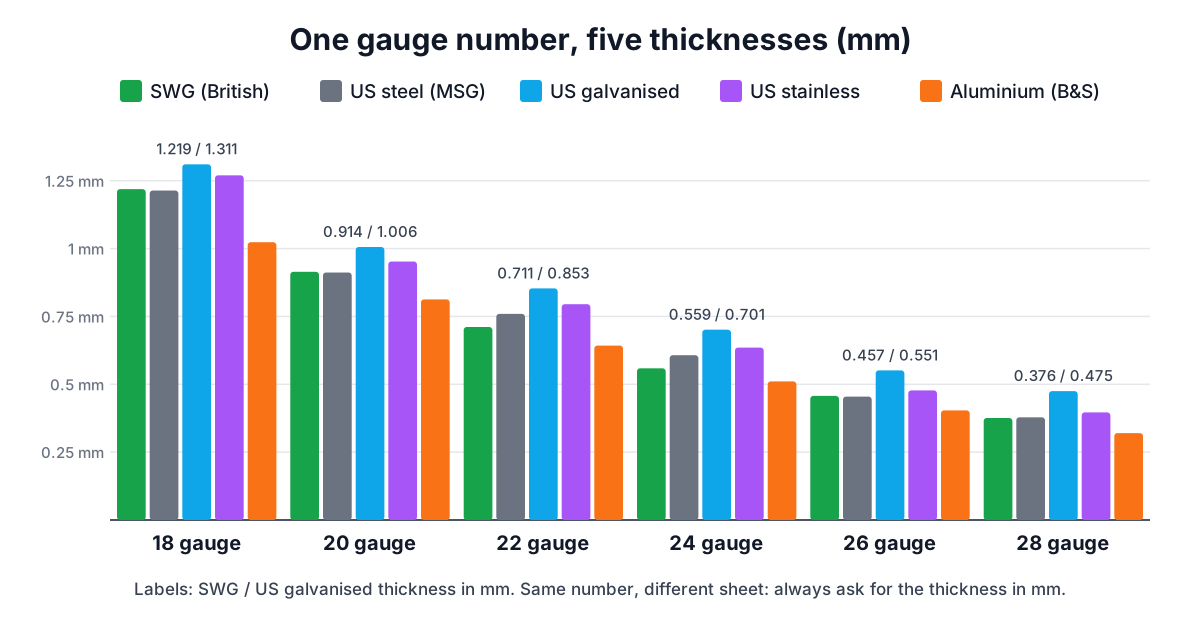
| Gauge | SWG (mm) | US steel (mm) | US galvanised (mm) | US stainless (mm) | Aluminium B&S (mm) | SWG steel (kg/m²) |
|---|---|---|---|---|---|---|
| 16 | 1.626 | 1.519 | 1.613 | 1.588 | 1.290 | 12.76 |
| 18 | 1.219 | 1.214 | 1.311 | 1.270 | 1.024 | 9.57 |
| 20 | 0.914 | 0.912 | 1.006 | 0.952 | 0.813 | 7.18 |
| 22 | 0.711 | 0.759 | 0.853 | 0.795 | 0.643 | 5.58 |
| 24 | 0.559 | 0.607 | 0.701 | 0.635 | 0.511 | 4.39 |
| 26 | 0.457 | 0.455 | 0.551 | 0.478 | 0.404 | 3.59 |
| 28 | 0.376 | 0.378 | 0.475 | 0.396 | 0.320 | 2.95 |
The weight column is the SWG thickness times 7,850 kg/m³, the steel density the converter uses.
Three things stand out from the table:
- At 18 and 20 gauge, SWG and US steel nearly agree. 18 SWG is 1.219 mm and US 18 is 1.214 mm. A mix-up here costs little.
- From 22 gauge down, they part. 22 SWG is 0.711 mm and US 22 is 0.759 mm, about 7% more steel. At 24 the gap is 0.048 mm.
- From 18 gauge down, the US galvanised column is the thickest, because it counts the zinc. A "26 gauge GI" sheet read from that column is 0.094 mm thicker than 26 SWG, about a fifth more.
Worked example: a quotation for "26 gauge GI"
A roofing contractor compares two quotations for 100 galvanised sheets of 2440 x 1219 mm. One says "26 gauge", the other "0.50 mm". Before comparing prices, put both on the same footing with the converter and the sheet weight calculator:
| Reading of the quotation | Thickness | Steel per sheet | 100 sheets |
|---|---|---|---|
| 26 SWG | 0.457 mm | 10.68 kg | 1,067.5 kg |
| US steel 26 | 0.455 mm | 10.62 kg | 1,061.6 kg |
| US galvanised 26 | 0.551 mm | 12.87 kg | 1,286.9 kg |
| 0.50 mm as quoted | 0.50 mm | 11.67 kg | 1,167.4 kg |
Read as SWG, the "26 gauge" offer is about 9% thinner than the 0.50 mm offer; read from the US galvanised table, it is 10% thicker. A price per sheet means nothing until the thickness is settled. The weights are for steel at 7,850 kg/m³; the galvanised table already includes the zinc in its thickness, so it slightly overstates the weight of the coated sheet.
Going the other way, the converter's "thickness to gauge" mode tells you what label a millimetre size will get:
- 0.50 mm is nearest 25 SWG (0.508 mm, 0.008 mm off), 25 in the US steel table (0.531 mm) and 27 in the US galvanised table (0.513 mm). One sheet, two gauge numbers.
- 0.40 mm is nearest 27 SWG (0.417 mm) and 30 in the US galvanised table (0.399 mm).
- 0.18 mm, the thinnest galvanised sheet in ISL's range, is thinner than any SWG in the table: the nearest, 30 SWG, is 0.315 mm, so the converter warns that nothing is within 0.1 mm.
- 2.50 mm, the top of ISL's galvanised range, falls between gauges in every table. 12 SWG is 2.642 mm, US steel 12 is 2.657 mm and US galvanised 13 is 2.372 mm, all more than 0.1 mm away. At that thickness, gauge has stopped being useful.
Standards: buy against a thickness, not a number
PSQCA's list of items that must meet Pakistan Standards names PS-ISO 3573 for hot-rolled carbon steel sheet of commercial and drawing qualities, PS-ISO 3574 for cold reduced carbon steel sheet, PS ISO 16143 for general-purpose stainless steel and PS 4798 for structural steel. None of these is a gauge table: they are product standards for steel ordered by grade and dimensions.
PS 4798:2017, the structural standard, is based on ASTM A36/A36M-14 and covers shapes, plates, sections and bars. It sends delivery requirements to ASTM A6/A6M and points hot-rolled sheet and strip to ASTM A1011 or A1018 at grade 36 [250]. Plate under it is specified by its thickness in millimetres or inches, not by a gauge number.
So a purchase line that survives any dealer reads like this: "GI sheet, 0.50 mm nominal base thickness, ASTM A653 CS Type B, Z120, 1219 x 2440 mm". If the shop insists on gauge, add it in brackets with the table: "(26 SWG = 0.457 mm)".
Tolerance and coating: what a micrometer will show
A gauge or a millimetre figure is nominal. The rolled sheet sits in a tolerance band set by its product standard, and on thin coated sheet two more things move the reading:
- Zinc. ISL lists galvanised coating masses from Z60 to Z275 grams per square metre. Check on the mill certificate whether the figure is for both sides together. At 275 g/m² in total, a 2440 x 1219 mm sheet carries 2.9744 m² x 0.275 = 0.82 kg of zinc, which is why GI sheet on a scale weighs more than a steel-only table predicts.
- Paint. Colour coated sheet adds primer and topcoat over the zinc, so a micrometer reading on PPGI is not the base steel thickness.
- Where you measure. Measure away from the cut edge and burrs, and compare like with like: base metal against a base metal figure, coated against a coated figure.
For press brake work, thickness matters more than for weight. The press brake tonnage calculator uses thickness squared, so a sheet 7% thicker than expected needs about 14% more tonnage, and the punch force calculator rises in step with thickness.
Common mistakes on Pakistani orders
- Comparing per-sheet prices across gauge tables. Convert both offers to mm first, then to kg if the price is per kg.
- Assuming "gauge" means SWG. Local charts often follow SWG, but imported coil and online charts may use US numbers. Ask.
- Reading the galvanised column for bare sheet. The US galvanised table includes zinc; for CR or HR sheet use the steel column or SWG.
- Specifying aluminium in a steel gauge. 22 gauge aluminium in Brown & Sharpe is 0.643 mm, thinner than either steel table.
- Stretching gauges into plate. Above about 3 mm, order in mm under PS 4798 or the relevant sheet standard.
For the weight side of the same question, with full sheet, plate and bundle examples in kilograms, see how to calculate sheet and plate weight in Pakistan.
Frequently asked questions
How thick is 26 gauge GI sheet in mm?
0.457 mm if the gauge is SWG, 0.455 mm in the US steel table and 0.551 mm in the US galvanised table, which includes the zinc. Ask the dealer for the base steel thickness in mm and the coating mass, and compare offers on those.
Is 18 gauge the same in SWG and the US chart?
Almost. 18 SWG is 1.219 mm and US 18 gauge steel is 1.214 mm, a difference of 0.005 mm. The tables only agree closely at a few numbers; at 22 gauge they differ by 0.048 mm and at 24 gauge by 0.048 mm.
Which Pakistan Standards apply to steel sheet?
PSQCA's compulsory list includes PS-ISO 3573 for hot-rolled carbon steel sheet and PS-ISO 3574 for cold reduced sheet, both of commercial and drawing qualities, and PS ISO 16143 for general-purpose stainless steel. Structural plate, shapes and bars fall under PS 4798.
Why does my 0.5 mm sheet show as 25 gauge in one chart and 27 in another?
Because 25 SWG is 0.508 mm and 27 in the US galvanised table is 0.513 mm. Each table puts its nearest number on the same sheet. The thickness is the fact; the gauge is only a label from whichever chart is in use.
Can I convert gauge to mm with one formula?
No. SWG is a list of fixed inch values, the US steel table comes from weight per square foot, and Brown & Sharpe follows a geometric series. Each number has to be looked up in its own table, which is what the converter does.
Sources and further reading
- List of compulsory items to meet Pakistan Standards, PSQCA. PS-ISO 3573, PS-ISO 3574, PS ISO 16143 and PS 4798.
- PS 4798:2017 (Rev) Carbon Structural Steel, PSQCA. Based on ASTM A36/A36M-14; delivery to ASTM A6/A6M.
- Products, International Steels Limited. Thickness, width and coating ranges for cold rolled, galvanised and colour coated sheet.
- Standard wire gauge, Wikipedia. The 1883 Order in Council, BS 3737 and BS 6722, and the SWG table.
- Sheet metal: gauge, Wikipedia. The 41.82 lb per square foot per inch basis of the US steel gauge.
- 15 U.S. Code § 206, Legal Information Institute, Cornell Law School. The 1893 US Standard Gauge used for stainless.
- B258: AWG sizes of solid round wires, ASTM International. The Brown & Sharpe series.
Open the Sheet Metal Gauge Converter
More Sheet Metal & Welding
Every tool in the Sheet Metal & Welding section, free and in your browser.