
Kilojoule Deficit for Weight Loss: How Much to Cut
How many kilojoules to cut to lose about half a kilo a week, reading kJ on Australian labels, and why the goal date drifts as you lose.
By Redbison Dev · · 6 min read
Australia edition. Plans in kilograms with daily targets in kilojoules as printed on Australian nutrition information panels, set against healthdirect's 8,700 kJ average and its waist and BMI guidance. US edition
To lose about half a kilogram a week, most adults need to eat around 2,100 kJ (500 kcal) a day less than they use. The Australian calorie deficit planner estimates what you use, takes off 1,050, 2,090 or 3,140 kJ, and turns the gap into a weekly loss and a goal date, all in kilojoules because that is how Australian labels count energy. This guide shows what those numbers rest on, where the date goes wrong, and how to read kJ on a pack so the plan survives the supermarket.
It is general information. If you take medicine for diabetes, are pregnant or breastfeeding, have kidney disease or a history of disordered eating, talk to your GP or an Accredited Practising Dietitian before cutting kilojoules.
The Australian reference points
| Figure | Value | Source |
|---|---|---|
| Average adult need | about 8,700 kJ a day | healthdirect |
| kJ per kcal | 4.2 (quick rule), 4.184 exact | healthdirect; the planner uses 4.184 |
| Energy in 1 kg of body fat | about 32,200 kJ (7,700 kcal) | Wishnofsky's estimate, converted |
| Waist where risk rises | 94 cm men, 80 cm women | healthdirect |
| Benefit from losing | even 5 to 10% of body weight | healthdirect |
Your own need can be far from the 8,700 kJ average: in the examples below, a small, sedentary 60-year-old woman uses about 6,060 kJ and a lightly active 95 kg man about 10,800 kJ.
Reading kilojoules on the pack
Food Standards Australia New Zealand requires the nutrition information panel to give the average energy per serving and per 100 g, in kilojoules or in kilojoules and kilocalories. Two habits make a deficit plan work with that panel:
- Compare per 100 g. Serving sizes vary between brands, so per 100 g is the fair comparison.
- Check the serving against what you eat. A "serve" of breakfast cereal on the pack may be smaller than the bowl you pour. The kJ you log should be for your portion.
Worked example: from 78 kg to 72 kg
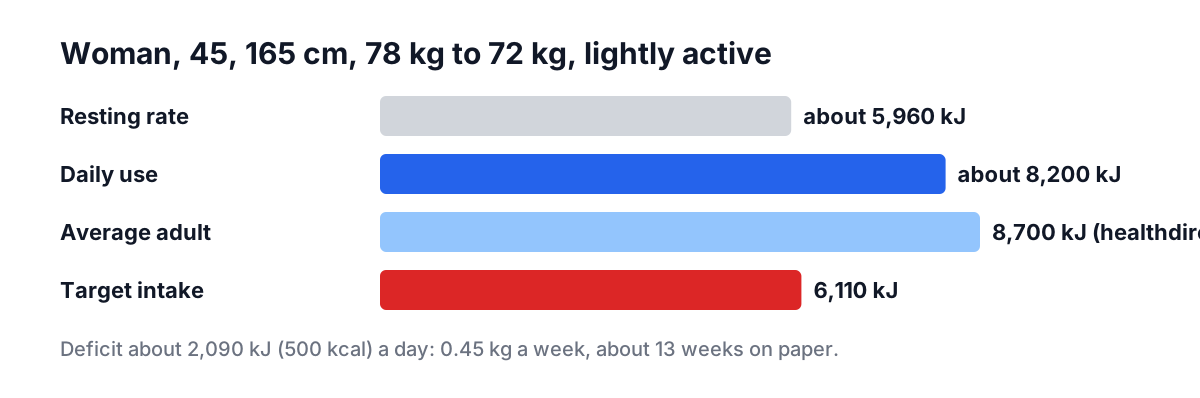
A 45-year-old woman, 165 cm, 78 kg, lightly active, goal 72 kg, moderate deficit:
| Step | kcal | kJ |
|---|---|---|
| Resting rate (Mifflin-St Jeor) | 1,425 | about 5,960 |
| Daily use (x 1.375) | 1,960 | about 8,200 |
| Target intake | 1,460 | 6,110 |
| Daily deficit | 500 | about 2,090 |
| Pace | 0.45 kg a week | |
| Time on paper | about 13 weeks (93 days) |
Six kilograms is 7.7% of her weight, inside the 5 to 10% range healthdirect links to real health benefits. Her waist is the second number to watch, because 80 cm is the healthdirect line for women.
The 13 weeks assumes her energy use stays at 8,200 kJ. It will not: each kilogram lost lowers her resting rate by about 42 kJ (10 kcal) under the equation the planner uses, and more once activity is counted. Kevin Hall's model, published in The Lancet in 2011, shows the result as a curve that flattens rather than a straight line. Re-run the planner after every 3 to 4 kg.
Worked example: a faster pace
A 38-year-old man, 178 cm, 95 kg, lightly active, goal 87 kg, aggressive setting:
| Step | Value |
|---|---|
| Daily use | 2,582 kcal (about 10,800 kJ) |
| Target intake | 1,832 kcal (7,670 kJ) |
| Deficit | 750 kcal (about 3,140 kJ) |
| Pace | 0.68 kg a week |
| Time on paper | about 12 weeks |
This is the top of the pace the planner treats as sensible, and it still leaves him well above the 6,280 kJ (1,500 kcal) floor for men. Faster cuts make it harder to eat enough protein and fibre and to keep going.
Worked example: when the floor bites
A 60-year-old woman, 158 cm, 68 kg, sedentary, goal 63 kg, moderate setting: her daily use is about 1,448 kcal (6,060 kJ). A full 2,090 kJ cut would take her below 5,020 kJ (1,200 kcal), so the planner holds her at 5,020 kJ. Her real deficit is only 248 kcal (about 1,040 kJ), 0.23 kg a week, and the 5 kg takes about 22 weeks. For her, moving more is the main lever left: every extra 30-minute walk raises her daily use without cutting food further.
How big a deficit?
| Planner setting | Daily cut | Pace on paper | 5 kg takes |
|---|---|---|---|
| Conservative | 1,050 kJ (250 kcal) | 0.23 kg/week | about 22 weeks |
| Moderate | 2,090 kJ (500 kcal) | 0.45 kg/week | about 11 weeks |
| Aggressive | 3,140 kJ (750 kcal) | 0.68 kg/week | about 7 weeks |
The planner also caps a first goal at 10% of current weight and never sets intake below 5,020 kJ for women or 6,280 kJ for men. healthdirect advises seeing your doctor if you are concerned about your weight or want to lose weight, and notes that prescription medicines and bariatric surgery are options for people living with obesity; those are decisions to make with a GP, not a calculator.
Common mistakes
- Mixing kcal and kJ. An app in calories and labels in kilojoules is the classic way to log about a quarter, or four times, what you eat. Pick one unit; multiply kcal by 4.2 for a quick conversion.
- Planning to the date. It comes from a straight-line rule. Add a few weeks to any plan longer than three months.
- Over-rating activity. "Moderate" for a desk job inflates your daily use; the Australian TDEE guide explains the settings.
- Cutting protein. Keep protein inside healthdirect's 10 to 35% of energy; the Australian protein calculator gives a target in grams.
Tools for this job
- Calorie deficit planner (Australia): daily kJ target, weekly pace and goal date.
- Calorie calculator (Australia): your maintenance estimate in kJ.
- Macro calculator (Australia): turns the kJ target into grams of protein, carbohydrate and fat.
- BMI calculator (Australia) for a sensible end point, and the Australian body composition guide for the waist lines.
Frequently asked questions
How many kilojoules should I eat to lose weight?
Take your daily use and subtract about 2,100 kJ for roughly 0.5 kg a week. For a lightly active 45-year-old woman of 165 cm and 78 kg that means about 6,110 kJ a day. The planner never goes below 5,020 kJ for women or 6,280 kJ for men.
How many kJ are in 1 kg of fat?
About 32,200 kJ, from the common estimate of 7,700 kcal per kilogram of body fat tissue. Real loss is slower than that rule predicts once your energy use falls with your weight.
How long does it take to lose 5 kg?
On a 2,090 kJ daily deficit, about 11 weeks on paper, usually a little longer in practice. A smaller, sedentary person whose target hits the floor may take twice as long unless they add activity.
Is 8,700 kJ a day right for me?
It is healthdirect's figure for an average adult maintaining weight. Taller, heavier or more active people use more, and smaller or less active people less, so work out your own figure before setting a deficit.
Sources and further reading
- Kilojoules, healthdirect Australia. The 8,700 kJ average and 4.2 kJ per kilocalorie.
- Obesity, healthdirect Australia. Benefits of losing 5 to 10% of body weight and when to see a doctor.
- Body mass index (BMI) and waist circumference, healthdirect Australia. Waist risk lines.
- Nutrition information panels, Food Standards Australia New Zealand. Energy per serving and per 100 g.
- Quantification of the effect of energy imbalance on bodyweight, The Lancet, 2011. Hall and colleagues.
- A new predictive equation for resting energy expenditure in healthy individuals, The American Journal of Clinical Nutrition, 1990. Mifflin, St Jeor and colleagues.
- Caloric Equivalents of Gained or Lost Weight, The American Journal of Clinical Nutrition, 1958. Wishnofsky.
Open the Calorie Deficit Planner
More Fitness Calculators
Every tool in the Fitness Calculators section, free and in your browser.
- BMI Calculator
- Calorie Calculator
- Protein Calculator
- Hydration Calculator
- Calorie Deficit Planner
- Body Fat Calculator
- Ideal Weight Calculator
- Running Pace Calculator
- Target Heart Rate Calculator
- One Rep Max Calculator
- Barbell Plate Calculator
- RPE Calculator
- Interval Timer
- Calories Burned Calculator
- Body Surface Area Calculator
- Waist-to-Hip Ratio Calculator
- VO2 Max Calculator
- Steps to Distance & Calories Calculator