
Calorie Deficit for Weight Loss: A Guide for Indians
How many kcal to cut for steady weight loss, why calculators may overestimate Indian energy needs, and what ICMR-NIN advises on pace.
By Redbison Dev · · 6 min read
India edition. Uses kg and kcal, sets goals against the Asian Indian BMI cut-offs (23 and 25), and reads calculator estimates beside the ICMR-NIN 2020 energy requirements and the Dietary Guidelines for Indians (2024). US edition
To lose about half a kilogram a week you need to eat roughly 500 kcal a day less than your body uses. The calorie deficit planner for India estimates that daily use, subtracts 250, 500 or 750 kcal, and turns the gap into a weekly loss and a goal date. For Indian readers there is one extra thing to know: the ICMR-NIN expert group found that standard international equations overestimate the resting energy use of Indians, so a plan built on a calculator may run slower than it promises. This guide shows how big that effect can be and how to plan around it.
It is general information. If you have diabetes and take insulin or tablets, have thyroid or kidney disease, are pregnant or breastfeeding, or have had an eating disorder, plan any diet with your doctor or a registered dietitian.
What ICMR-NIN says about Indian energy needs
The 2020 Nutrient Requirements for Indians, from the ICMR-National Institute of Nutrition, reset adult energy needs lower than the 2010 figures. Two changes drove it:
- Lower BMR. International BMR equations (FAO/WHO/UNU) were built from data that included young, muscular people, and studies in India found they overestimate Indian BMR by 10 to 12%, because Indian body composition includes relatively more fat. The committee cut the BMR estimate by a further 5% on top of the earlier 5%.
- Lower activity factor. The physical activity ratio for a sedentary adult fell from 1.53 to 1.40.
The result for the reference adults (a 65 kg man and a 55 kg woman):
| Work | Man (65 kg) | Woman (55 kg) |
|---|---|---|
| Sedentary | 2,110 kcal | 1,660 kcal |
| Moderate | 2,710 kcal | 2,130 kcal |
| Heavy | 3,470 kcal | 2,720 kcal |
The planner uses the Mifflin-St Jeor equation, which was developed in the US. It is not the FAO/WHO/UNU equation ICMR-NIN tested, so the 10 to 12% figure does not transfer directly; but the direction is a useful warning. If your weight does not move after three or four weeks at the planner's target, your real energy use is probably lower than the estimate.
Worked example: an office worker from 80 to 74 kg
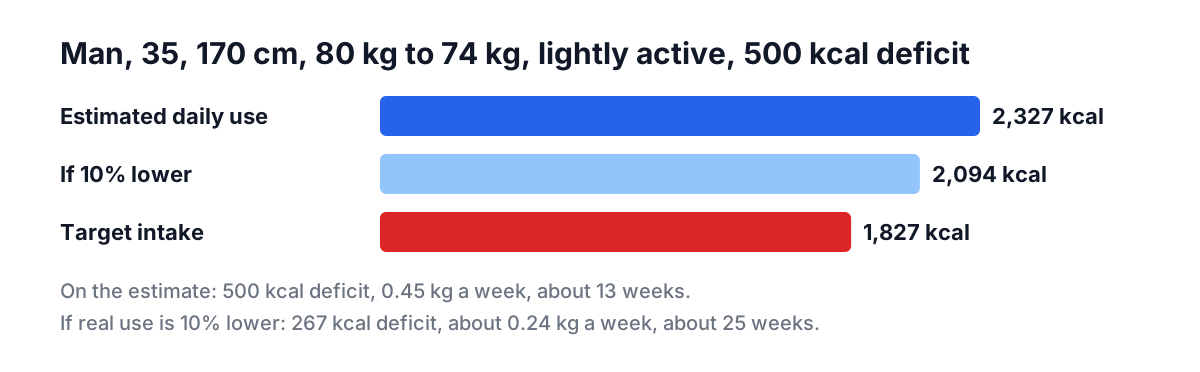
Male, 35, 170 cm, 80 kg, lightly active, goal 74 kg, moderate deficit:
| Step | Value |
|---|---|
| BMR (Mifflin-St Jeor) | 1,693 kcal |
| Daily use (x 1.375) | 2,327 kcal |
| Target intake | 1,827 kcal |
| Deficit | 500 kcal a day |
| Pace | 0.45 kg a week |
| Time on paper | about 13 weeks (93 days) |
| BMI | 27.7 now, 25.6 at the goal |
Six kilograms is 7.5% of his weight, inside the planner's 10% limit for a first goal. Even at 74 kg his BMI is above 25, the obesity line used for Indians in the ICMR-INDIAB study, so this is a first stage, not the end.
Now suppose his real daily use is 10% lower than the estimate, 2,094 kcal instead of 2,327. Eating 1,827 kcal then gives a deficit of only 267 kcal, about 0.24 kg a week, and the 6 kg takes about 25 weeks, close to double. Nothing is wrong with his discipline; the estimate was high. That is why weighing every week and adjusting after a month beats following the calculator's date.
Worked example: a small, sedentary woman
Female, 32, 158 cm, 68 kg, sedentary, goal 62 kg:
| Setting | Target intake | Real deficit | Pace | Time |
|---|---|---|---|---|
| Conservative | 1,366 kcal | 250 kcal | 0.23 kg/week | about 26 weeks |
| Aggressive | 1,200 kcal (floor) | 416 kcal | 0.38 kg/week | about 16 weeks |
| Moderate, lightly active | 1,351 kcal | 500 kcal | 0.45 kg/week | about 13 weeks |
Her sedentary energy use is about 1,616 kcal, close to ICMR-NIN's 1,660 kcal for a sedentary 55 kg woman. The aggressive setting cannot cut 750 kcal without going below the 1,200 kcal floor, so the planner stops there. The third row is the useful one: by walking enough to count as lightly active, she gets a full 500 kcal deficit while eating more than on the aggressive plan. The Dietary Guidelines for Indians suggest at least 30 to 45 minutes a day of brisk walking or other moderate activity for adults, which is about what that change takes.
How fast is safe?
The Dietary Guidelines for Indians (2024) advise slow and steady weight reduction and warn that extreme approaches to weight loss may lead to health hazards. The planner's settings fit that advice:
| Deficit | Pace on paper | In a month |
|---|---|---|
| 250 kcal | 0.23 kg/week | about 1 kg |
| 500 kcal | 0.45 kg/week | about 2 kg |
| 750 kcal | 0.68 kg/week | about 3 kg |
The planner never sets intake below 1,200 kcal for women or 1,500 kcal for men, and rejects a first goal bigger than 10% of current weight.
Why the loss slows down
The rule behind the date is about 7,700 kcal per kilogram of body fat. It assumes your energy use stays the same, but a lighter body uses less: in Mifflin-St Jeor, each kilogram lost lowers BMR by 10 kcal, and more once multiplied by activity. Kevin Hall's model in The Lancet (2011) shows the result: the real weight curve bends and flattens while the simple rule draws a straight line. Re-run the planner after every 3 to 4 kg.
Indian kitchen traps
- Oil counts. ICMR-NIN limits visible fat to 20 to 50 g a day by energy need, and not more than 27 g on a 2,000 kcal diet. ICMR-NIN counts that range as 4 to 10 teaspoons, so a teaspoon is about 5 g, or 45 kcal at 9 kcal per gram of fat; three extra teaspoons a day erase more than a quarter of a 500 kcal deficit.
- Sugary drinks and fried snacks. The Dietary Guidelines advise avoiding soft drinks and cutting down deep-fried and refined foods.
- Sleep. The guidelines link 6 to 8 hours of sleep with fewer unhealthy eating habits.
- Skipping protein. Keep dal, curd, eggs, paneer or chicken in each meal; the protein calculator for India gives a target against the ICMR-NIN RDA.
Tools for this job
- Calorie deficit planner for India: daily kcal target, weekly pace and goal date in kg.
- Calorie calculator for India: your maintenance estimate before choosing a deficit.
- BMI calculator for India with the Asian cut-offs, to set a sensible end point.
- The Indian TDEE guide explains activity levels, and the body composition guide for Indians covers waist and body fat targets.
Frequently asked questions
How many calories should I eat to lose 1 kg a week?
About 1,100 kcal a day below your daily use, by the 7,700 kcal per kg rule. For most people that would push intake below 1,200 or 1,500 kcal, so the planner limits the deficit to 750 kcal (about 0.68 kg a week). The Dietary Guidelines for Indians favour slow and steady loss.
How much does an average Indian adult need to eat in a day?
ICMR-NIN's 2020 figures are 2,110 kcal for a sedentary 65 kg man and 1,660 kcal for a sedentary 55 kg woman, rising to 2,710 and 2,130 kcal for moderate work. Your own need depends on your weight, age and activity.
Why am I not losing weight on a 500 calorie deficit?
The most common reason is that your real energy use is lower than the calculator's estimate. ICMR-NIN found that international BMR equations overestimate Indian BMR by 10 to 12%. If your weight is flat for three to four weeks, reduce intake by 100 to 200 kcal or add daily walking, and re-check.
What BMI should I aim for?
18.5 to 22.9 is the healthy range on the Asian cut-offs used for Indians; 23 to 24.9 is overweight and 25 or more is obesity. A first goal of 5 to 10% of your current weight is a sensible step towards it.
Sources and further reading
- Nutrient Requirements for Indians 2020: brief note, ICMR-National Institute of Nutrition. BMR adjustment, activity ratios, energy tables and visible fat.
- Dietary Guidelines for Indians (2024), ICMR-National Institute of Nutrition. Guidelines 9 and 10 on weight reduction and physical activity.
- Prevalence of generalized and abdominal obesity in urban and rural India: the ICMR-INDIAB study, Indian Journal of Medical Research, 2015. The BMI 23 and 25 cut-offs.
- Quantification of the effect of energy imbalance on bodyweight, The Lancet, 2011. Hall and colleagues.
- A new predictive equation for resting energy expenditure in healthy individuals, The American Journal of Clinical Nutrition, 1990. Mifflin, St Jeor and colleagues.
- Caloric Equivalents of Gained or Lost Weight, The American Journal of Clinical Nutrition, 1958. Wishnofsky's 3,500 kcal per pound.
Open the Calorie Deficit Planner
More Fitness Calculators
Every tool in the Fitness Calculators section, free and in your browser.
- BMI Calculator
- Calorie Calculator
- Protein Calculator
- Hydration Calculator
- Calorie Deficit Planner
- Body Fat Calculator
- Ideal Weight Calculator
- Running Pace Calculator
- Target Heart Rate Calculator
- One Rep Max Calculator
- Barbell Plate Calculator
- RPE Calculator
- Interval Timer
- Calories Burned Calculator
- Body Surface Area Calculator
- Waist-to-Hip Ratio Calculator
- VO2 Max Calculator
- Steps to Distance & Calories Calculator